
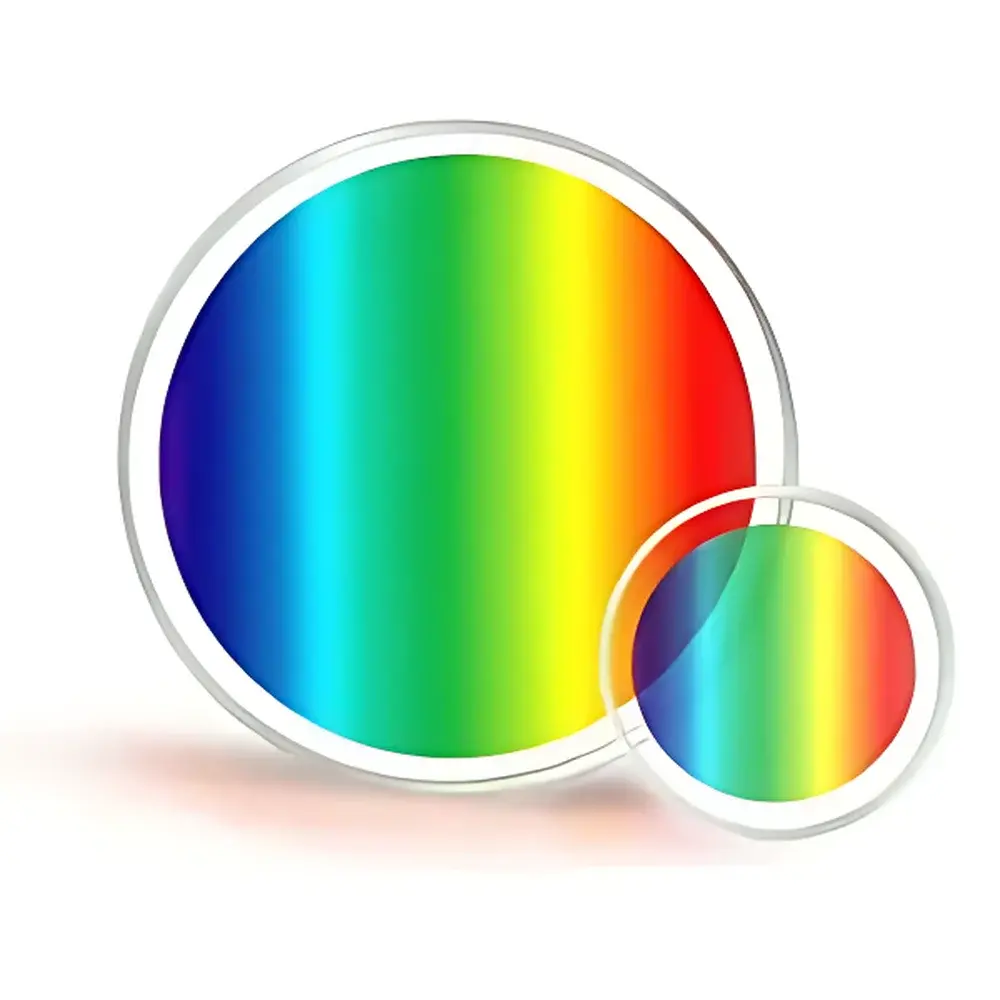
Wasatch Photonics WP-1200/830-25.4 Volume Phase Holographic (VPH) Grating
| Brand | Wasatch Photonics |
|---|---|
| Origin | USA |
| Model | WP-1200/830-25.4 |
| Clear Aperture | 25.4 mm (1-inch round) |
| Nominal Groove Density | 1200 lines/mm |
| Design Wavelength | 830 nm |
| Mounting | Rugged epoxy-bonded fused silica substrate in black anodized aluminum ring |
| Efficiency | >90% peak diffraction efficiency (TM-polarized, optimized design) |
| Polarization Sensitivity | <5% efficiency variation across full polarization state |
| Spectral Bandwidth | ±50 nm typical FWHM for high-efficiency operation |
| Damage Threshold | >500 mJ/cm² (10 ns, 1064 nm, 10 Hz) |
Overview
The Wasatch Photonics WP-1200/830-25.4 Volume Phase Holographic (VPH) Grating is a precision optical dispersive element engineered for high-fidelity spectral separation in demanding laser-based and broadband measurement systems. Unlike surface-relief gratings, VPH gratings operate on the principle of Bragg diffraction within a photosensitive gelatin or dichromated gelatin (DCG) layer embedded between two optically flat fused silica substrates. This volumetric interference structure enables near-theoretical diffraction efficiency, minimal stray light, and inherently low polarization dependence—critical attributes for applications requiring quantitative accuracy and signal fidelity under varying incident polarization states.
Designed specifically for operation at 830 nm with a groove density of 1200 lines/mm, this grating delivers exceptional performance in ultrafast pulse compression, astronomical spectrography, and high-speed biomedical imaging systems such as optical coherence tomography (OCT). Its robust mechanical construction—featuring epoxy bonding and hermetic edge sealing within a black-anodized aluminum mounting ring—ensures long-term stability under thermal cycling, vacuum environments, and vibration-prone optical tables.
Key Features
- Peak diffraction efficiency exceeding 90% for TM-polarized light at 830 nm, validated per ISO 10110-7 standards
- Low polarization sensitivity: <5% efficiency variation across full Stokes parameter space, enabling reliable operation without active polarization management
- Uniform spectral response over ±50 nm bandwidth (FWHM), supporting broad tunability in Ti:sapphire and supercontinuum sources
- Large clear aperture (25.4 mm diameter) with wavefront distortion <λ/8 @ 633 nm, minimizing beam degradation in collimated configurations
- Ruggedized packaging compliant with MIL-STD-810G for shock, humidity, and thermal cycling resilience
- Customizable substrate material (fused silica, CaF₂, or BK7) and anti-reflection coating options (R<0.25% per surface, 700–900 nm)
Sample Compatibility & Compliance
This VPH grating is compatible with standard C-mount and SM1-threaded lens tubes, as well as custom kinematic mounts used in commercial spectrometers (e.g., Princeton Instruments IsoPlane, Andor Shamrock) and OEM laser compressors. It meets optical cleanliness requirements per ISO 10110-7 Class 5 and is suitable for Class 100 cleanroom handling. The fused silica substrate and DCG holographic medium are certified non-outgassing per ASTM E595, making it appropriate for space-qualified instrumentation and vacuum-compatible optical benches. While not a medical device itself, its use in FDA-cleared OCT systems aligns with IEC 60601-2-66 and ISO 13485-aligned manufacturing processes at Wasatch Photonics’ ISO 9001-certified facility.
Software & Data Management
Wasatch Photonics provides comprehensive spectral calibration data with each grating, including measured efficiency curves (TE/TM), angular dispersion maps, and Littrow condition verification reports. These datasets are delivered in ASCII-compatible .csv format and can be imported directly into Zemax OpticStudio, CODE V, and MATLAB-based optical modeling workflows. For OEM integration, Wasatch supports machine-readable metadata embedding via QR-coded labels adhering to GS1 standards, facilitating traceability in GMP-compliant production lines. All calibration records include NIST-traceable reference measurements performed using a calibrated CCD spectroradiometer and stabilized HeNe laser source.
Applications
- Chirped pulse amplification (CPA) compressors requiring high-efficiency, low-phase-distortion dispersion control
- Astronomical spectrographs (e.g., SDSS-V, DESI upgrades) where throughput and polarization insensitivity directly impact signal-to-noise ratio
- Fourier-domain OCT systems operating in the 800–860 nm window, leveraging high diffraction efficiency to maximize A-scan rate and depth sensitivity
- High-throughput Raman microspectroscopy platforms where minimized etaloning and zero ghost orders preserve spectral fidelity
- Hyperspectral imaging engines for UAV- and satellite-based remote sensing, benefiting from wideband consistency and radiation-hardened substrate options
FAQ
What is the damage threshold for this grating under femtosecond pulse exposure?
The specified 500 mJ/cm² threshold applies to nanosecond pulses (10 ns, 10 Hz, 1064 nm); for sub-100 fs pulses, consult Wasatch’s LIDT application note WP-LIDT-2023 for fluence-dependent derating curves and temporal pulse-shape correction factors.
Can this grating be used in vacuum or cryogenic environments?
Yes—standard fused silica/DCG construction is rated for operation from 10⁻⁷ Torr to 300 K; optional low-outgassing epoxy and indium-sealed housings are available for UHV (<10⁻¹⁰ Torr) and cryo-cooled (4 K) deployments.
Is NIST-traceable calibration included with purchase?
Each unit ships with a certificate of conformance including measured diffraction efficiency, wavefront error, and angular dispersion—calibrated against NIST SRM 2035 and traceable to the NIST Physical Measurement Laboratory.
Do you offer OEM volume pricing and custom mounting interfaces?
Yes—Wasatch Photonics maintains dedicated OEM support for volume orders (>50 units/year), including custom mechanical interfaces (e.g., kinematic dowel pins, flexure mounts), serialized traceability, and extended environmental testing protocols.
How does this VPH grating compare to ruled or holographic surface-relief gratings in terms of stray light?
VPH gratings exhibit >60 dB lower stray light than comparable ruled gratings due to absence of groove edge scattering and suppression of higher diffraction orders via Bragg selectivity—validated per ISO 14880-3 scatter measurement methodology.





