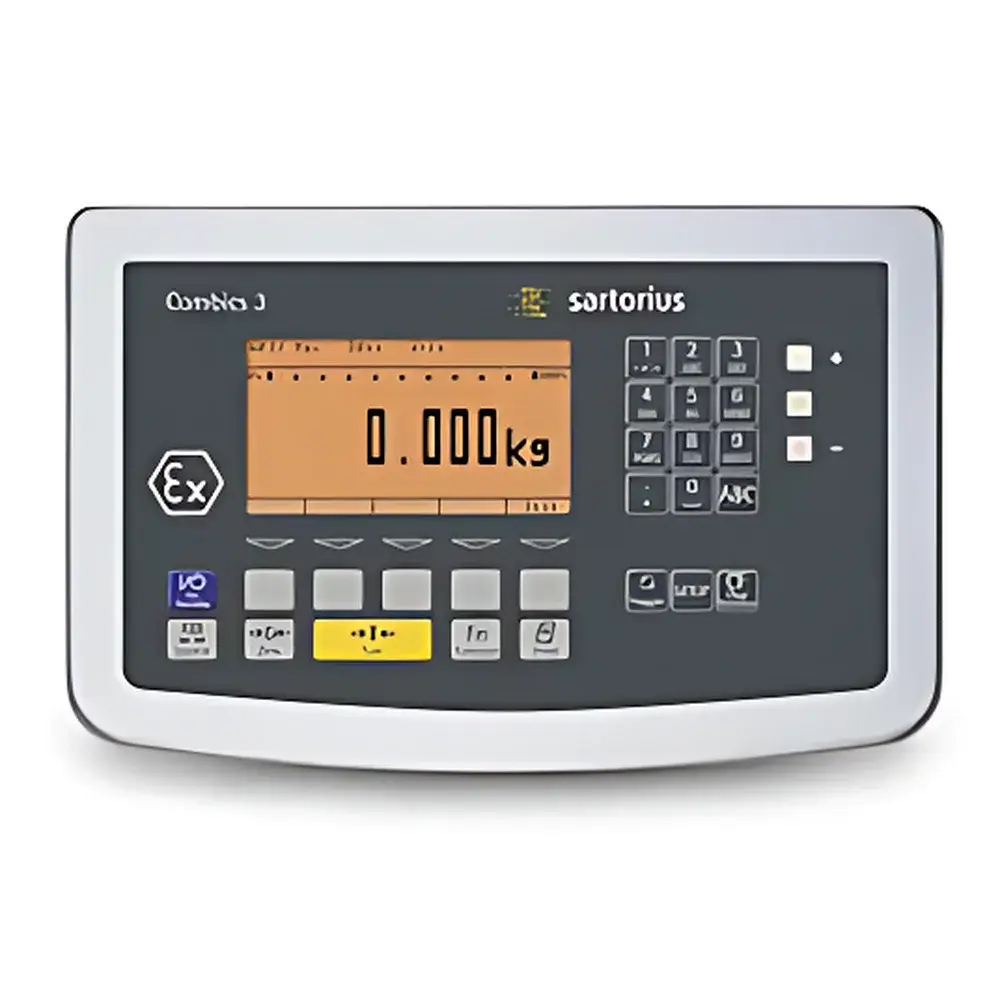
Sartorius Combics Intrinsically Safe Weighing Indicator
| Brand | Sartorius |
|---|---|
| Origin | Germany |
| Model | Combics |
| Certification | ATEX II 2 G1D EEx ib IIC T4 (T135°C), FM/C-UL US Class I, II, III Div 1 & 2, Groups A–G |
| Hazardous Area Zones | Zone 1, 2 (gas) |
| Input Compatibility | Up to 2 x IS-X precision platforms + Combics-Ex analog platforms + certified intrinsically safe load cells |
| Communication | RS232 (×2), RS422/RS485 (software-selectable), Profibus DP, 4–20 mA analog output, WLAN Client, wireless IS barcode scanner interface |
| Power | Configurable IS power supply for up to two field devices |
| Mounting Options | Benchtop, wall, column, floor stand, cabinet |
| Display | High-contrast alphanumeric LCD with intuitive text-based UI |
| Printing | Customizable label output (barcode, font scaling, graphics) |
| Software Functions | Auto-filtering of thermal drift and mechanical vibration |
| Optional Modules | “Basic” (H3) and “Plus” (H4) filling control modes |
| Network Capacity | Up to 8 indicators daisy-chained via serial bus |
Overview
The Sartorius Combics Intrinsically Safe Weighing Indicator is the central control and display unit of the Combics modular weighing system engineered specifically for operation in hazardous environments governed by international explosion protection directives. Built to comply with rigorous intrinsic safety (IS) principles, it functions as a certified barrier-compatible interface that safely processes low-energy signals from certified IS load cells, platforms, and peripheral devices without risk of ignition in flammable atmospheres. Its core architecture integrates a high-resolution analog-to-digital converter with embedded firmware implementing adaptive filtering algorithms—designed to suppress measurement disturbances caused by ambient temperature gradients, structural vibrations, and electromagnetic interference common in industrial process areas. Unlike general-purpose indicators, the Combics IS unit is not merely rated for hazardous locations; it is fully type-approved under both ATEX (2014/34/EU) and North American FM/C-UL standards, enabling seamless deployment across Zone 1/2 (gas) and Zone 20/21/22 (combustible dust) environments without additional system-level certification overhead.
Key Features
- Intrinsically safe design certified to ATEX II 2 G1D EEx ib IIC T4 (surface temperature ≤135°C) and FM/C-UL Class I, II, III, Division 1 & 2, Groups A–G—fully compliant with IEC 60079-0, -11 and UL 913.
- Dual-channel input support: Simultaneously interfaces with up to two Sartorius IS-X precision platforms and/or Combics-Ex analog platforms, along with compatible IS-certified load cells per zone-specific approval scope.
- Integrated IS power distribution: Configurable galvanically isolated power supply capable of powering up to two field devices within the same hazardous area zone, minimizing external barrier requirements.
- Flexible connectivity: Dual RS232 ports; third serial port configurable via software between RS422 and RS485; native Profibus DP slave interface; 4–20 mA analog output with scalable range and linearization; WLAN Client module for secure industrial Wi-Fi integration.
- Expandable peripheral ecosystem: Supports connection of IS-certified wireless barcode scanners and optional IS rechargeable battery packs for mobile or temporary installation scenarios.
- Human-centric HMI: High-visibility monochrome LCD with context-sensitive text prompts, multilingual menu navigation, and customizable backlighting—optimized for gloved operation and low-light conditions.
Sample Compatibility & Compliance
The Combics IS indicator is validated exclusively for use with Sartorius-certified intrinsically safe components, including Combics-Ex stainless steel platforms, IS-X precision platforms, and associated IS load cells—all bearing matching ATEX/FM entity approval codes. Each combination must be verified against the official Sartorius System Approval Matrix (Doc. No. EX-SYS-MAT-Combics) to ensure compliance with maximum allowable capacitance/inductance limits and loop energy constraints. The device meets EN ISO/IEC 17025 requirements for metrological traceability when used with calibrated IS platforms. It supports configuration for legal-for-trade applications in accordance with OIML R76-1 (Class III and IIII) when paired with appropriate certified weighing modules and subjected to national verification procedures.
Software & Data Management
Firmware includes embedded data logging with time-stamped weight records, configurable sampling intervals, and non-volatile memory retention (≥10,000 entries). All parameter changes, calibration events, and user logins are recorded in an immutable audit trail compliant with FDA 21 CFR Part 11 Annex 11 requirements when operated in validated GxP environments. The indicator supports direct export of weight data via RS232/RS485 to SCADA, MES, or LIMS systems using ASCII or Modbus RTU protocols. Optional Sartorius LabX® Link software enables remote configuration, firmware updates, and centralized monitoring of multiple Combics units across distributed hazardous-area installations.
Applications
Typical deployment contexts include solvent-based chemical batching in Zone 1 reactor feed lines; pharmaceutical powder dispensing in Zone 21 cleanroom isolators; explosive precursor handling in fine chemical synthesis; and bulk bag filling operations in Zone 22 grain-handling facilities. Its modular compatibility makes it suitable for hybrid systems integrating static weighing (platforms), dynamic checkweighing (conveyor-linked IS sensors), and semi-automated filling (H3/H4 modes), all under unified IS governance.
FAQ
What hazardous area certifications does the Combics IS indicator hold?
ATEX II 2 G1D EEx ib IIC T4 (T135°C), IECEx Ex ib IIC T4 Gb, FM/C-UL Class I, II, III, Div 1 & 2, Groups A–G, and CSA C/US IS Class I, II, III, Div 1 & 2.
Can it operate without external barriers?
Yes—the integrated IS power supply and input circuitry eliminate the need for separate Zener barriers or galvanic isolators when used with Sartorius-certified IS field devices.
Is it suitable for trade-approved (legal-for-trade) applications?
Yes—when configured with OIML R76-1 Class III or IIII certified platforms and load cells, and verified by national metrology institutes per local regulatory requirements.
Does it support wireless communication in hazardous zones?
Yes—via optional IS-certified WLAN Client module and IS wireless barcode scanner, both approved for Zone 1/21 operation.
How many units can be networked together?
Up to eight Combics IS indicators may be daisy-chained via RS485 multi-drop configuration for synchronized process monitoring and centralized data aggregation.