
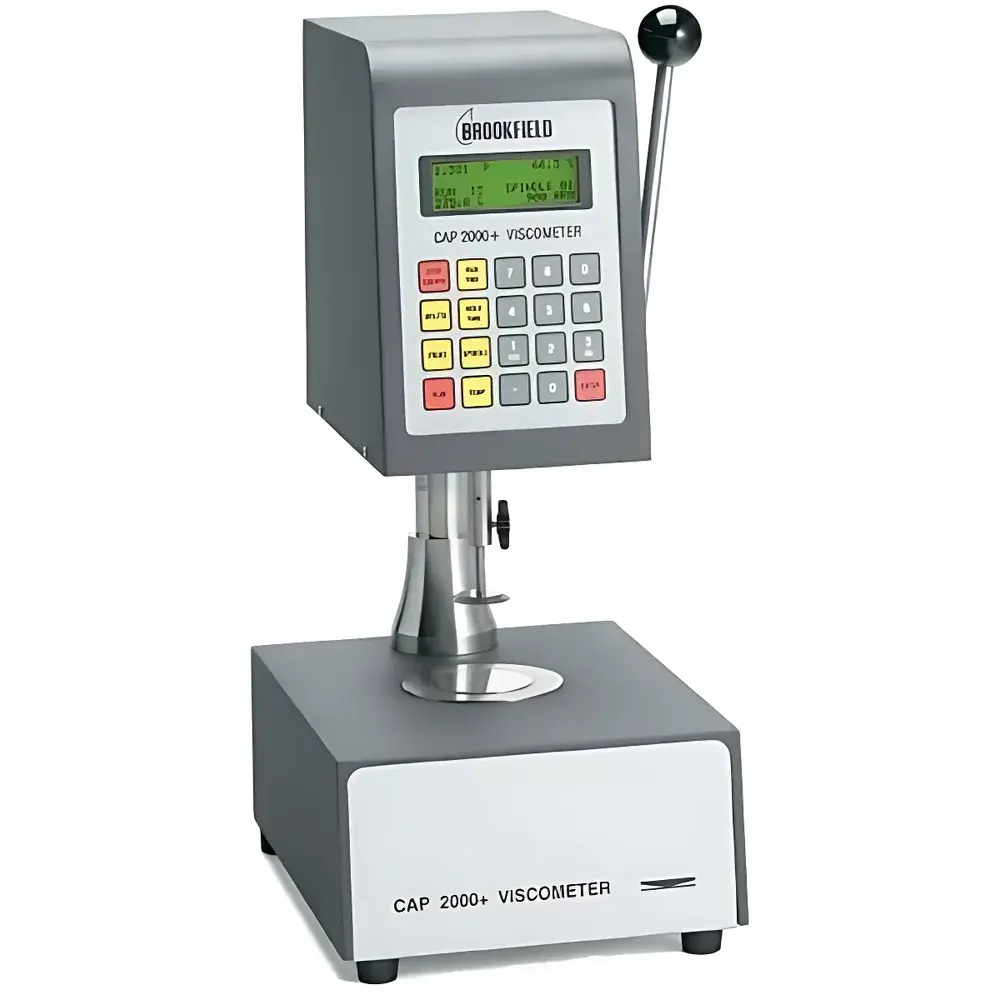
Brookfield CAP 1000+ Cone-Plate Viscometer
| Brand | Brookfield |
|---|---|
| Origin | USA |
| Model | CAP 1000+ |
| Operating Shear Rate | Up to 10,000 s⁻¹ |
| Temperature Control Options | L-Series (5–75°C) or H-Series (50–235°C) |
| Sample Volume | < 1 mL |
| Torque Range Options | High (181,000 dyne·cm, ICI-compliant) or Low (7,970 dyne·cm) |
| Standard Rotational Speeds | 750 rpm or 900 rpm (optional speeds: 100 rpm, 400 rpm) |
| Compliance | ASTM D4287, ISO 2884, BS 3900, GB/T 9751 |
Overview
The Brookfield CAP 1000+ Cone-Plate Viscometer is a precision-engineered rotational viscometer designed specifically for high-shear rheological characterization of low-to-medium viscosity fluids under controlled thermal conditions. It operates on the fundamental principle of cone-and-plate geometry, where a precisely angled conical spindle rotates above a flat, temperature-regulated plate—generating a uniform shear field across the sample gap. This configuration ensures well-defined shear rates up to 10,000 s⁻¹, making it ideal for evaluating structural breakdown, yield behavior, and apparent viscosity in coatings, inks, adhesives, and polymer dispersions. Unlike coaxial cylinder systems, the cone-plate design eliminates end-effects and provides exceptional reproducibility for quality control and R&D applications requiring compliance with standardized high-shear test protocols.
Key Features
- Automated cone-plate gap setting via motorized vertical positioning—ensuring repeatable geometry and eliminating manual calibration drift.
- Dual temperature control configurations: L-Series (5–75°C) for aqueous and solvent-based formulations; H-Series (50–235°C) for high-temperature resins, hot-melt adhesives, and thermosetting systems.
- Minimal sample requirement (< 1 mL), reducing material consumption and enabling rapid screening of expensive or limited-batch samples.
- Selectable torque ranges: high-torque mode (181,000 dyne·cm) meets ICI (International Chocolate Institute) specifications for thickened industrial fluids; low-torque mode (7,970 dyne·cm) optimizes sensitivity for low-viscosity inks and thin coatings.
- Fixed-speed operation at 750 rpm or 900 rpm as standard—with optional speed modules available (e.g., 100 rpm, 400 rpm) to support multi-point shear rate profiling when paired with compatible controllers.
- Modular mechanical architecture with stainless-steel wetted parts and chemically resistant bearing seals—designed for long-term stability in aggressive solvent environments common in paint and ink manufacturing.
Sample Compatibility & Compliance
The CAP 1000+ is validated for use with Newtonian and mildly non-Newtonian liquids exhibiting shear-thinning behavior typical of pigment dispersions, latex emulsions, and UV-curable formulations. Its fixed-gap, constant-shear-rate methodology satisfies the strict geometric and operational requirements of ASTM D4287 (Standard Test Method for Viscosity of Paints, Varnishes, Lacquers, and Related Products by the Cone-and-Plate Viscometer), ISO 2884-1 (Paints and varnishes — Determination of viscosity using a cone-and-plate viscometer), BS 3900-A6, and GB/T 9751 (Chinese national standard for high-shear viscosity of coatings). The instrument supports GLP-aligned workflows through traceable calibration certificates (NIST-traceable standards available), and its mechanical design facilitates routine verification per ASTM D1200 and ISO 2555.
Software & Data Management
While the CAP 1000+ operates as a standalone analog/digital hybrid unit, it integrates seamlessly with Brookfield’s optional PC-based software suite (via RS-232 or USB interface) for automated data logging, report generation, and statistical process control (SPC) charting. Software features include customizable pass/fail thresholds, audit trail functionality compliant with FDA 21 CFR Part 11 requirements (when deployed with appropriate system validation), and export to CSV or PDF formats for laboratory information management systems (LIMS). All torque and temperature readings are timestamped and stored with metadata—including operator ID, sample ID, and environmental conditions—to support full traceability in regulated QC environments.
Applications
- Quality assurance of architectural and industrial coatings—monitoring batch-to-batch consistency in gloss retention, leveling, and spatter resistance.
- Rheological screening of inkjet inks to assess jetting stability and droplet formation at nozzle-relevant shear rates.
- Formulation development of waterborne acrylic dispersions, where high-shear viscosity correlates directly with pigment suspension stability and film coalescence behavior.
- Process simulation of roller coating, curtain coating, and spray application—validating viscosity profiles under industrially relevant shear conditions.
- Regulatory submission support for cosmetic and pharmaceutical suspensions requiring ISO 2884-compliant viscosity documentation.
FAQ
What is the primary advantage of cone-plate geometry over concentric cylinder systems for coating measurements?
Cone-plate geometry delivers uniform shear rate distribution across the entire sample volume, minimizing wall-slip artifacts and enabling direct correlation with application-relevant shear fields—critical for ASTM D4287 and ISO 2884 compliance.
Can the CAP 1000+ be used for yield stress estimation?
No—the CAP 1000+ is a constant-shear-rate instrument and does not provide ramped or oscillatory testing capability; yield stress determination requires a controlled-stress rheometer with torque-controlled startup or vane geometry.
Is calibration verification required before each test series?
Yes—Brookfield recommends daily verification using certified silicone oil standards (e.g., Brookfield NIST-traceable viscosity standards) to ensure measurement integrity, especially when operating across wide temperature ranges.
Does the instrument meet FDA 21 CFR Part 11 requirements out of the box?
The hardware itself is Part 11–capable when configured with audit-trail-enabled software and electronic signature modules; full compliance requires site-specific validation documentation and procedural controls per GxP guidelines.
How frequently should the cone and plate surfaces be cleaned and inspected?
After every sample run—particularly following solvent-based or pigment-laden materials—to prevent residue buildup that compromises gap accuracy and thermal transfer efficiency.



