
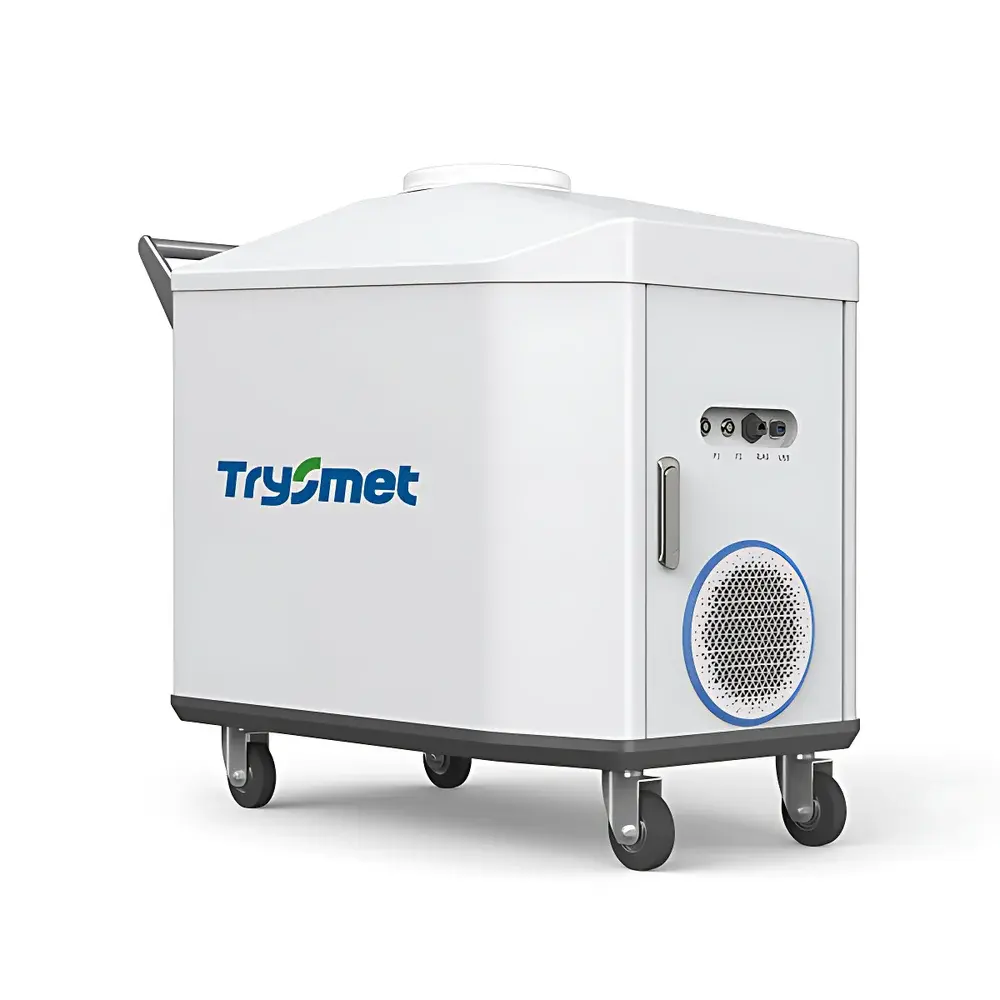
TrySmet DT-600N Next-Generation Vaporized Hydrogen Peroxide (VHP®) Sterilizer
| Brand | TrySmet |
|---|---|
| Origin | Beijing, China |
| Model | DT-600N |
| Hydrogen Peroxide Dosing Rate | 5–40 g/min |
| Airflow Capacity | 1000 m³/h |
| Sterilization Volume | 600 m³ |
| Vaporization Temperature | 120 °C |
| Dehumidification Threshold | >85% RH |
| Filter Efficiency | 0.2 µm |
| Sterilant | 35% Aqueous Hydrogen Peroxide Solution |
| Microbial Reduction | 3–12 log₁₀ |
Overview
The TrySmet DT-600N is a next-generation vaporized hydrogen peroxide (VHP®) sterilizer engineered for high-reliability bio-decontamination of large-scale enclosed environments—including cleanrooms, isolators, transfer hatches, and pharmaceutical production suites. It operates on the principle of controlled-phase vaporization: liquid 35% hydrogen peroxide solution is thermally vaporized at 120 °C into a dry, non-condensing, uniformly dispersible VHP gas phase. This process ensures rapid diffusion through complex geometries while maintaining material compatibility with stainless steel, polymers, electronics, and sensitive instrumentation. Unlike fogging or condensation-based systems, the DT-600N employs third-generation pure gaseous-phase generation—eliminating micro-droplet formation and enabling reproducible, residue-free decontamination across volumes up to 600 m³. Its integrated airflow system delivers 1000 m³/h of conditioned air, supporting rapid environmental equilibration and uniform VHP distribution under dynamic pressure-controlled conditions.
Key Features
- Triple-sensor real-time feedback loop: Integrated tri-modal probe continuously monitors temperature, relative humidity (RH), and hydrogen peroxide vapor concentration (ppm) at the chamber inlet—enabling closed-loop, adaptive dosing control.
- Intelligent variable-rate dosing: Peristaltic pump driven by a frequency-controlled motor adjusts injection rate from 5 to 40 g/min in real time based on sensor feedback—ensuring optimal H₂O₂ saturation without overexposure or under-treatment.
- Eight preconfigured sterilization cycles: Factory-loaded protocols cover standard room sizes (100–600 m³), each with validated exposure times, dwell phases, and aeration profiles aligned with ISO 14644-3 and EU GMP Annex 1 requirements.
- Configurable log-reduction targeting: Users select desired microbial reduction (3–12 log₁₀) directly via touchscreen interface; the controller automatically calculates and executes cycle parameters—including total dose, exposure duration, and catalytic decomposition time—to meet the specified bioburden challenge.
- Modular architecture with expansion capability: Standard RS485 and Ethernet interfaces support integration with building management systems (BMS); optional remote monitoring probes (up to four) extend environmental sensing into hard-to-reach zones with full data synchronization to the master PLC.
- Role-based access control: Three-tier permission system (Operator / Supervisor / Engineer) enforces audit-compliant parameter lockdown—critical for FDA 21 CFR Part 11 and EU Annex 11 validation environments.
Sample Compatibility & Compliance
The DT-600N is validated for use with common cleanroom materials including 316L stainless steel, polycarbonate, acetal, silicone elastomers, and epoxy-coated surfaces. It complies with ISO 14937:2009 (sterilization of health care products), EN 17125:2020 (VHP process validation), and supports user-defined validation per ISO 11135 (ethylene oxide) and ISO 11140 (indicator systems) frameworks. The 0.2 µm final-stage filter ensures particulate-free vapor delivery, meeting ISO 14644-1 Class 5 air quality requirements during operation. Dehumidification logic activates automatically when ambient RH exceeds 85%, preventing condensation and ensuring consistent VHP phase stability—essential for achieving ≥6-log sporicidal efficacy against Geobacillus stearothermophilus ATCC 7953.
Software & Data Management
Embedded industrial-grade PLC firmware provides full-cycle traceability: timestamped event logs, sensor trend graphs, dose history, and cycle completion certificates are stored locally (SD card) and exportable via USB or network transfer. All critical parameters—including setpoints, actuals, alarms, and user actions—are recorded with immutable timestamps and operator ID tags, satisfying ALCOA+ (Attributable, Legible, Contemporaneous, Original, Accurate, Complete, Consistent, Enduring, Available) data integrity principles. Optional software package enables remote cycle initiation, live dashboard viewing, and automated report generation compliant with 21 CFR Part 11 electronic signature and audit trail requirements.
Applications
- Decontamination of ISO Class 5–8 cleanrooms and aseptic processing suites prior to media fill or batch release.
- Terminal sterilization of isolators, RABS, and transfer hatches in biopharmaceutical manufacturing.
- Emergency bio-decontamination following contamination events (e.g., fungal growth, viral aerosol release).
- Validation support for sterility assurance level (SAL) of 10⁻⁶ in GMP-regulated facilities.
- Research laboratory biosafety cabinet and containment room revalidation after maintenance or relocation.
FAQ
What is the maximum recommended volume for validated 6-log sporicidal performance?
The DT-600N achieves ≥6-log reduction of Geobacillus stearothermophilus spores in volumes up to 600 m³ when operated within specified environmental limits (RH ≤85%, initial temperature ≥18 °C) and using 35% H₂O₂ solution.
Does the system support integration with facility SCADA or MES platforms?
Yes—via Modbus TCP/IP or OPC UA protocol over Ethernet, enabling real-time status monitoring, alarm forwarding, and centralized cycle logging.
Is catalytic aeration included as part of the standard cycle?
Yes—integrated palladium-based catalytic converters reduce residual H₂O₂ to water vapor and oxygen post-cycle, with automatic aeration timing calculated based on measured ppm decay kinetics.
Can users generate custom validation reports?
Yes—the embedded reporting engine allows configuration of PDF/CSV output templates containing cycle metadata, sensor trends, and compliance flags per ISO/IEC 17025 documentation standards.
What safety interlocks prevent accidental exposure during operation?
Hardware-enforced door lockout, dual-channel H₂O₂ concentration shutdown (>100 ppm), real-time RH override, and emergency purge activation ensure personnel safety per IEC 61000-6-4 and ISO 10648-2 occupational exposure guidelines.
Related Products



