
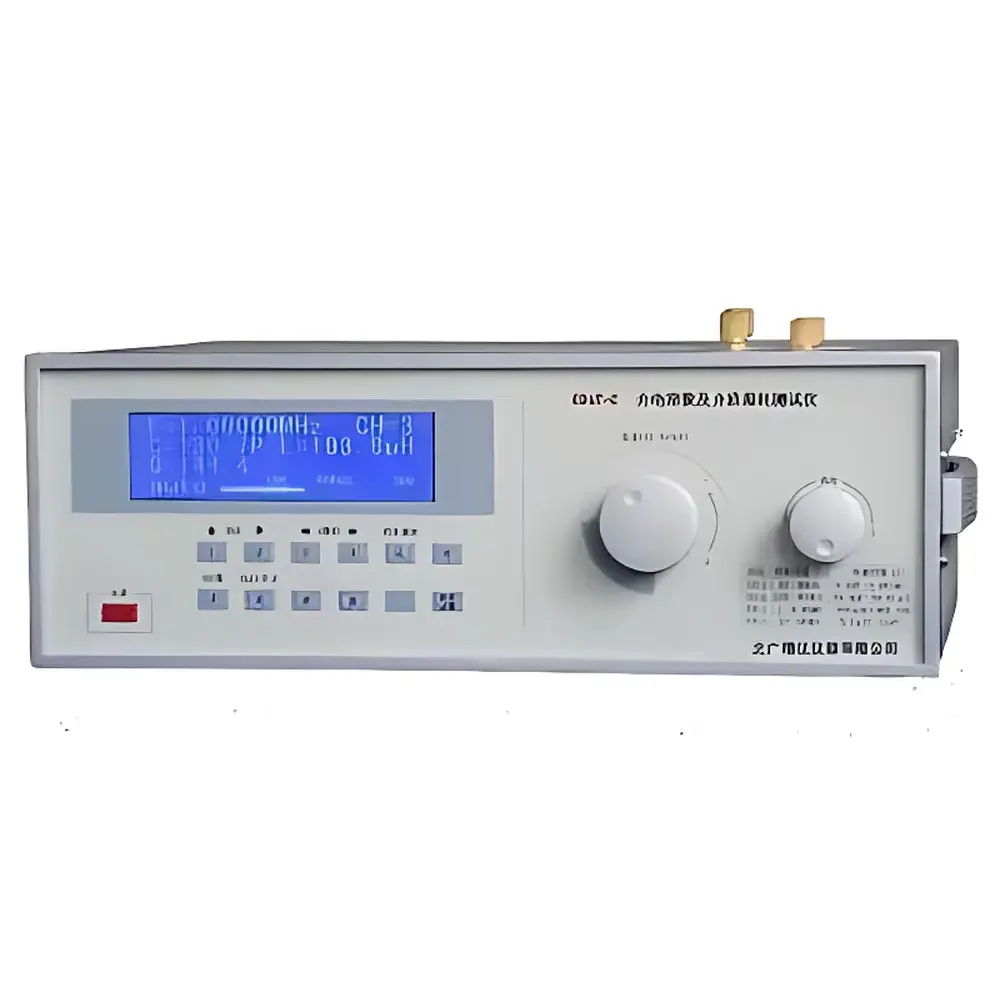
North Guangjingyi GDAT-C Dielectric Constant and Dissipation Factor (tan δ) Analyzer
| Brand | North Guangjingyi / All Precision Instrument |
|---|---|
| Origin | Beijing, China |
| Manufacturer Type | Manufacturer |
| Product Origin | Domestic |
| Model | GDAT-C |
| Price Range | USD 2,800 – 7,000 |
| Measurement Principle | Series/Parallel Resonance Method with Q-meter Integration |
| Frequency Range | 100 kHz – 160 MHz (digitally segmented) |
| tan δ Range | 0.002 – 1.0 (equivalent to Q = 2–1023) |
| Capacitance Range (Direct) | 1–200 pF |
| Main Capacitor Tuning Range | 18–220 pF (±1 pF accuracy) |
| Inductance Range | 4.5 nH – 140 mH |
| Electrode Diameter Options | 38 mm or 50 mm |
| Electrode Spacing Adjustment | 0–15 mm (micrometer resolution: 0.001 mm) |
| Fixture Loss tan δ | ≤1×10⁻⁴ @ 1 MHz |
| Compliance | GB/T 1409–2006 |
Overview
The North Guangjingyi GDAT-C Dielectric Constant and Dissipation Factor (tan δ) Analyzer is a precision impedance-based measurement system engineered for the quantitative characterization of dielectric properties in solid, liquid, and powder insulating materials. It operates on the principle of high-frequency resonance—specifically, the series or parallel resonant circuit method—wherein a test sample is integrated into a calibrated LC network, and changes in resonant frequency and bandwidth are used to derive complex permittivity (ε* = ε′ − jε″) and its loss tangent (tan δ = ε″/ε′). Designed to meet GB/T 1409–2006—the Chinese national standard aligned with IEC 60250 and ASTM D150—the instrument delivers traceable, repeatable measurements across an extended frequency spectrum from 100 kHz to 160 MHz. Its architecture integrates a stable RF signal source, a high-Q reference inductor bank, a digitally tunable main capacitor, and a micro-precision parallel-plate electrode fixture. This configuration enables accurate determination of both relative permittivity (dielectric constant, εr) and energy dissipation behavior under AC excitation, supporting R&D, quality control, and material certification workflows in polymer science, ceramics engineering, electrical insulation evaluation, and advanced composites development.
Key Features
- Wide dynamic frequency coverage: 100 kHz to 160 MHz in digitally defined segments, ensuring applicability across low-frequency polarization mechanisms (dipolar, interfacial) and high-frequency electronic/resonant responses.
- High-resolution capacitance tuning: Main capacitor adjustable from 18 pF to 220 pF with ±1 pF mechanical accuracy, enabling precise resonance matching for diverse sample geometries and dielectric strengths.
- Dual-electrode fixture with interchangeable 38 mm and 50 mm diameter plates, coupled with micrometer-driven spacing control (0–15 mm, 1 µm resolution) for standardized thickness calibration per GB/T 1409–2006.
- Low-loss fixture design: Measured tan δ ≤ 1×10⁻⁴ at 1 MHz, minimizing parasitic contributions and preserving measurement fidelity for low-loss materials such as polyethylene, fused silica, and high-purity alumina.
- Integrated Q-factor measurement capability: Q range 2–1023, with four auto/manual switchable ranges (30, 100, 300, 1000), supporting both high-Q (low-loss) and low-Q (high-conductivity) material evaluation.
- Reference inductor library: Nine calibrated coils covering 0.125 µH to 25 mH, each characterized for distributed capacitance and Q at specified frequencies—providing traceable inductance standards for system validation and cross-checking.
Sample Compatibility & Compliance
The GDAT-C accommodates rigid solids (films, sheets, rods), powders (via pelletized compression), and low-conductivity liquids (e.g., transformer oils, silicone fluids) using standardized electrode configurations. Sample thickness is determined mechanically via the micrometer-adjusted electrode gap, eliminating reliance on independent calipers and reducing uncertainty in εr calculation (εr ∝ C × d / A). The system conforms to GB/T 1409–2006, which specifies test procedures, electrode geometry tolerances, shielding requirements, and environmental controls (temperature, humidity) for reproducible dielectric measurements. While not pre-certified to ISO/IEC 17025, the instrument’s documented calibration hierarchy—including factory-traceable capacitor and inductor standards—supports laboratory implementation of GLP-compliant protocols. Users may establish internal SOPs referencing ASTM D150 (Standard Test Methods for Dielectric Constant and Dissipation Factor of Electrical Insulating Materials) and IEC 60250 (Measurement of the Permittivity and Dielectric Dissipation Factor of Electrical Insulating Materials at Power, Audio and Radio Frequencies) for international reporting.
Software & Data Management
The GDAT-C operates as a benchtop manual instrument without embedded firmware or PC connectivity; however, it is fully compatible with external data acquisition systems via analog output ports (Q, frequency, capacitance) and digital display readouts. Users commonly integrate it with LabVIEW, MATLAB, or Python-based scripts using USB-to-RS232 adapters to log time-stamped parameter sets. All front-panel indicators—including frequency counter (±1 digit error), main capacitor dial, and Q-meter scale—are mechanically indexed and optically readable, supporting audit-ready manual recording. For regulated environments, laboratories implement paper-based or electronic lab notebooks (ELN) to document test conditions (temperature, RH, electrode configuration, sample ID), raw readings, and calculated εr/tan δ values. Though the device lacks 21 CFR Part 11-compliant electronic signatures, its deterministic analog operation and physical calibration records satisfy basic GMP/GLP documentation requirements when paired with controlled procedural documentation.
Applications
- Electrical insulation qualification: Verification of εr and tan δ in epoxy resins, polyimide films, and silicone rubbers used in high-voltage bushings, PCB substrates, and motor windings.
- Dielectric material R&D: Correlation of molecular structure (e.g., polar group density, crystallinity) with frequency-dependent permittivity dispersion in thermoplastics and biopolymers.
- Ceramic processing control: Monitoring sintering-induced changes in εr and loss tangent during densification of BaTiO₃, Al₂O₃, and ZrO₂-based dielectrics.
- Quality assurance of transformer oils: Detection of oxidation byproducts and moisture ingress via elevated tan δ at power frequencies (50/60 Hz equivalent, extrapolated from low-MHz trends).
- Academic teaching labs: Hands-on instruction in electromagnetic theory, resonance phenomena, and the Kramers–Kronig relations governing causal dielectric response.
FAQ
What standards does the GDAT-C comply with?
It is designed and validated per GB/T 1409–2006, which aligns closely with IEC 60250 and ASTM D150 for dielectric constant and dissipation factor measurement.
Can the GDAT-C measure conductive or semi-crystalline polymers?
Yes—within limits. Samples must exhibit bulk resistivity >10⁹ Ω·cm to avoid shunting the measurement circuit; semi-crystalline polymers (e.g., PP, PET) are routinely characterized using temperature-controlled stages to resolve α- and β-relaxation peaks.
Is calibration traceable to national metrology institutes?
Factory calibration uses reference capacitors and inductors with documented uncertainties; end users may perform periodic verification against NIST-traceable LCR meters (e.g., Keysight E4980A) at discrete frequencies.
How is electrode spacing verified for accuracy?
The micrometer feed screw has a stated resolution of 0.001 mm and is factory-checked with gauge blocks; users should perform zero-offset verification before each test series using non-contact methods (e.g., optical interferometry) or certified feeler gauges.
Does the system support automated frequency sweeps?
No—the GDAT-C is manually tuned. For spectral analysis, users increment frequency in discrete steps, record Q and C at each point, and post-process data to generate Cole–Cole or ε″ vs. f plots.



