
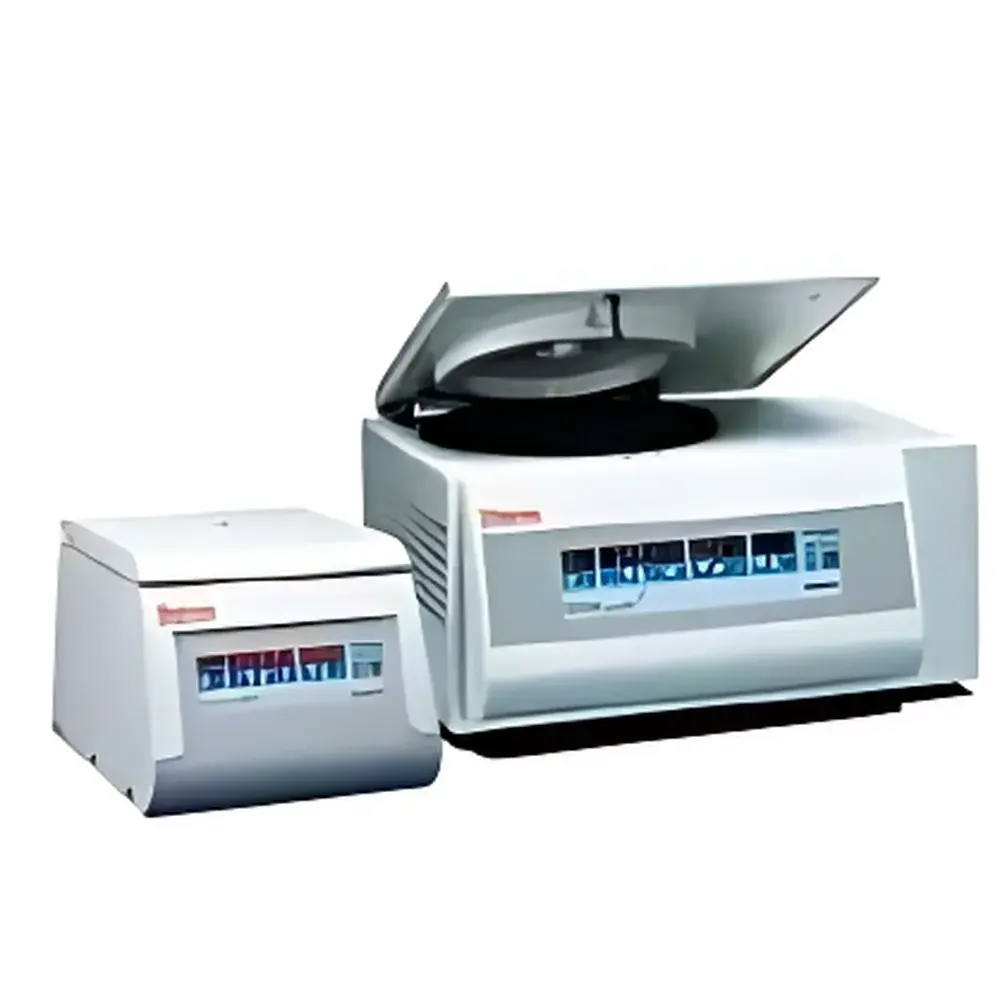
Thermo Fisher Scientific Heraeus Biofuge Primo Benchtop Centrifuge
| Brand | Thermo Fisher Scientific |
|---|---|
| Origin | USA |
| Model | Heraeus Biofuge Primo |
| Maximum Speed | 15,000 rpm |
| Minimum Speed | 300 rpm |
| RCF Max | 21,885 × g |
| Capacity | 6 × 50 mL (fixed-angle), 4 × 100 mL (swing-bucket) |
| Temperature Range | Ambient |
| Acceleration/Deceleration Steps | 9 / 2 |
| Noise Level | < 62 dBA |
| Timer Range | 0–9 h 59 min + continuous |
| Drive System | Brushless DC motor |
| Control System | EASYcontrol II microprocessor-based interface |
| Rotor Recognition | Automatic |
| Imbalance Detection | Electronic, rotor-agnostic |
| Safety Compliance | EN 61010-1, EN 61010-2-020, EN 50081-1, EN 50082-1, UVV VBG 7z |
| Dimensions (H×W×D) | 315 × 380 × 475 mm |
| Weight | 40 kg |
| Power Input | 350 W |
Overview
The Thermo Fisher Scientific Heraeus Biofuge Primo is a high-performance benchtop centrifuge engineered for precision, versatility, and operational safety in modern life science laboratories. Utilizing brushless DC motor technology and advanced microprocessor-based control architecture, the Biofuge Primo delivers consistent rotational force across a broad speed range (300–15,000 rpm) with reproducible RCF values up to 21,885 × g. Its design integrates three functional centrifugation modes—microcentrifugation, high-speed centrifugation, and general-purpose centrifugation—within a single compact platform. This tri-modal capability eliminates the need for multiple dedicated instruments in routine biochemical, molecular biology, and clinical research workflows. The unit operates at ambient temperature and is optimized for rapid sample turnaround via programmable acceleration and deceleration profiles (9-step acceleration, 2-step deceleration), minimizing run time without compromising pellet integrity or sample stability.
Key Features
- Triple-Mode Operational Flexibility: Supports microcentrifuge tubes (0.2–2.0 mL), standard conical tubes (15–50 mL), and larger-volume containers (up to 100 mL DIN format) through six interchangeable rotors—including fixed-angle, swing-bucket, and microplate carriers—enabling seamless transition between DNA extraction, cell pelleting, serum separation, and virus concentration protocols.
- EASYcontrol II Human-Centered Interface: A high-contrast LCD display presents real-time parameters including speed (rpm), RCF, time remaining, temperature (ambient), and rotor identification. Intuitive icon-driven keypad layout reduces training overhead and minimizes input error, supporting GLP-compliant documentation practices.
- Electronic Imbalance Detection System: Continuously monitors load distribution during both loading and active rotation. Detects asymmetry caused by tube breakage, uneven filling, or rotor misalignment and initiates immediate deceleration and shutdown—protecting both instrument integrity and laboratory personnel.
- Low-Noise Engineering: Acoustic optimization yields sound pressure levels below 62 dBA at maximum speed, enabling placement in shared lab spaces without disruption to adjacent instrumentation or personnel concentration.
- Robust Mechanical Architecture: Stainless steel base and reinforced aluminum chamber ensure long-term dimensional stability and resistance to chemical exposure. Integrated dual-locking lid mechanism complies with IEC 61010-2-020 mechanical safety requirements for Class II biological containment.
Sample Compatibility & Compliance
The Biofuge Primo accommodates a wide range of primary sample containers used in academic, pharmaceutical, and diagnostic settings—including polypropylene conical tubes (Falcon® 15/50 mL), vacuum blood collection tubes (7–15 mL), microcentrifuge tubes (0.2–2.0 mL), and 96-well PCR plates. All rotors are certified for use with biosafety level 2 (BSL-2) agents under third-party validation per ISO 13485 and EU Directive 93/42/EEC. The system meets essential electrical safety and electromagnetic compatibility standards: EN 61010-1 (general safety), EN 61010-2-020 (particular requirements for centrifuges), EN 50081-1 (EMI emission), and EN 50082-1 (EMS immunity). It also conforms to German occupational safety regulation UVV VBG 7z for rotating machinery.
Software & Data Management
While the Biofuge Primo operates as a standalone instrument without external software dependency, its EASYcontrol II firmware supports audit-ready data retention. The device automatically stores the last executed protocol—including speed, time, RCF, rotor ID, and date/time stamp—in non-volatile memory. This feature facilitates traceability during internal quality audits and aligns with FDA 21 CFR Part 11 principles for electronic records when paired with laboratory information management systems (LIMS) via manual log export. No proprietary drivers or cloud connectivity are required; all configuration remains local and deterministic.
Applications
- Molecular biology: Plasmid DNA purification, RNA isolation, and PCR product cleanup using 0.2–2.0 mL microtubes.
- Clinical diagnostics: Serum/plasma separation from whole blood in 7–15 mL evacuated tubes, compliant with CLSI GP44-A4 handling guidelines.
- Cell culture: Harvesting adherent and suspension cells at 300–3,000 rpm for downstream lysis or cryopreservation.
- Protein biochemistry: Clarification of lysates and partial purification via differential centrifugation (e.g., 10,000–15,000 rpm for organelle fractionation).
- Virology: Concentration of lentiviral or AAV vectors using swing-bucket rotors with sealed buckets and aerosol-tight caps.
FAQ
Does the Biofuge Primo support refrigerated operation?
No—the Biofuge Primo is an ambient-temperature-only centrifuge. For temperature-controlled applications, consider the Heraeus Multifuge X3R or Sorvall ST series.
Can rotor types be interchanged without recalibration?
Yes. Automatic rotor recognition eliminates manual calibration; each rotor contains an embedded identifier that communicates geometry and maximum speed limits directly to the control system.
Is the imbalance detection system validated for all rotor configurations?
Yes. The electronic imbalance sensor functions independently of rotor type and has been verified across all six compatible rotors per EN 61010-2-020 Annex BB test protocols.
What power supply options are available?
Two variants are offered: 75005181 (230 V, 50/60 Hz) and 75005182 (120 V, 50 Hz). Voltage selection must match local infrastructure; no universal auto-sensing capability is integrated.
How is maintenance tracked for compliance purposes?
The unit does not include built-in service logging. Users are advised to maintain external maintenance records aligned with ISO/IEC 17025 Clause 6.4.2 for equipment verification and calibration history.



