
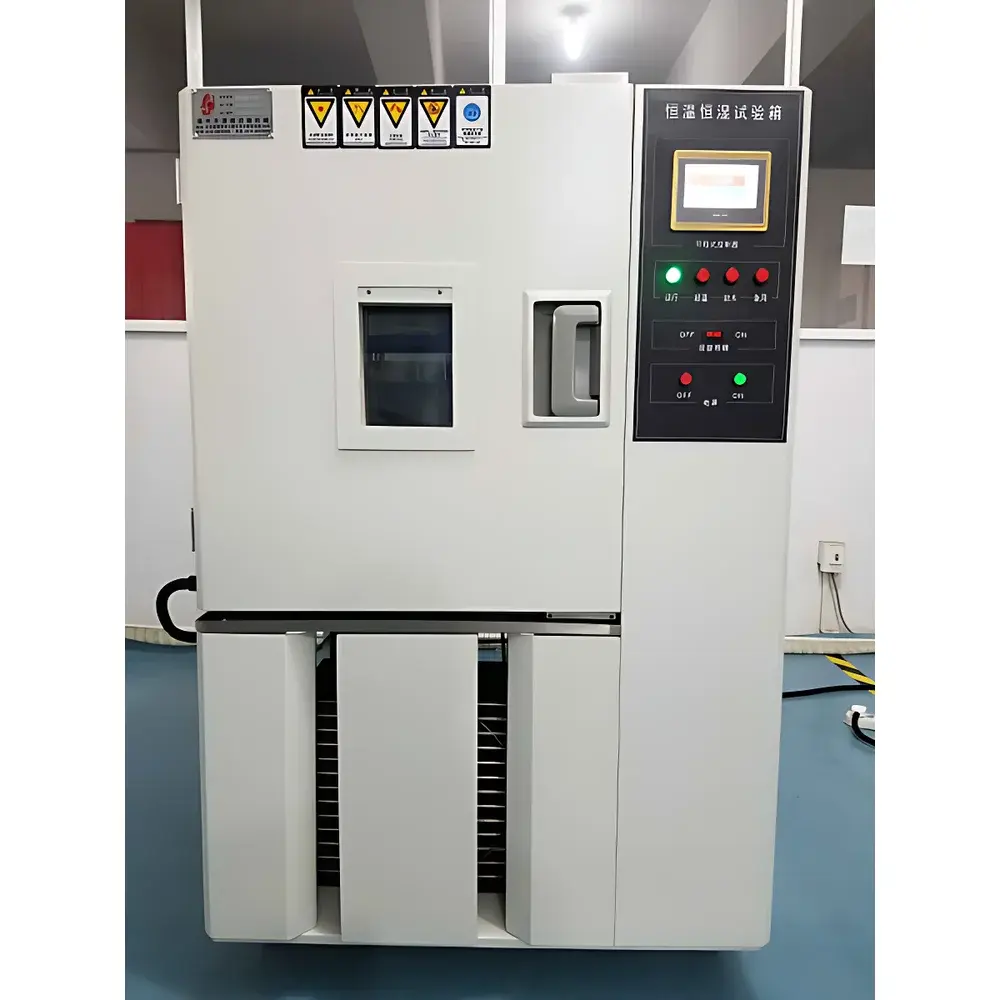
Beiguang Jingyi BG9102 Precision Constant Temperature and Humidity Environmental Test Chamber
| Brand | Beiguang Jingyi / All Precision Instrument |
|---|---|
| Origin | Beijing, China |
| Manufacturer Type | Direct Manufacturer |
| Country of Origin | China |
| Model | BG9102 |
| Price Range | USD 7,000 – 14,000 |
| Internal Chamber Dimensions (W×D×H) | 450 × 400 × 550 mm |
| Temperature Range (unloaded) | −20 °C to +100 °C |
| Temperature Uniformity (unloaded) | ±2 °C |
| Temperature Fluctuation (unloaded) | ≤ ±0.5 °C |
| Humidity Range (no active thermal load) | 20–98 %RH |
| Humidity Fluctuation | ≤ ±3 %RH |
| Heating Rate (20 → 100 °C) | ≤40 min |
| Cooling Rate (20 → −20 °C) | ≤30 min |
| Controller | Programmable high-resolution color touchscreen (English/Chinese interface), PID control with SSR output, 10 program groups × 16 segments = 160 total segments, max segment duration: 99 h 59 min, max full cycles: 999, partial cycles: 99, USB data logging support |
| Temperature Sensor | PT100 armored resistance thermometer |
| Humidity Measurement Principle | Dry-wet bulb psychrometry |
| Compressor | Imported Tecumseh (France) eco-friendly hermetic compressor |
| Refrigerant | R404a (DuPont, USA) |
| Expansion Valve | Danfoss (Denmark) |
| Drier Filter | Parker Alico (USA) |
| Solenoid Valve | Castel (Italy) |
| Humidification System | Electronic water-level controller (imported Taiwan), built-in stainless steel reservoir with sight-glass level indicator |
| Safety Protections | Over-temperature alarm (chamber & compressor), over-current/overload protection, humidity tank low-water alarm, fan overheat protection, ground fault circuit interrupter (GFCI), phase-loss protection, zero-crossing thyristor power controller, fuse protection |
Overview
The Beiguang Jingyi BG9102 Precision Constant Temperature and Humidity Environmental Test Chamber is engineered for rigorous environmental simulation in materials science, polymer testing, electronics reliability validation, and quality assurance laboratories. It operates on a dual-parameter closed-loop control architecture—simultaneously regulating temperature and relative humidity within a thermally insulated stainless-steel chamber—using psychrometric dry-wet bulb measurement for humidity feedback and high-stability PT100 resistance thermometry for temperature sensing. The system adheres to fundamental principles of heat transfer and moisture equilibrium, enabling reproducible exposure conditions required for ASTM D4332, ISO 2231, IEC 60068-2-30, and GB/T 2423.3–2016 (IEC 60068-2-78) compliance. Designed for long-term stability under continuous operation, the BG9102 delivers calibrated environmental profiles across its full operating envelope without requiring external humidification or cooling utilities—making it suitable for both R&D benchtop validation and production-line environmental stress screening.
Key Features
- High-fidelity programmable controller with dual-language (English/Chinese) touch interface, supporting up to 160-step multi-segment profiles and 999-cycle looping for complex test sequences including ramp-hold-soak transitions.
- Imported refrigeration components—including Tecumseh compressor, Danfoss thermostatic expansion valve, Parker Alico drier filter, and Castel solenoid valves—ensuring low-noise, oil-free operation and extended service life under cyclic thermal loading.
- Dry-wet bulb humidity measurement system with real-time psychrometric calculation, eliminating reliance on capacitive RH sensors subject to drift or condensation-induced calibration loss.
- Robust safety architecture: 11 independent protective functions including chamber over-temperature cutoff, compressor thermal overload detection, low-water alarm with automatic pump shutdown, GFCI-protected power distribution, and zero-crossing thyristor-based heater control for EMI suppression.
- Electronically regulated water-level management with imported Taiwan liquid-level sensor and transparent sight-glass reservoir—minimizing manual intervention while preventing boil-dry incidents during extended humidification cycles.
- Thermally optimized chamber design featuring double-wall vacuum-insulated construction, anti-fog heated observation window (9 W LED backlight), and precision-balanced air circulation via centrifugal blower with adjustable flow baffle.
Sample Compatibility & Compliance
The BG9102 accommodates standard-sized test specimens up to 400 mm depth × 450 mm width × 550 mm height, compatible with ISO 2041, ASTM D618, and GB/T 2918 specimen conditioning protocols. Its uniformity specification (±2 °C spatial deviation, ≤±3 %RH fluctuation) satisfies requirements for pre-test conditioning of polymeric films, elastomeric seals, PCB assemblies, and pharmaceutical packaging per USP , ISO 11607-1, and ICH Q5C stability guidelines. All electrical components—including Omron relays, Chint contactors, and Schneider circuit breakers—meet CE, RoHS, and GB 4793.1 safety standards. The unit is factory-calibrated traceable to CNAS-accredited reference standards, and supports GLP/GMP audit readiness through timestamped USB data logging (temperature, humidity, runtime, alarm events) with no proprietary software dependency.
Software & Data Management
No external PC software is required for basic operation; all profile programming, real-time monitoring, and historical data review occur natively on the embedded 7-inch TFT touchscreen. The controller stores complete runtime logs—including setpoint deviations, alarm timestamps, and cycle completion status—in non-volatile memory. USB export enables CSV-formatted time-series data ingestion into Excel, MATLAB, or LIMS platforms. For integration into automated test networks, optional RS485 Modbus RTU communication allows remote parameter read/write and status polling. Audit trail functionality includes operator ID tagging (via configurable login), change history of setpoints and programs, and tamper-evident event logging compliant with FDA 21 CFR Part 11 Annex 11 expectations for electronic records integrity.
Applications
The BG9102 serves critical roles across multiple technical domains: accelerated aging of automotive interior trim per SAE J2412; moisture absorption/desorption kinetics studies for biodegradable polymers; preconditioning of lithium-ion battery cells prior to electrochemical cycling; stability testing of adhesive tapes and pressure-sensitive materials under tropical (40 °C/93 %RH) and desert (60 °C/15 %RH) profiles; qualification of medical device packaging per ISO 11607-2; and validation of optical lens coatings under thermal-hygric cycling. Its rapid thermal response (<40 min from 20 °C to 100 °C; <30 min from 20 °C to −20 °C) enables efficient execution of JEDEC JESD22-A104 temperature cycling and MIL-STD-810H Method 502.7 humidity storage tests.
FAQ
What is the maximum sample mass the chamber can accommodate without compromising uniformity?
The chamber maintains specified uniformity for loads up to 15 kg distributed evenly on the perforated stainless-steel shelf. Exceeding this mass may impede airflow and degrade spatial homogeneity—verified per ISO 16750-4 Annex C.
Does the system support unattended weekend operation with power failure recovery?
Yes. Built-in UPS-compatible power loss detection triggers automatic resume from last valid segment upon restoration, preserving test continuity and data integrity without manual reset.
Can humidity be controlled independently of temperature during a program?
No. Humidity control is interdependent with chamber temperature due to psychrometric constraints; RH setpoints are only valid within the operational temperature range where saturation limits permit stable vapor pressure generation.
Is third-party calibration certification available?
Factory calibration certificates (traceable to NIM, China) are included. Optional on-site calibration by CNAS-accredited providers (e.g., China Metrology Institute No. 514 or 304) can be arranged at customer request.
What maintenance intervals are recommended for optimal performance?
Compressor oil inspection every 2,000 operating hours; refrigerant leak check annually; humidifier reservoir cleaning weekly; dry-wet bulb wick replacement quarterly; and full system verification per ISO/IEC 17025 every 12 months.



