
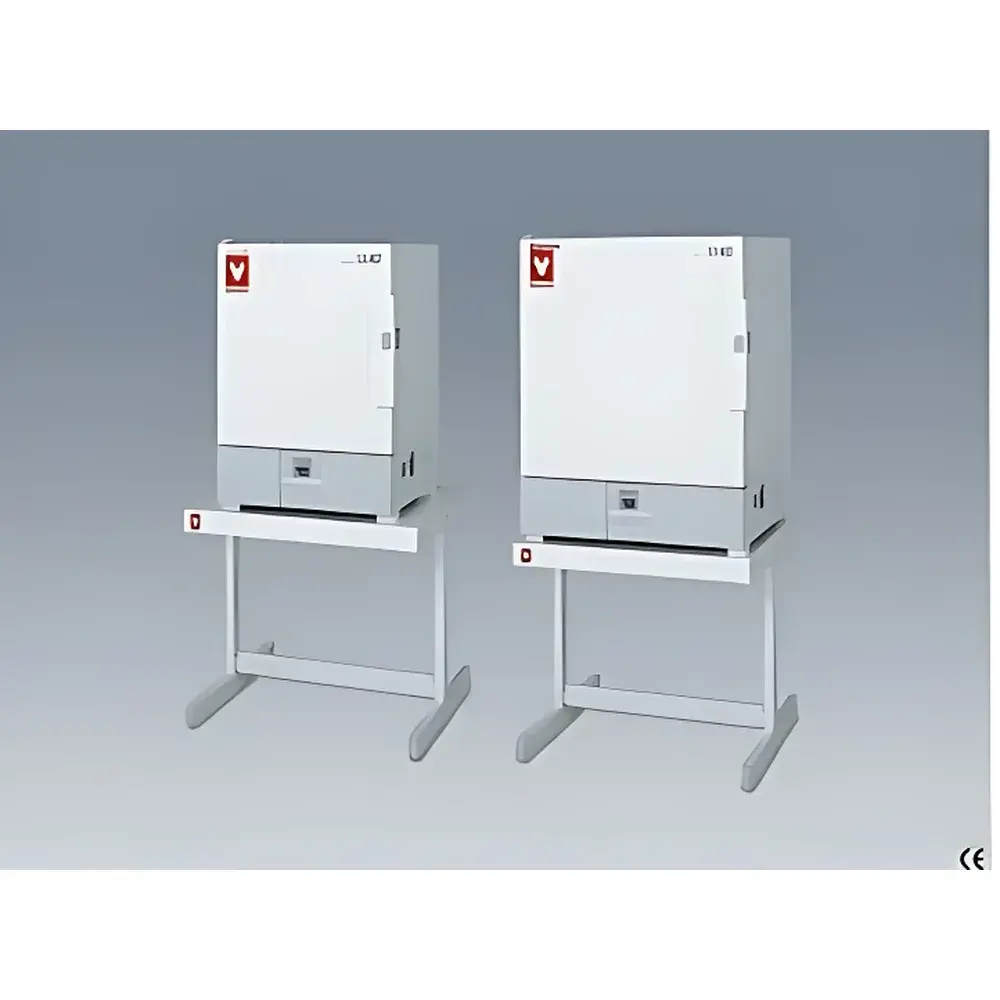
YAMATO DY310C / DY410C / DY610C Entry-Level Constant-Temperature Drying Oven
| Brand | YAMATO |
|---|---|
| Origin | Japan |
| Model | DY310C / DY410C / DY610C |
| Heating Method | Natural Convection |
| Temperature Range | Ambient +5°C to 300°C (DY310C), Ambient +5°C to 280°C (DY410C/DY610C) |
| Temp. Control Accuracy | ±1°C at max setpoint |
| Temp. Uniformity | ±10°C at max setpoint |
| Chamber Volume | 28 L / 74 L / 153 L |
| Interior Dimensions (W×D×H mm) | 300×310×300 / 450×410×400 / 600×510×500 |
| Exterior Dimensions (W×D×H mm) | 400×440×630 / 550×540×730 / 700×640×830 |
| Shelf Load Capacity | 15 kg per shelf |
| Shelf Quantity | 6 / 9 / 12 |
| Shelf Spacing | 35 mm |
| Heater Power | 0.9 kW / 1.36 kW / 1.36 kW |
| Timer Range | 1 min – 99 h 59 min |
| Control System | PID-based digital temperature controller with Pt100 sensor and bimetallic over-temperature cut-off |
| Safety Features | Self-diagnostic circuit (sensor fault detection, over-temperature prevention), independent mechanical over-temperature limiter, earth-leakage circuit breaker (ELCB), parameter lock function |
| Construction | Stainless steel interior, cold-rolled steel exterior with chemical-resistant coating, rockwool insulation |
| Exhaust Ports | Two × Ø30 mm, top-mounted |
| Power Supply | AC 220 V, 50/60 Hz (5 A / 7 A / 7 A) |
| Weight | ~23 kg / ~38 kg / ~56 kg |
Overview
The YAMATO DY310C, DY410C, and DY610C are entry-level, naturally convective constant-temperature drying ovens engineered for routine laboratory and quality control applications requiring reliable thermal stabilization without forced-air circulation. Designed for cost-conscious institutions—such as academic teaching labs, pharmaceutical QC units, and industrial R&D facilities—these ovens operate on a simple yet robust principle: passive heat distribution via natural convection, minimizing energy consumption and mechanical complexity while maintaining stable thermal environments across defined operating ranges. Each model is calibrated for precision within ±1°C at maximum setpoint (300°C for DY310C; 280°C for DY410C/DY610C), with temperature uniformity specified at ±10°C under steady-state conditions. Their stainless steel interiors resist corrosion from solvents and moisture-laden samples, while rockwool insulation ensures consistent thermal retention and low external surface temperatures during extended operation.
Key Features
- Digital PID temperature control system with dual LED display: red 4-digit readout for actual chamber temperature, green 4-digit display for setpoint.
- Intuitive menu-driven interface using dedicated function keys and up/down buttons for rapid parameter entry and real-time adjustment.
- Configurable operational modes including fixed-temperature (constant-setpoint) operation and automatic shutdown after user-defined timer duration (1 minute to 99 hours 59 minutes).
- Integrated safety architecture featuring self-diagnostic monitoring of Pt100 sensor integrity and upper-temperature limit violation, backed by an independent mechanical over-temperature limiter and ELCB protection.
- Parameter lock function prevents unauthorized changes to critical settings—a requirement in GLP-compliant environments where procedural consistency must be auditable.
- Modular shelving system with standardized 35 mm spacing, supporting up to 15 kg per shelf and scalable layer counts (6, 9, or 12 shelves depending on model) to accommodate diverse sample volumes and geometries.
Sample Compatibility & Compliance
These ovens are suitable for drying, baking, sterilizing, and pre-conditioning non-volatile or low-volatility materials—including glassware, metal parts, polymer substrates, filter papers, and inert powders. They are not intended for flammable solvent evaporation or biological decontamination requiring validated sterilization cycles. All models comply with IEC 61010-1:2010 for electrical safety in laboratory equipment and meet Japanese JIS B 7751 standards for temperature-controlled ovens. The stainless steel chamber and chemical-resistant exterior coating support cleaning protocols aligned with ISO 14644 cleanroom maintenance guidelines. While not certified for FDA 21 CFR Part 11 compliance out-of-the-box, audit trails can be generated externally via optional data loggers interfaced through the oven’s analog output port (available upon request).
Software & Data Management
The DY-series ovens operate without embedded software or network connectivity, reflecting their design philosophy as standalone, deterministic instruments. All configuration and operational data reside locally on the front-panel controller, with no internal memory or firmware update capability. However, the analog voltage output (0–10 V DC proportional to chamber temperature) enables integration with third-party data acquisition systems for continuous logging and trend analysis. Users may export time-stamped temperature profiles for inclusion in SOP documentation, batch records, or regulatory submissions. For laboratories requiring electronic record retention, pairing with a validated USB or Ethernet-connected datalogger satisfies ALCOA+ principles (Attributable, Legible, Contemporaneous, Original, Accurate) when deployed under documented procedures.
Applications
- Routine drying of glassware, ceramic crucibles, and metal components prior to gravimetric analysis or coating processes.
- Moisture content determination per ASTM D2240 or ISO 293:2004 (when used in conjunction with certified analytical balances and standardized desiccation protocols).
- Pre-heating of test specimens before tensile, hardness, or thermal expansion testing per ASTM E8/E23 or ISO 6892.
- Baking of printed circuit boards (PCBs) and electronic assemblies to remove residual flux or humidity prior to conformal coating.
- Conditioning of hygroscopic reference standards (e.g., potassium hydrogen phthalate) in environmental chambers where ambient humidity control is maintained externally.
- Stabilization of calibration weights and metrology tools at controlled thermal states prior to mass verification.
FAQ
What is the difference between natural convection and forced-air drying ovens?
Natural convection relies on buoyancy-driven air movement without fans, resulting in gentler thermal exposure and lower power draw—but reduced temperature uniformity compared to fan-assisted models. It is preferred for heat-sensitive, lightweight, or loosely packed samples where airflow-induced displacement must be avoided.
Can these ovens be used for sterilization?
No. These units lack validation-grade temperature mapping, HEPA filtration, and steam generation capabilities required for microbiological sterilization (e.g., autoclaving or dry-heat depyrogenation per USP ). They are rated for thermal conditioning only.
Is calibration documentation provided with shipment?
Each unit ships with a factory calibration certificate traceable to JCSS (Japanese Calibration Service System), covering temperature accuracy at three points (100°C, 200°C, and max operating temperature). Full UKAS or NIST-traceable certificates are available as optional add-ons.
Are replacement shelves and accessories available globally?
Yes. Stainless steel mesh shelves (part no. SH-SS-300), shelf supports (SR-35), and optional accessories—including stackable stands (ONS30C/ONS60C) and vertical stacking kits (ODK80C/ODK82C/ODK84C)—are stocked by authorized YAMATO distributors in North America, EMEA, and APAC regions.
Does the oven support remote monitoring or IoT integration?
Not natively. The controller lacks Ethernet, Wi-Fi, or Modbus interfaces. Integration requires external hardware: a compatible analog input module connected to a SCADA or LabVantage system, configured per user-defined alarm thresholds and sampling intervals.



