
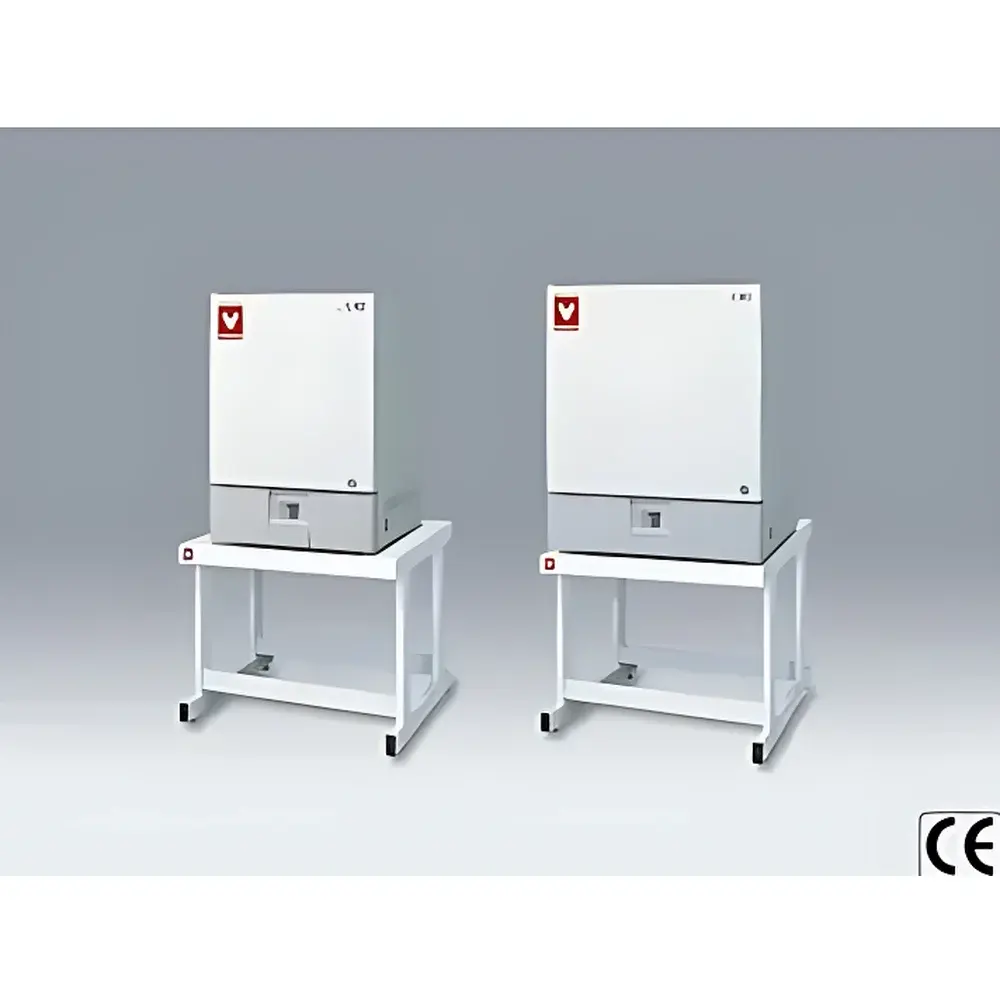
YAMATO IC113C/413C/613C/813C Economy Temperature-Controlled Incubator
| Brand | YAMATO |
|---|---|
| Origin | Japan |
| Model | IC113C / IC113CW / IC413C / IC413CW / IC613C / IC613CW / IC813C / IC813CW |
| Temperature Range | Ambient +5°C to 80°C |
| Temperature Control Accuracy | ±0.5°C (at 37°C) |
| Temperature Uniformity | ±1.0°C (at 37°C) |
| Chamber Volume | 37 L / 97 L / 159 L / 318 L |
| Heating Power | 0.2 kW / 0.3 kW / 0.4 kW / 0.7 kW |
| Control System | PID with Digital LED Display (Green for Actual, Red for Setpoint) |
| Safety Features | Self-Diagnostic Circuit (Sensor Fault, Display Fault, Measurement Deviation), Keypad Lock, Offset Calibration, Power Failure Recovery |
| Construction | Stainless Steel Interior, Powder-Coated Cold-Rolled Steel Exterior, Glass Fiber Insulation |
| Air Circulation | Natural Convection |
| Timer Range | 1 min – 99 h 59 min & 100 – 999 h 50 min (with Delay Start Function) |
| Power Supply | AC 220 V, 50/60 Hz |
Overview
The YAMATO IC113C, IC413C, IC613C, and IC813C series are economy-grade, temperature-controlled incubators engineered for reliable, stable thermal environments in academic laboratories, quality control units, and routine microbiological applications. Designed around natural convection airflow—rather than forced-air circulation—these units eliminate fan-induced vibration and turbulence, making them especially suitable for static cell culture, microbial growth assays, enzyme activity studies, and long-term stability testing where mechanical disturbance must be minimized. Each model operates within a precise temperature range of ambient +5°C to 80°C, with control accuracy of ±0.5°C at the reference point of 37°C and uniformity maintained within ±1.0°C across the chamber volume under standardized load conditions. The absence of internal fans contributes to lower acoustic output (<35 dB(A)), reduced maintenance requirements, and enhanced long-term reliability—critical considerations for unattended overnight or multi-day incubation protocols.
Key Features
- Natural convection thermal management ensures homogeneous temperature distribution without airflow-induced sample desiccation or mechanical stress.
- Dual-door configuration (standard on IC413C and larger models) minimizes heat loss during access; inner door constructed from tempered safety glass enables real-time visual monitoring without compromising thermal stability.
- Intuitive digital interface with dedicated function keys and up/down navigation allows rapid setup of constant-temperature operation, timed start/stop cycles, and automatic shutdown—supporting GLP-compliant workflow documentation.
- PID-based temperature controller with K-type thermocouple feedback delivers responsive regulation and inherent resistance to external ambient fluctuations.
- Comprehensive safety architecture includes self-diagnostic circuitry detecting sensor failure, display anomalies, and measurement deviations—triggering audible/visual alerts and automatic thermal hold.
- Offset calibration function enables traceable adjustment against NIST-traceable reference standards, supporting ISO/IEC 17025 laboratory accreditation requirements.
- Keypad lock prevents unauthorized parameter changes; power failure recovery retains setpoints and resumes operation upon grid restoration—ensuring continuity in regulated environments.
Sample Compatibility & Compliance
These incubators accommodate standard laboratory vessels including Petri dishes, multi-well plates (6–96-well), culture flasks (T25–T225), and test tubes—supported by adjustable stainless-steel wire shelves (load capacity: ~15 kg per shelf). Shelf spacing is fixed at 30 mm, optimized for vertical stacking while maintaining adequate air gap clearance. All interior surfaces are electropolished stainless steel (SUS304), resistant to common disinfectants (e.g., 70% ethanol, 1% sodium hypochlorite) and compatible with autoclave-safe accessories. The units comply with IEC 61010-1:2010 for electrical safety in laboratory equipment and meet EMC requirements per IEC 61326-1. While not certified for humidified operation, their sealed construction and optional observation window (model suffix “W”) support integration into cleanroom-adjacent workflows under ISO 14644-1 Class 7/8 environments.
Software & Data Management
The IC-series operates as a standalone instrument with no embedded data logging or network connectivity. Temperature setpoints, timer values, and operational status are displayed via dual-color 4-digit LED readouts (green = actual, red = setpoint), enabling immediate verification without external instrumentation. For laboratories requiring audit trails, optional analog voltage output (0–5 V DC proportional to chamber temperature) can be interfaced with third-party DAQ systems compliant with FDA 21 CFR Part 11 when paired with validated software and electronic signature protocols. Offset calibration records and maintenance logs should be retained manually per ISO 17025 clause 7.7 and GLP Principle 5.
Applications
- Bacterial and fungal culture propagation under defined thermal conditions (e.g., E. coli, S. aureus, C. albicans).
- Enzyme kinetics assays requiring strict thermal consistency over extended durations.
- Seed germination and plant tissue culture pre-incubation stages.
- Stability testing of pharmaceutical intermediates per ICH Q1A(R2) guidelines.
- Storage of temperature-sensitive reagents, antibodies, and diagnostic kits at controlled non-refrigerated conditions.
- Pre-warming of media, buffers, and consumables prior to aseptic processing.
FAQ
Are these incubators suitable for CO₂-dependent cell culture?
No. The IC-series provides only temperature control and lacks CO₂ regulation, humidity control, or sterile filtration—features required for mammalian cell culture.
Can the incubators be stacked vertically?
Yes—models IC413C and above support optional stacking brackets (OD40C, OD60C) designed for structural integrity and ventilation clearance.
Is the observation window made of laminated or tempered glass?
All W-suffix models feature a single pane of tempered safety glass meeting JIS R 3212 standards, rated for thermal shock resistance up to 150°C.
What is the maximum allowable ambient operating temperature?
The specified performance envelope assumes ambient conditions of 15–30°C and relative humidity ≤80% RH non-condensing.
Do the units include validation documentation?
Factory-installed calibration certificates (as-found/as-left) are available upon request and may be supplemented with IQ/OQ protocols aligned with ASTM E2500-13 for user qualification.




