
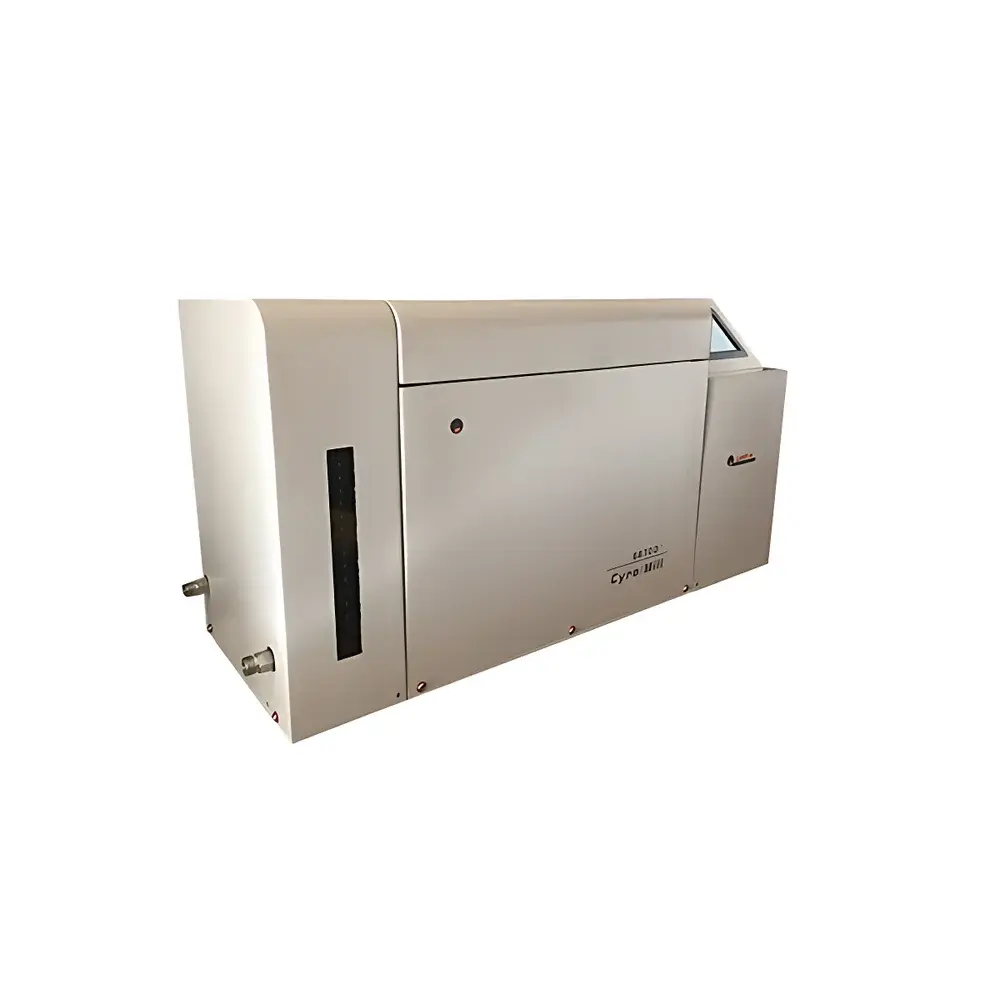
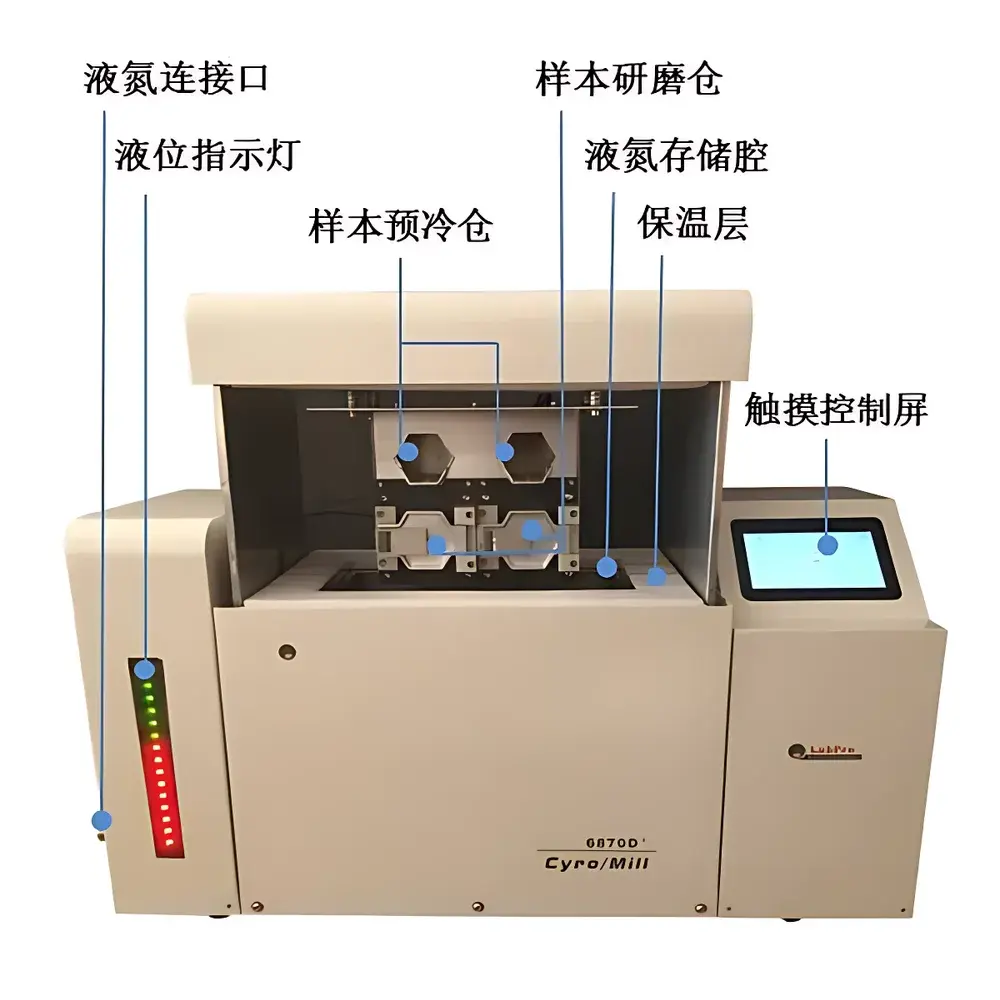
LabPre Cryo/Mill 6870D+ Ultra-Low Temperature Cryogenic Grinder
| Brand | LabPre |
|---|---|
| Origin | Beijing, China |
| Model | Cryo/Mill 6870D+ |
| Sample Type | Frozen biological & hard materials |
| Final Particle Size | <1 µm |
| Feed Size | Unrestricted |
| Batch Capacity | 2 × 180 mL (1–100 g per jar) |
| Cooling Medium | Liquid nitrogen (−196 °C) |
| Grinding Mechanism | Dual electromagnetic coil-driven steel impactors |
| Display | 7-inch color touchscreen with bilingual UI |
| Programmable Protocols | 36 user-defined methods |
| Safety Features | Integrated level sensor, auto N₂ fill/recovery, tilt shutdown (>5°), motorized sample stage lift/lower |
| Certifications | CE |
Overview
The LabPre Cryo/Mill 6870D+ is an ultra-low temperature cryogenic grinder engineered for high-fidelity, reproducible sample homogenization under controlled liquid nitrogen conditions (−196 °C). It operates on the principle of electromagnetic impact grinding: dual high-efficiency coils generate synchronized magnetic fields that accelerate stainless-steel impactors inside sealed, cryo-rated grinding jars fully immersed in liquid nitrogen. This mechanism ensures rapid, uniform mechanical fragmentation without thermal degradation—critical for preserving labile biomolecules, volatile compounds, and structural integrity in thermally sensitive matrices. Unlike ambient or chilled grinders, the Cryo/Mill 6870D+ maintains true cryogenic continuity from sample loading through final particle formation, eliminating phase transitions, recrystallization, or enzymatic activity during processing. Its architecture conforms to core requirements of ISO/IEC 17025-compliant laboratories for sample preparation traceability and method robustness.
Key Features
- Dual independent grinding chambers with concurrent dual pre-cooling zones—enabling parallel processing of two 180 mL jars (1–100 g each), eight 18 mL vials (0.5–5 g), or twenty-four 2 mL micro-tubes (0.1–0.5 g).
- Integrated liquid nitrogen management system featuring real-time level sensing via capacitive probe, automatic top-up when below threshold, and post-run N₂ recovery into external dewar—reducing consumption by up to 35% versus manual refilling.
- Motorized sample stage with programmable lift/lower function for ergonomic, glove-compatible jar handling; eliminates manual lifting force and minimizes operator exposure to cold surfaces.
- 7-inch full-color capacitive touchscreen with intuitive wizard-guided interface supporting both English and Chinese; stores up to 36 customizable protocols including pre-cool duration, impact frequency (Hz), cycle count, dwell time, and total grinding duration.
- Multi-layer safety architecture: tilt-sensitive digital inclinometer halts operation if chassis deviation exceeds ±5°; interlocked chamber door prevents actuation during active grinding; N₂ vapor concentration monitoring optional via external sensor integration.
- CE-certified design with reinforced stainless-steel frame, cryo-rated seals, and low-vibration electromagnetic drive—ensuring long-term reliability in continuous-use environments such as QC labs and core facilities.
Sample Compatibility & Compliance
The Cryo/Mill 6870D+ accommodates a broad spectrum of challenging sample types—including fibrous plant tissues, frozen animal organs, bone, dental enamel, polymer composites, elastomers, PCB substrates, pharmaceutical excipients, and cryopreserved cell pellets—without cross-contamination or thermal artifact. All grinding vessels are manufactured from certified cryo-grade stainless steel (ASTM F138) or biocompatible polymers compliant with USP Class VI and ISO 10993-5. The system supports GLP/GMP-aligned workflows: protocol parameters are timestamped and stored locally with audit trail capability; optional Ethernet or USB export enables integration with LIMS platforms. For RNA/DNA extraction applications, it meets the procedural rigor recommended in ISO 20387:2018 (Biobanking) and supports adherence to FDA 21 CFR Part 11 when paired with validated electronic signature modules.
Software & Data Management
The embedded firmware logs all operational events—including start/stop timestamps, N₂ fill cycles, jar ID (via optional RFID reader), actual impact frequency vs. setpoint deviation, and chamber temperature estimates derived from thermal decay modeling. Data exports as CSV or PDF reports compatible with analytical validation packages (e.g., JMP, Minitab). No cloud dependency: all storage resides on internal industrial-grade eMMC memory with write-protection toggle. Remote diagnostics are accessible via secure SSH tunneling (disabled by default); firmware updates require physical USB key authentication to prevent unauthorized modification—aligning with IEC 62443-3-3 cybersecurity benchmarks for laboratory instrumentation.
Applications
This instrument is routinely deployed in translational research settings where molecular integrity dictates downstream assay success: RNA-seq library prep from archived tumor biopsies; proteomic profiling of membrane protein complexes isolated via cryo-milling followed by native MS; trace metal analysis in geological samples using cryo-pulverized sub-milligram fractions; homogenization of thermolabile APIs prior to HPLC dissolution testing; and forensic fiber identification via cryo-milled textile fragments analyzed by FTIR or pyrolysis-GC/MS. In industrial QA/QC, it enables batch-consistent particle size reduction for inhalable dry powder formulations (per USP ) and validates polymer blend homogeneity prior to rheological characterization.
FAQ
What is the minimum recommended sample mass for optimal grinding efficiency?
For 180 mL jars, the lower limit is 1 g; for 2 mL tubes, it is 0.1 g. Below these thresholds, impact energy distribution becomes non-uniform, increasing coefficient of variation in final particle size distribution.
Can the system be integrated into automated sample prep lines?
Yes—RS-232 and discrete I/O ports support handshake signaling with robotic arms or carousel loaders; custom API wrappers are available under NDA for Python-based orchestration.
Is liquid nitrogen consumption monitored per run or cumulatively?
Both: real-time level tracking is displayed during operation, while cumulative N₂ usage (L) is logged per protocol execution and exported with session reports.
How is cross-contamination prevented between runs?
Each jar is single-use per protocol; the system enforces mandatory cleaning verification via UV-C irradiation log (optional accessory) or barcode-scanned disposable liner confirmation before initiating next sequence.
Does the instrument comply with explosion-proof requirements for volatile organic samples?
While not intrinsically rated for Zone 0/1, its fully enclosed grinding chamber and N₂-purged headspace meet ATEX Category 3G requirements when operated within ventilated fume hoods certified for Class I, Division 2 environments.



