
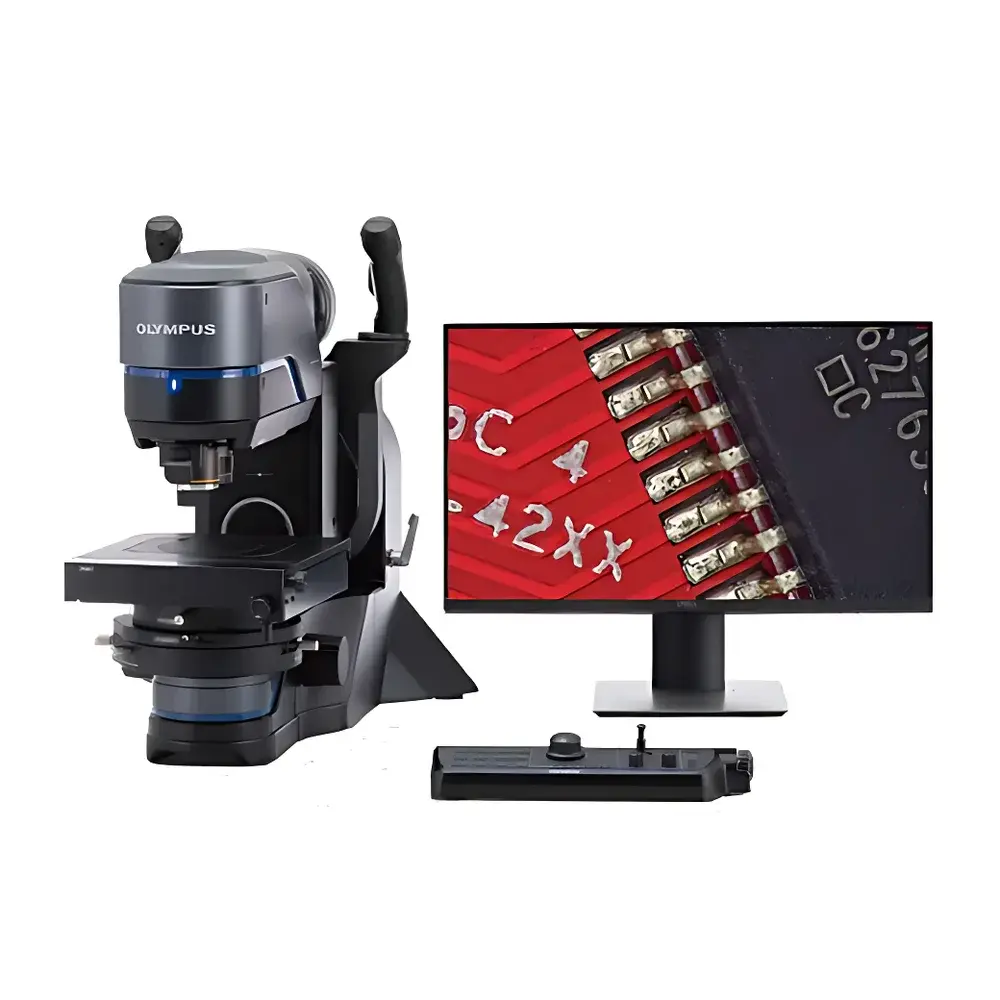
Olympus DSX1000 Digital Microscope
| Brand | Olympus |
|---|---|
| Origin | Japan |
| Model | DSX1000 |
| Magnification Range | 20–7,000× |
| Objective Lenses | 15 (including 5 newly added) |
| Observation Methods | Brightfield, Darkfield, MIX, Polarized Light, Simplified Polarization, Differential Interference Contrast (DIC) |
| Head & Stage Tilt Range | ±90° independently |
| Optical System | Telecentric |
| 3D Imaging Speed | Up to 10× faster than previous Olympus digital microscopes |
| Working Distance | Long-working-distance objectives optimized for irregular, tall, or reflective samples |
| Compliance | Designed for ISO/IEC 17025-compliant laboratories |
Overview
The Olympus DSX1000 Digital Microscope is an engineered solution for high-precision industrial inspection, failure analysis, and quality assurance in electronics, automotive, semiconductor, and precision manufacturing environments. Unlike conventional optical microscopes, the DSX1000 integrates a fully motorized telecentric optical path with a modular objective turret and programmable illumination architecture—enabling consistent, distortion-free imaging across its full 20–7,000× magnification range. Its core measurement integrity derives from telecentric optics, which eliminate perspective error by maintaining constant magnification regardless of focus position—a critical requirement for traceable dimensional metrology in regulated production settings. The system captures calibrated 2D and 3D surface topography without mechanical stage scanning, leveraging high-speed z-stack acquisition and proprietary surface reconstruction algorithms. Designed for walk-up usability, it eliminates reliance on eyepieces or manual alignment, delivering repeatable results across operator skill levels.
Key Features
- 15-objective modular turret—including five newly developed long-working-distance (LWD) objectives—enables seamless coverage from macro-scale component inspection (20×) to sub-micron feature resolution (7,000×), with working distances up to 40 mm for unobstructed access to PCBs, machined parts, and wafer edge profiles.
- Six integrated observation modes: Brightfield, Darkfield, MIX (simultaneous BF/DF blending), Polarized Light, Simplified Polarization, and Differential Interference Contrast (DIC)—each optimized for specific material responses, such as stress-induced birefringence in glass substrates or surface relief contrast in etched silicon.
- Independent ±90° tilt capability for both microscope head and motorized XY stage—facilitating oblique-angle imaging of steep sidewalls, through-holes, solder joints, and curved automotive components without repositioning the sample.
- Telecentric optical architecture ensures pixel-level geometric fidelity across all magnifications, supporting NIST-traceable length measurements compliant with ISO 10360 and ASTM E2817 standards for optical coordinate measuring systems.
- Accelerated 3D surface reconstruction—achieved via optimized z-stack acquisition and GPU-accelerated rendering—reduces time-to-3D from minutes to seconds compared to prior-generation Olympus digital microscopes, improving throughput in high-volume QA/QC labs.
Sample Compatibility & Compliance
The DSX1000 accommodates diverse sample geometries—from 200-mm semiconductor wafers and multi-layer flexible circuits to cast engine blocks and medical device housings—without requiring vacuum chambers, conductive coating, or complex fixturing. Its LWD objectives and tilting mechanics support non-contact inspection of highly reflective, transparent, or topographically complex surfaces. The system complies with ISO/IEC 17025 requirements for test equipment validation and includes built-in calibration verification routines. Measurement data logs include timestamped metadata, user ID, instrument configuration, and environmental parameters—supporting FDA 21 CFR Part 11 compliance when deployed with validated software configurations and electronic signature protocols.
Software & Data Management
Olympus DSX1000 operates with the DSX-SW application software, a Windows-based platform supporting automated report generation (PDF/CSV), multi-user permission tiers, and configurable measurement templates aligned with internal SOPs or industry standards (e.g., IPC-A-610, JIS Z 8103). All image and measurement datasets are stored with embedded calibration certificates and audit trails, enabling full traceability from raw acquisition to final certification. Software modules support statistical process control (SPC) export, GD&T annotation, and cross-platform compatibility with Metrology Data Management Systems (MDMS) via standardized APIs.
Applications
- Semiconductor: Wafer defect mapping, bond pad inspection, lithography residue analysis, and trench depth profiling using DIC-enhanced contrast.
- Electronics Manufacturing: Solder joint void detection, BGA coplanarity assessment, flex circuit trace continuity verification, and conformal coating thickness estimation.
- Automotive: Surface finish evaluation of cylinder bores, wear scar analysis on transmission gears, and adhesive bond line inspection on composite assemblies.
- Precision Engineering: Tool wear monitoring, micro-machined feature verification, and surface roughness parameter extraction (Sa, Sq, Sz) per ISO 25178.
- Research & Development: Rapid comparative morphology studies of thin-film coatings, corrosion propagation tracking, and failure root cause correlation across multiple imaging modalities.
FAQ
Does the DSX1000 require routine recalibration?
Yes—Olympus recommends annual calibration by certified service engineers, with optional on-site verification following installation or relocation to ensure continued metrological traceability.
Can measurement data be exported to external statistical analysis tools?
Yes—CSV and XML exports include raw pixel coordinates, calibrated dimensions, and metadata required for integration with Minitab, JMP, or custom Python-based SPC pipelines.
Is the DSX1000 compatible with cleanroom environments?
The system meets ISO Class 5 (Class 100) particulate limits when operated with optional laminar flow enclosures and static-dissipative stage accessories.
What level of training is required for first-time operators?
Basic operation requires under 30 minutes of guided orientation; advanced metrology and multi-modal analysis workflows are supported by context-sensitive help and role-based software wizards.
How is focus stability maintained during extended 3D acquisitions?
The system employs active focus drift compensation using real-time Z-sensor feedback, ensuring sub-micron axial repeatability over acquisition durations exceeding 10 minutes.





