
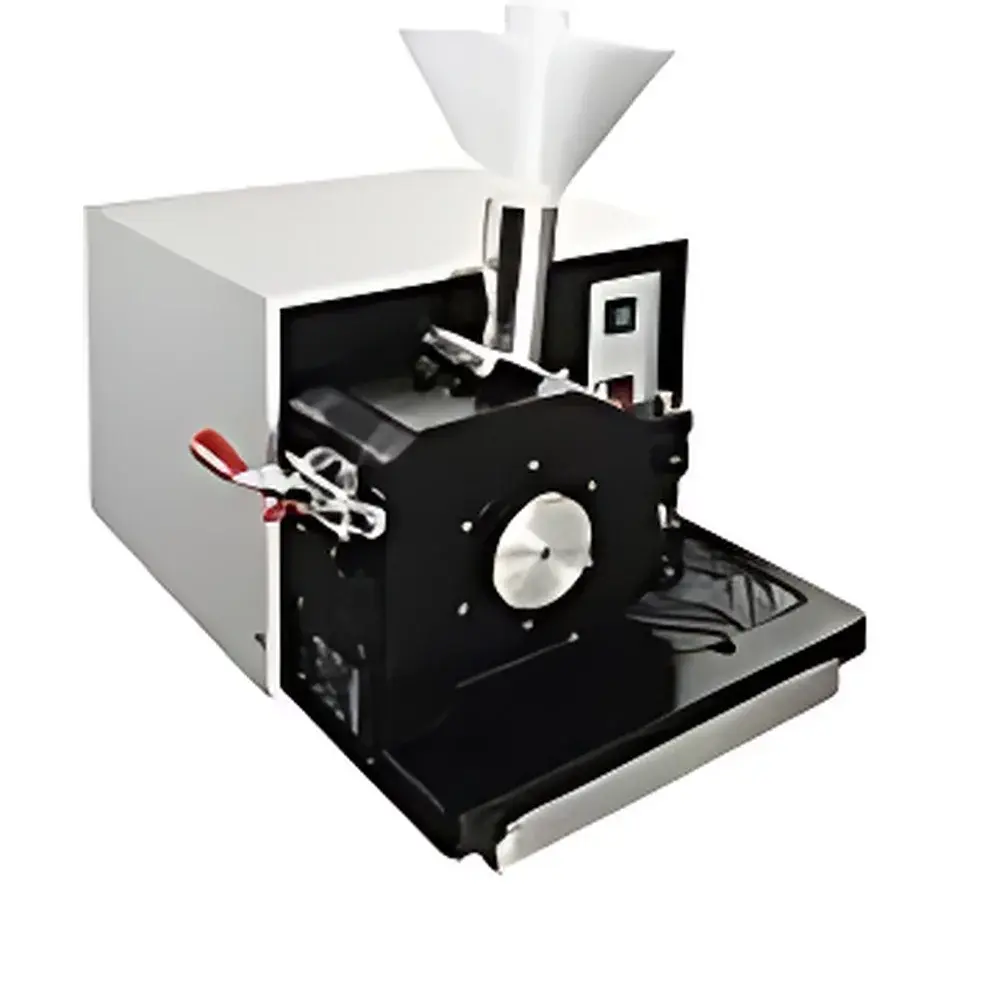
FRITSCH PULVERISETTE 19 Universal Cutting Mill
| Brand | FRITSCH |
|---|---|
| Origin | Germany |
| Model | PULVERISETTE 19 |
| Max. Feed Size | 70 × 80 mm |
| Throughput | up to 60 L/h |
| Final Particle Size | 0.25 – 6.00 mm |
| Rotor Speed | 2800 rpm |
| Net Weight | 56 kg |
| Gross Weight | 96 kg |
| Dimensions (W×D×H) | 45 × 55 × 63 cm |
| Material Contact Parts | RoHS-compliant stainless steel (Cr-free) |
| Dust Extraction Interface | Yes |
Overview
The FRITSCH PULVERISETTE 19 Universal Cutting Mill is a high-performance, laboratory-scale comminution instrument engineered for reproducible size reduction of heterogeneous, multi-material samples—particularly those governed by RoHS compliance requirements. Unlike impact or jaw-based mills, the PULVERISETTE 19 employs a precision-engineered cutting principle: a dynamically balanced rotor equipped with geometrically optimized, Cr-free stainless-steel cutting knives rotates at a constant 2800 rpm, shearing bulk material against fixed counter-blades and a perforated sieve. This shear-dominated mechanism ensures minimal thermal load, low contamination risk, and consistent particle size distribution across complex feedstocks—including printed circuit boards (PCBs), mixed electronic waste, polymer composites, leather, rubber, fibrous biomass, and brittle pharmaceutical solids. Its design aligns with the mechanical preprocessing needs of environmental analysis (e.g., EN 14385, IEC 62321-3-1), regulatory screening (RoHS, WEEE), and preparatory steps for subsequent elemental analysis (ICP-OES, XRF) or thermal testing (TGA, DSC).
Key Features
- RoHS-compliant construction: All wetted parts—including rotor knives, stationary blades, and sieve inserts—are manufactured from chromium-free stainless steel to eliminate heavy metal leaching during grinding.
- Modular cutting geometry: Interchangeable knife sets with variable edge angles (e.g., straight, serrated, beveled) enable optimization for ductile metals, elastomers, laminates, or fibrous organics.
- Controlled particle size output: Adjustable sieve aperture (0.25–6.00 mm) allows precise definition of final granulometry; optional fine-grinding kits extend lower limit to 0.1 mm.
- Integrated dust management: Standardized 100 mm vacuum port enables direct connection to industrial-grade extraction systems, maintaining sample temperature below 40 °C during prolonged operation and minimizing airborne particulate exposure.
- Tool-free maintenance architecture: Quick-release clamping system permits full disassembly of grinding chamber in under 90 seconds; surface-treated components resist adhesion and support aqueous or solvent-based cleaning per GLP protocols.
- Robust drive system: Brushless AC motor with electronic speed stabilization ensures torque consistency across variable load conditions—critical when processing layered PCBs or reinforced polymers.
Sample Compatibility & Compliance
The PULVERISETTE 19 accepts feed materials up to 70 × 80 mm in dimension and delivers throughput rates up to 60 L/h—making it suitable for batch preparation of representative subsamples from heterogeneous waste streams. Verified compatibility includes: halogenated and non-halogenated plastics (ABS, PVC, polyamide), soldered PCB assemblies, lithium-ion and NiCd battery casings, copper/aluminum cables, vulcanized rubber, tanned leather, cereal grains, dried botanicals, animal feed pellets, calcined bone, and pharmaceutical tablets. It conforms to ISO 17025:2017 requirements for sample homogenization prior to accredited testing. For regulated environments, its Cr-free material contact surfaces satisfy EU Directive 2011/65/EU (RoHS 2) Annex II restrictions on hexavalent chromium, lead, cadmium, mercury, PBB, and PBDE. Optional documentation packages include Factory Calibration Certificates traceable to DKD/DAkkS standards.
Software & Data Management
While the PULVERISETTE 19 operates as a standalone mechanical unit without embedded microprocessor control, it integrates seamlessly into digital lab workflows via external monitoring. Its standardized electrical interface (230 V / 50 Hz / 2.2 kW) supports integration with programmable logic controllers (PLCs) or Lab Information Management Systems (LIMS) through dry-contact relay outputs for run-status signaling. Optional FRITSCH Digital Logbook modules record operational timestamps, total runtime, and sieve change history—supporting audit trails required under FDA 21 CFR Part 11 for GMP-compliant pharmaceutical preprocessing. All maintenance logs, calibration records, and material compatibility matrices are provided in English-language PDF format compliant with ISO/IEC 17025 clause 7.6.
Applications
- Environmental laboratories: Homogenization of WEEE fractions prior to heavy metal screening (Pb, Cd, Hg, Cr⁶⁺) per IEC 62321-3-1.
- Electronics recycling R&D: Size reduction of mixed e-waste for density separation, pyrometallurgical feedstock conditioning, or leaching assay preparation.
- Pharmaceutical QA/QC: Controlled milling of coated tablets and excipient blends for content uniformity testing (USP <905>).
- Agricultural research: Grinding of feedstuffs, grain kernels, and forage samples for proximate analysis (AOAC 967.21, 971.21).
- Materials science: Preprocessing of composite laminates and thermoset resins for SEM-EDS cross-section analysis.
- Veterinary diagnostics: Pulverization of calcified tissues (hooves, antlers, teeth) for mineral profiling via ICP-MS.
FAQ
Is the PULVERISETTE 19 suitable for cryogenic grinding?
No—this mill is designed for ambient-temperature operation only. Cryogenic applications require liquid nitrogen-cooled impact mills (e.g., FRITSCH PULVERISETTE 14).
Can it process wet or oily samples?
No. The instrument is rated for dry, free-flowing, or slightly hygroscopic materials only. High-moisture or viscous feeds risk clogging the sieve and unbalancing the rotor.
What safety certifications does it hold?
It carries CE marking per Machinery Directive 2006/42/EC, EMC Directive 2014/30/EU, and RoHS 2 Directive 2011/65/EU. Full Declaration of Conformity is supplied with each unit.
How often must the cutting knives be replaced?
Under typical RoHS sample loads, knife service life exceeds 500 operating hours; wear is monitored via visual inspection of edge geometry and measured throughput decline (>15% reduction indicates replacement).
Is remote diagnostic support available?
Yes—FRITSCH’s global service network provides video-assisted troubleshooting and on-site technician dispatch within 72 hours in EEA and North America regions.



