
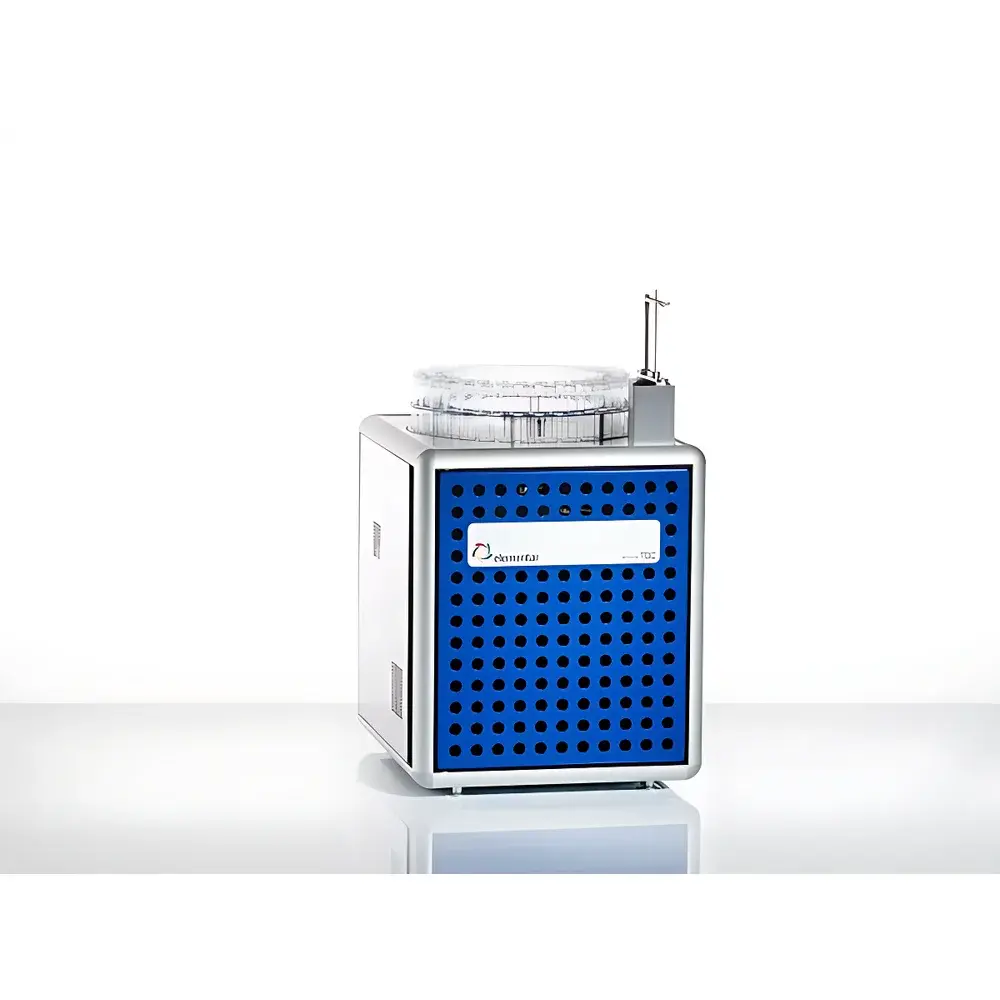
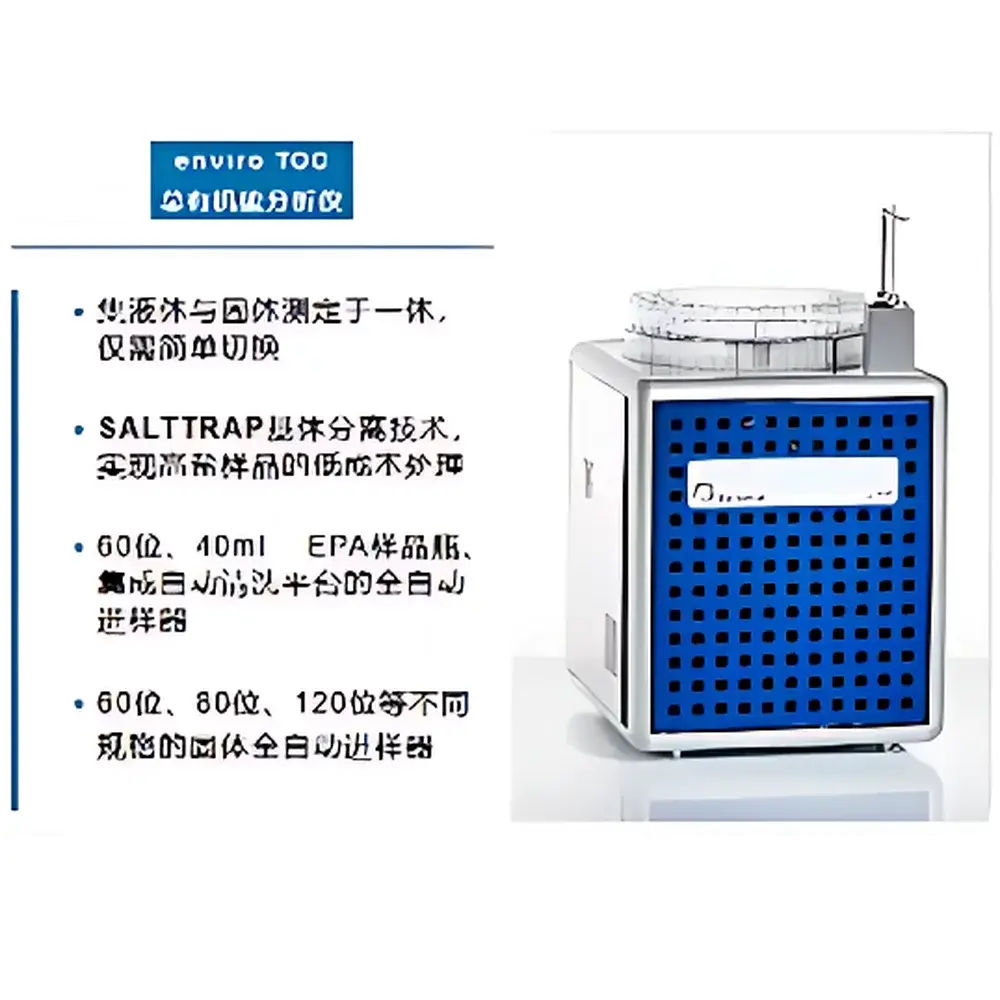
Elementar enviro TOC Total Organic Carbon Analyzer
| Brand | Elementar |
|---|---|
| Origin | Germany |
| Model | enviro TOC |
| Instrument Type | Laboratory TOC Analyzer |
| Detection Principle | Non-Dispersive Infrared (NDIR) Absorption |
| Oxidation Method | High-Temperature Catalytic Combustion |
| Measurement Range | 0–100,000 ppm C |
| Accuracy | ±3% of reading |
| Resolution | 0.001 ppb C |
| Detection Limit | 0.005 ppm C |
| Repeatability | ≤1% RSD |
| Sample Throughput | Up to 60 samples unattended |
| Solid & Liquid Sample Capability | Yes, fully automated without hardware modification |
| TNb Detection Option | Electrochemical (EC) cell or integrated Chemiluminescence Detector (CLD) |
| Compliance | Designed for ASTM D7573, ISO 8245, USP <643>, EN 1484, and EPA Method 415.3 |
Overview
The Elementar enviro TOC is a high-performance, laboratory-grade total organic carbon (TOC) analyzer engineered for rigorous environmental water and solid waste analysis. It employs high-temperature catalytic combustion (typically at 900 °C) to quantitatively oxidize all organic carbon species in aqueous or solid matrices to CO₂, followed by precise detection using a thermally stabilized, wide-dynamic-range non-dispersive infrared (NDIR) detector. This fundamental measurement architecture ensures trace-level sensitivity, broad linear dynamic range, and robustness against matrix interferences—critical requirements for regulatory-compliant analysis of complex environmental samples such as wastewater, surface water, groundwater, soils, and municipal sludge. Unlike UV-persulfate or wet chemical oxidation systems, the catalytic combustion approach delivers complete oxidation of refractory and particulate-bound carbon, minimizing underestimation bias and supporting accurate determination of TC (total carbon), IC (inorganic carbon), TOC (total organic carbon), NPOC (non-purgeable organic carbon), DOC (dissolved organic carbon), POC (particulate organic carbon), and TNb (total bound nitrogen). The instrument’s dual-mode capability—supporting both liquid injection and direct solid sample combustion—enables seamless method switching without mechanical reconfiguration.
Key Features
- High-temperature catalytic combustion furnace (up to 900 °C) with platinum catalyst for complete oxidation of recalcitrant organics and suspended solids
- SALTTRAP® matrix separation technology to eliminate chloride and salt interference during NDIR detection, ensuring stable baseline and long-term detector integrity
- Integrated 60-position autosampler with programmable rinse cycles and intelligent carryover mitigation for high-throughput routine operation
- Dual detection pathways: NDIR for carbon quantification and optional integrated chemiluminescence detector (CLD) for simultaneous TNb analysis—no external gas handling or dedicated CLD bench space required
- Automated solid-sample analysis mode: direct combustion of soils, sediments, and solid waste without hardware modification or manual pretreatment
- Robust thermal management and pressure-compensated flow control to maintain analytical precision across variable ambient conditions
- Self-diagnostic routines, real-time system status monitoring, and event-logged maintenance alerts aligned with GLP/GMP operational expectations
Sample Compatibility & Compliance
The enviro TOC is validated for use with diverse environmental matrices including raw and treated wastewater, drinking water, surface and groundwater, leachates, soil extracts, and homogenized solid waste. Its ability to handle high-salinity, high-suspended-solid, and high-nitrate samples—without dilution or filtration—derives from SALTTRAP®-enabled matrix separation and optimized combustion kinetics. The system meets or exceeds performance criteria specified in key international standards: ASTM D7573 (standard test method for TOC in water), ISO 8245 (water quality — determination of organic carbon), EN 1484 (water analysis — guidelines for TOC determination), USP (pharmaceutical water testing), and EPA Method 415.3 (determination of TOC in drinking water). Full audit trail functionality, electronic signature support, and configurable user access levels comply with FDA 21 CFR Part 11 requirements for regulated laboratories.
Software & Data Management
Control and data acquisition are managed via Elementar’s proprietary TOC-Control software, a Windows-based platform featuring intuitive workflow configuration, method library management, and automated report generation. All analytical parameters—including oxidation temperature, carrier gas flow, acid addition volume, purge duration, and calibration curve settings—are stored with full versioning and timestamped metadata. Raw detector signals, intermediate calculations (e.g., IC subtraction, blank correction), and final result exports (CSV, PDF, XML) are retained with immutable audit trails. The software supports LIMS integration via ASTM E1384-compliant export protocols and includes built-in validation tools for IQ/OQ/PQ documentation. Calibration verification checks, system suitability tests (SST), and drift monitoring reports are generated automatically per run or on schedule.
Applications
- Regulatory compliance monitoring of wastewater treatment plant effluent and influent for TOC discharge limits
- Source water assessment and watershed organic load tracking in surface and groundwater networks
- Leachate characterization from landfills and contaminated sites
- Soil carbon sequestration studies and solid waste organic content screening (e.g., compost maturity evaluation)
- Pharmaceutical water system validation per USP and EU GMP Annex 1
- Research into carbon cycling, biodegradability, and nutrient co-limitation in aquatic ecosystems via concurrent TOC/TNb profiling
FAQ
Does the enviro TOC require separate instruments for TOC and TNb analysis?
No—the system supports simultaneous TOC and TNb quantification using either an electrochemical (EC) cell or the integrated chemiluminescence detector (CLD), eliminating the need for parallel instrumentation.
Can it analyze undiluted seawater or brine samples?
Yes—SALTTRAP® technology actively removes chloride interference prior to NDIR detection, enabling direct analysis of high-salinity samples without pre-dilution.
Is solid sample analysis truly plug-and-play?
Yes—solid samples (soils, sediments, sludges) are loaded into quartz boats and introduced directly into the combustion zone; no hardware adaptation or accessory kits are required.
What is the typical calibration frequency for routine environmental monitoring?
Calibration verification is recommended before each analytical batch; full multi-point calibration is typically performed daily or per 24-hour operation, depending on regulatory protocol and sample load.
How does the system ensure data integrity for audited environments?
All user actions, method changes, calibration events, and result calculations are time-stamped, digitally signed where enabled, and retained in an encrypted, non-editable audit trail compliant with 21 CFR Part 11 and ISO/IEC 17025 requirements.







