
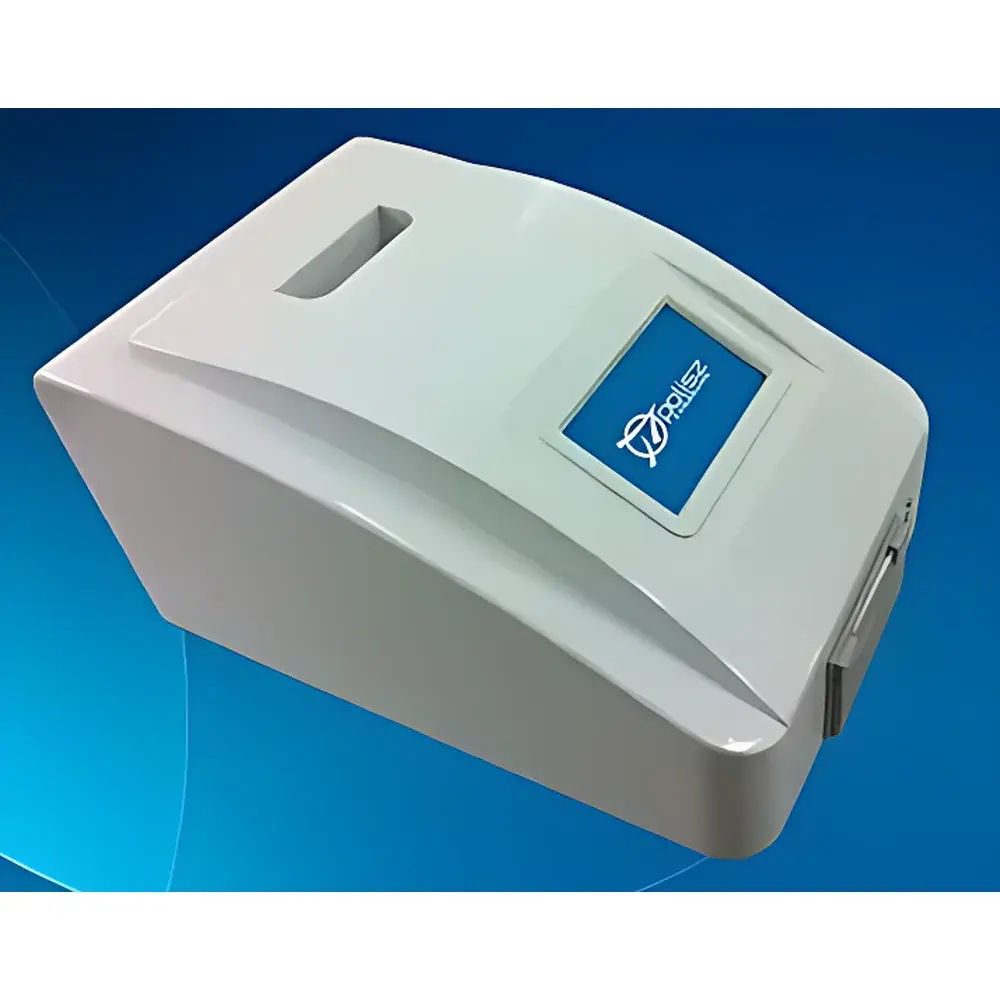
North Guang Precision Instrument BC-31 Portable Total Organic Carbon Analyzer
| Brand | North Guang Precision Instrument |
|---|---|
| Origin | Beijing, China |
| Manufacturer Type | Manufacturer |
| Product Category | Domestic |
| Model | BC-31 |
| Price Range | USD 1,400 – 7,000 (approx.) |
| Instrument Type | Portable TOC Analyzer |
| Detection Principle | Direct Conductivity Method |
| Oxidation Method | UV/Persulfate Oxidation |
| Measurement Range | 0–50,000 ppm (as C) |
| Accuracy | ±3% |
| Resolution | 0.001 ppm |
| Detection Limit | 0.05 ppm |
| Repeatability | ≤3% |
Overview
The North Guang Precision Instrument BC-31 Portable Total Organic Carbon (TOC) Analyzer is an engineered solution for rapid, field-deployable quantification of organic carbon content in ultrapure and process water streams. It operates on the fundamental principle of differential conductivity measurement following complete oxidation of organic carbon to CO₂. The instrument implements a dual-measurement protocol: first measuring inorganic carbon (TIC) in the native sample, then oxidizing all organic carbon using combined UV irradiation (185/254 nm) and persulfate chemistry under controlled acidic conditions, followed by measurement of total carbon (TC). TOC is derived arithmetically as TC − TIC. This methodology aligns with established regulatory frameworks for pharmaceutical water quality control, including USP , EP 2.2.44, and JP 2.09, and satisfies the analytical requirements specified in the Chinese Pharmacopoeia (2020 Edition, General Chapter 0682). Designed for operation in cleanroom-adjacent environments and mobile laboratory applications, the BC-31 delivers trace-level sensitivity without reliance on carrier gases, high-pressure components, or consumable reagents—ensuring operational simplicity and long-term stability.
Key Features
- True portable architecture: Compact footprint (W × D × H ≈ 320 × 280 × 180 mm), integrated battery option (optional), and ergonomic carry handle enable direct sampling at point-of-use locations—including water distribution loops, purification skids, and filling lines.
- UV/persulfate oxidation system with real-time reaction monitoring ensures >95% oxidation efficiency across diverse organic matrices (e.g., acetates, alcohols, amino acids, low-MW surfactants) within ≤6 minutes per analysis cycle.
- High-stability dual-conductivity cell with temperature-compensated electronics provides resolution down to 0.001 ppm and detection limit of 0.05 ppm, validated per ASTM D5905-22 guidelines.
- Embedded Linux-based control system with 7-inch capacitive color touchscreen supports intuitive navigation, multilingual UI (English/Chinese selectable), and context-sensitive help overlays.
- No moving parts in fluidic path: Solid-state peristaltic-free design eliminates pump wear, reduces calibration drift, and extends mean time between maintenance (MTBM) beyond 12 months under routine use.
- Integrated alarm logic with configurable threshold triggers (pre-set or user-defined) enables automatic relay output (dry contact, 24 VDC) for integration into facility SCADA or PLC systems during out-of-specification events.
- Fully compliant with IQ/OQ/PQ documentation templates aligned to GMP Annex 15 and FDA 21 CFR Part 11 requirements for electronic records and signatures.
Sample Compatibility & Compliance
The BC-31 is validated for aqueous samples with conductivity <10.0 µS/cm and TOC concentrations up to 1.0 ppm in primary pharmaceutical applications (PW, WFI, Purified Water per USP/EP/ChP). It accommodates sample temperatures from 1°C to 90°C and tolerates particulate loadings ≤5 µm without inline filtration. For higher-conductivity or high-TIC matrices (e.g., wastewater effluents, seawater dilutions), optional external dilution module (BC-DIL-1) is available. Regulatory alignment includes compliance with ISO 8573-1 (compressed air TOC), ASTM D7573-22 (TOC in reclaimed water), and environmental monitoring protocols under EPA Method 415.3. All firmware and calibration routines are traceable to NIST-traceable sucrose and sodium bicarbonate standards.
Software & Data Management
Data acquisition, storage, and reporting are managed via the BC-31’s onboard SecureLog™ firmware. Up to 10,000 test records—including raw conductivity values, oxidation kinetics curves, operator ID, timestamp, and environmental metadata (sample temp, ambient humidity)—are retained with audit trail functionality. Export options include CSV (via USB 2.0 port) and encrypted PDF reports with digital signature fields. Optional BC-Link PC software enables remote configuration, trend analysis (Shewhart X-bar/R charts), and automated report generation compliant with ALCOA+ principles (Attributable, Legible, Contemporaneous, Original, Accurate, Complete, Consistent, Enduring, Available).
Applications
- Pharmaceutical manufacturing: Real-time verification of PW/WFI system integrity, cleaning validation (swab/rinse water TOC), and bioburden correlation studies.
- Microelectronics: Monitoring rinse water purity in semiconductor wafer fabrication (SEMI F57-0218 compliance).
- Power generation: Feedwater and condensate TOC surveillance in ultra-supercritical boiler systems per ASTM D4582.
- Environmental laboratories: Field screening of surface water, groundwater, and treated effluent per ISO 8245 and EN 1484.
- Food & beverage: Validation of CIP cycle efficacy and final rinse water quality in dairy and beverage production lines.
FAQ
Does the BC-31 require carrier gas or chemical reagents for routine operation?
No. It operates exclusively on UV/persulfate oxidation without compressed air, oxygen, or acid/base reagent delivery systems.
Can the BC-31 be used for online continuous monitoring?
It is designed for grab-sample and semi-continuous (interval-based) analysis; for true 24/7 online deployment, integration with a certified sample interface module (e.g., BC-ONLINE-Kit) is required.
Is the instrument suitable for high-salinity or seawater-diluted samples?
Not without pre-treatment: conductivity must remain below 10.0 µS/cm; high-TIC matrices require dilution or offline IC removal prior to analysis.
What calibration standards are recommended?
NIST-traceable 1,000 mg/L sucrose (for TOC) and 1,000 mg/L NaHCO₃ (for TIC), both prepared in 18.2 MΩ·cm ultrapure water per USP procedures.
How is data integrity ensured for regulated environments?
Firmware enforces role-based access control, electronic signature capture, immutable audit trails, and export encryption—all documented in the included 21 CFR Part 11 readiness package.







