
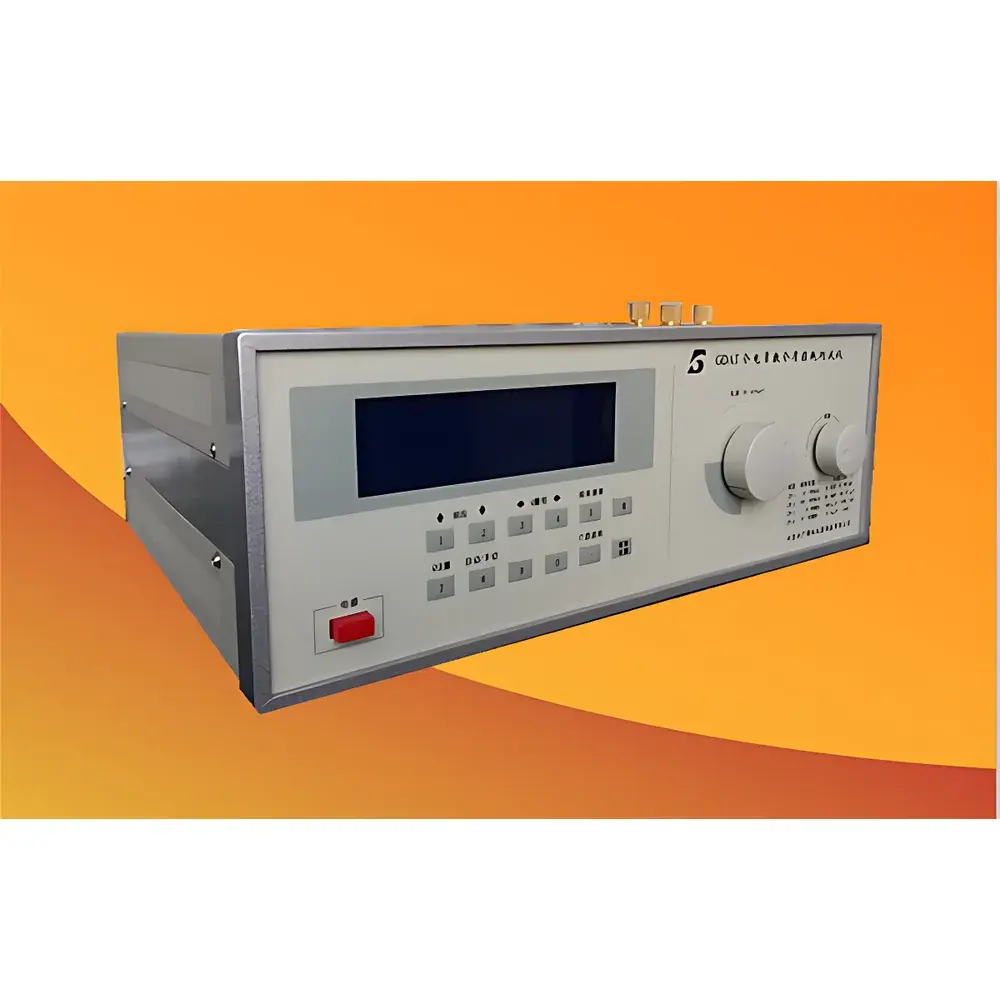
Beiguang Jingyi BQS-37A High-Voltage Schering Bridge
| Brand | Beiguang Jingyi / All Precision Instrument |
|---|---|
| Origin | Beijing, China |
| Manufacturer Type | Manufacturer |
| Country of Origin | China |
| Model | BQS-37A |
| Price | USD 4,500 (approx.) |
Overview
The Beiguang Jingyi BQS-37A High-Voltage Schering Bridge is a precision AC impedance measurement instrument engineered for the accurate determination of dielectric loss tangent (tan δ) and relative permittivity (εr) of solid and liquid insulating materials under high-voltage AC excitation. Based on the classical Schering bridge topology—widely adopted in high-voltage dielectrics testing per IEC 60270, ASTM D150, and GB/T 1409—the instrument operates at a nominal frequency of 50 Hz and supports test voltages up to 2.5 kV (rms) via its integrated digital high-voltage source. The bridge employs a dual-shielded, guarded construction with active potential tracking to suppress stray capacitance and electromagnetic interference, ensuring stable null detection and metrological traceability in industrial QC labs and power equipment R&D environments. Its design complies with fundamental requirements for high-voltage dielectric characterization in accordance with GB/T 5654 (liquid insulating oils) and GB/T 1409 (solid insulating materials), supporting both routine quality verification and long-term aging studies.
Key Features
- Integrated 0–2500 V rms digitally regulated high-voltage source with ±3% output accuracy and built-in overcurrent protection.
- Internal 100 pF reference capacitor with dissipation factor < 5×10⁻⁵, thermally aged for long-term stability and low drift.
- Dual-layer electrostatic shielding (outer guard + inner S-shield) coupled with automatic potential tracking circuitry to eliminate parasitic coupling effects.
- High-stability decade resistance (10×[1 kΩ + 100 Ω + 10 Ω + 1 Ω + 0.1 Ω]) and capacitance (10×[0.1 µF + 0.01 µF + 0.001 µF + 0.0001 µF]) arms with gold-plated contacts and extended mechanical life.
- Null detector featuring analog galvanometer with voltage sensitivity ≥1×10⁻⁶ V/div and current sensitivity ≥2×10⁻⁹ A/div; harmonic rejection >25 dB (2nd) and >50 dB (3rd).
- Optimized bridge balance algorithm enabling simultaneous adjustment of R3 (resistive arm) and C4 (capacitive arm) for direct readout of Cx and tan δ without iterative computation.
Sample Compatibility & Compliance
The BQS-37A accommodates a broad range of insulating specimens—including transformer oil, epoxy resin, polyethylene films, ceramic substrates, and impregnated paper—when paired with standardized test electrodes (e.g., three-terminal electrode systems per IEC 60243-1). Measurement validity is maintained within ambient conditions of 20±5°C and 30–80% RH. The instrument meets essential electrical safety requirements per GB 4793.1 (IEC 61010-1) and supports audit-ready documentation workflows compliant with GLP and ISO/IEC 17025. While not inherently 21 CFR Part 11–certified, its manual data recording architecture aligns with laboratory SOPs requiring handwritten logs, calibration certificates, and raw balance-point annotations.
Software & Data Management
The BQS-37A is a fully manual, analog-null instrument with no embedded firmware or digital interface. All measurements are recorded manually using calibrated dials and visual null indication. This architecture ensures immunity to electromagnetic compatibility (EMC) disturbances common in high-voltage test bays and eliminates software validation overhead. Users maintain full control over uncertainty propagation by applying standard correction formulas—for instance, frequency compensation for non-50 Hz operation: tan δactual = (f′/f) × tan δmeasured. Traceable calibration is supported through periodic verification against NIST-traceable reference capacitors and certified high-voltage dividers.
Applications
- Quality control of transformer insulation oils per ASTM D924 and IEC 60429.
- Evaluation of dielectric aging in polymer-based cable insulation and bushing materials.
- Research-grade permittivity mapping of composite laminates used in high-voltage DC (HVDC) applications.
- Verification of vacuum impregnation efficacy in rotating machine windings.
- Supporting failure analysis in power capacitor manufacturing per IEC 60831.
- Teaching laboratories for undergraduate and graduate-level courses in dielectrics and high-voltage engineering.
FAQ
What is the maximum recommended test voltage for the BQS-37A?
The bridge is rated for continuous operation at up to 2.5 kV rms across terminals A and B relative to ground. Voltage application must be ramped gradually to avoid transient overvoltage stress on the specimen.
Can external standard capacitors be used with this bridge?
Yes—the instrument includes dedicated terminals for external reference capacitors and provides auxiliary balancing circuitry to accommodate non-100 pF standards, subject to user-provided calibration documentation.
Is the BQS-37A suitable for measuring low-loss materials (tan δ < 0.001)?
Within its specified range (0–0.1 at R4 = 318.3 Ω), the bridge achieves ±1.5% tan δx ± 0.0001 absolute accuracy, making it appropriate for evaluating high-purity insulators such as fused quartz or sapphire substrates.
How does the automatic potential tracking system improve measurement reliability?
By maintaining equipotential conditions between bridge nodes A, B, and inner shield S, the tracking circuit minimizes leakage currents and stray coupling—critical when measuring high-impedance samples or in electromagnetically noisy environments.
Does the instrument require periodic recalibration?
Yes—annual calibration against traceable references is recommended. Key parameters to verify include high-voltage source linearity, standard capacitor value/dissipation, and null detector sensitivity per manufacturer’s technical bulletin BGJY-BQS37A-CAL-2023.



