
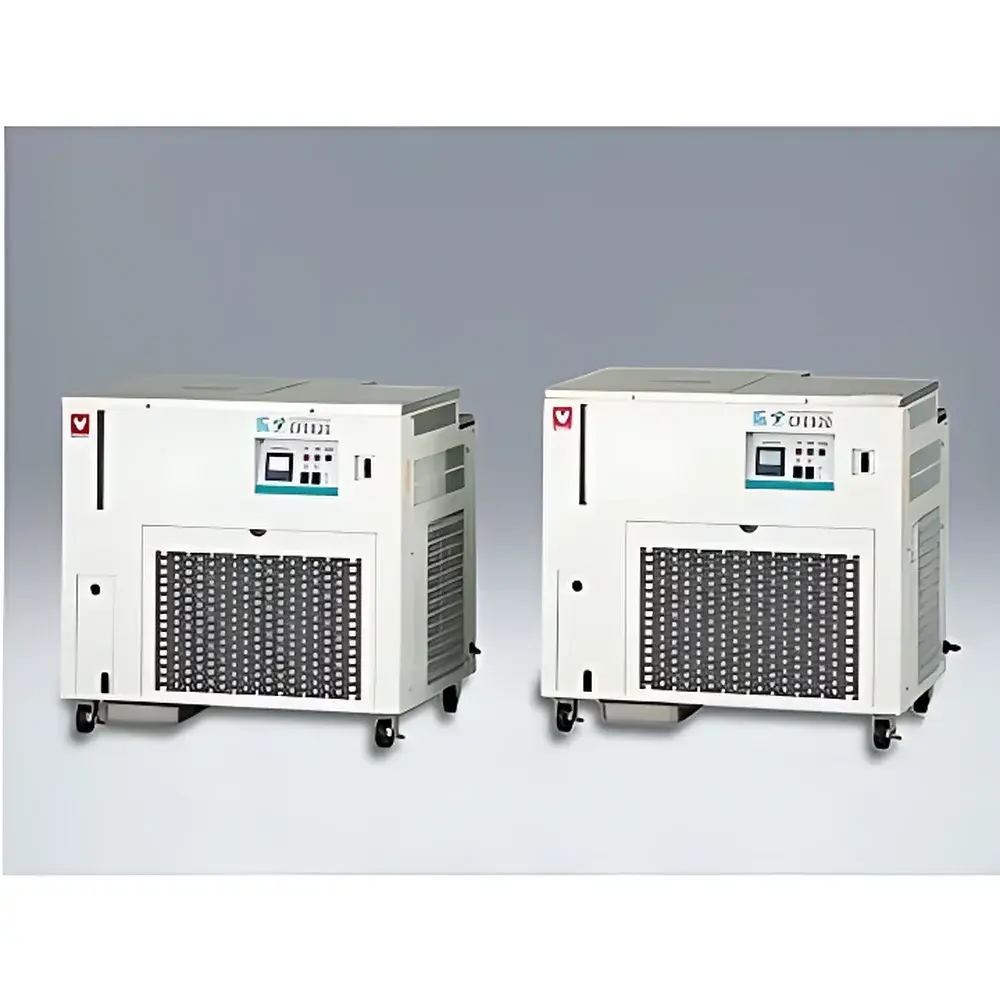
Yamato CFE820/CFE920 Variable-Frequency Controlled Circulating Chiller
| Brand | Yamato |
|---|---|
| Origin | USA |
| Model | CFE820 / CFE920 |
| Cooling Capacity | 730 W @ –10°C (CFE820), 270 W @ –20°C (CFE920) |
| Temperature Range | –20°C to +20°C |
| Temp. Stability | ±0.5°C |
| Pump Type | Magnetic Drive Circulation Pump |
| Max. Flow Rate | 14.7 L/min (60 Hz, combined dual-circuit for CFE920) |
| Max. Head | 13.6 m |
| Reservoir Volume | 14 L (13 L usable) |
| Refrigerant | R407C |
| Power Supply | AC 100 V, 15 A |
| Dimensions (W×D×H) | 620 × 440 × 600 mm |
| Weight | 65 kg |
| Safety Protections | Overcurrent/RCD, Compressor Overload Relay, High-Pressure Cut-off, Pump Thermal Protector, Inverter Overload Protection, Bypass Circuit for Pump Protection |
| Compliance | Designed for GLP-compliant laboratory environments |
Overview
The Yamato CFE820 and CFE920 are high-performance, variable-frequency controlled circulating chillers engineered for stable, precise thermal management of externally connected analytical, process, and research equipment. These units operate on a closed-loop refrigeration principle—utilizing a hermetically sealed, air-cooled compressor system with R407C refrigerant—and integrate frequency-modulated compressor control to dynamically match cooling output to real-time thermal load. This architecture ensures energy-efficient operation, reduced mechanical wear, and exceptional temperature stability (±0.5°C) across the full operating range of –20°C to +20°C. Unlike fixed-speed chillers, the inverter-driven compressor enables continuous modulation of refrigeration capacity without on/off cycling, minimizing thermal overshoot and supporting applications requiring sustained low-temperature conditions—particularly critical for rotary evaporation, distillation condensers, laser sources, and spectrophotometer Peltier modules.
Key Features
- Variable-frequency compressor control delivers responsive, stepless cooling power adjustment—optimized for fluctuating heat loads typical in rotary evaporator workflows.
- CFE920 model integrates two independent, valve-isolated circulation circuits (Rc3/8” NPT female fittings, each with integrated shutoff valves), enabling simultaneous cooling of two separate instruments without cross-contamination or pressure imbalance.
- Front-panel–mounted controls include flow regulation valves, drain valve, overflow drain valve, and main power switch—designed for ergonomic, single-plane access during routine lab operation and maintenance.
- Magnetic-drive circulation pump (125 W) eliminates seal leakage risk and ensures corrosion-resistant fluid handling; stainless steel reservoir (14 L total, 13 L working volume) resists oxidation and supports long-term coolant integrity.
- Comprehensive safety architecture includes RCD-protected overcurrent protection, compressor high-pressure cut-off relay, thermal overload relays for both compressor and pump, inverter overload monitoring, and a dedicated bypass circuit to safeguard pump operation during low-flow conditions.
- Integrated T-type thermocouple sensor with digital setpoint and display enables accurate, repeatable temperature programming; deviation correction function allows user-adjusted offset compensation for system-specific thermal lag or sensor drift.
Sample Compatibility & Compliance
The CFE820/CFE920 is designed for use with standard laboratory coolant fluids (e.g., 50% ethylene glycol/water mixtures) and interfaces seamlessly with common external equipment via Rc3/8” threaded ports. Its sealed-loop architecture prevents contamination of sensitive instrument cooling jackets and maintains consistent flow dynamics under varying backpressure conditions. The unit conforms to electrical safety standards applicable to Class I laboratory equipment (IEC 61010-1). While not certified for medical device use, its design supports GLP and ISO/IEC 17025 laboratory quality systems—particularly through traceable temperature control, audit-ready operational parameters (e.g., runtime logging via optional external data acquisition), and mechanical reliability suitable for 24/7 operation in regulated QC/QA environments. It meets ambient operating requirements per ASTM E2912 (Standard Practice for Environmental Conditions for Laboratory Equipment) when installed in conditioned spaces (5–30°C ambient).
Software & Data Management
These chillers operate as standalone hardware with no embedded microcontroller-based software stack or network interface. Temperature setpoints, status indicators (cooling active, fault codes), and real-time bath temperature are displayed digitally on the front panel. For integration into automated laboratories, analog voltage outputs (0–5 V or 4–20 mA) can be added via optional OEM modules to feed temperature and operational status to SCADA or LIMS platforms. All safety interlocks and protection events—including compressor high-pressure trips, pump thermal faults, and inverter overloads—are latched and indicated via LED status codes, supporting root-cause analysis during GLP audits. No firmware updates or cybersecurity protocols apply, as the system contains no programmable logic controller (PLC) or network-facing components.
Applications
- Routine and high-throughput rotary evaporation—especially where solvent boiling points require sub-0°C condenser temperatures (e.g., dichloromethane, ether, pentane).
- Cooling of HPLC column ovens, GC detectors, and mass spectrometer source blocks requiring stable, vibration-free thermal sinks.
- Thermal conditioning of laser diodes, CCD detectors, and optical interferometers sensitive to thermal drift.
- Process support for small-scale chemical synthesis reactors and jacketed glassware where precise exotherm control is required.
- Backup or primary cooling for FTIR, UV-Vis, and fluorescence spectrometers equipped with Peltier-cooled detectors.
FAQ
What is the difference between the CFE820 and CFE920 models?
The CFE820 features a single circulation circuit with one inlet and one outlet port. The CFE920 adds a second independent circuit with dedicated inlet/outlet ports and individual shut-off valves—enabling concurrent cooling of two instruments without flow interference.
Can these chillers operate continuously at –20°C?
Yes—both models are rated for continuous operation at –20°C ambient-equivalent liquid temperature, provided ambient room temperature remains within 5–30°C and proper ventilation is maintained around the air-cooled condenser.
Is R407C refrigerant compliant with current environmental regulations?
R407C is a zeotropic blend with zero ozone depletion potential (ODP = 0) and a GWP of 1,774. It remains permitted for use in laboratory chillers under current EPA SNAP and EU F-Gas Regulation Annexes, though end-of-life recovery must follow local refrigerant handling protocols.
Does the unit include a built-in coolant level alarm?
No—coolant level is monitored visually via a calibrated sight glass (water level gauge); low-level operation triggers automatic shutdown via the pump thermal protector and flow-sensing circuitry.
What maintenance intervals are recommended for long-term reliability?
Condenser filter cleaning every 3 months; annual inspection of refrigerant charge integrity and electrical connections; biannual verification of temperature sensor calibration using a NIST-traceable reference probe.



