
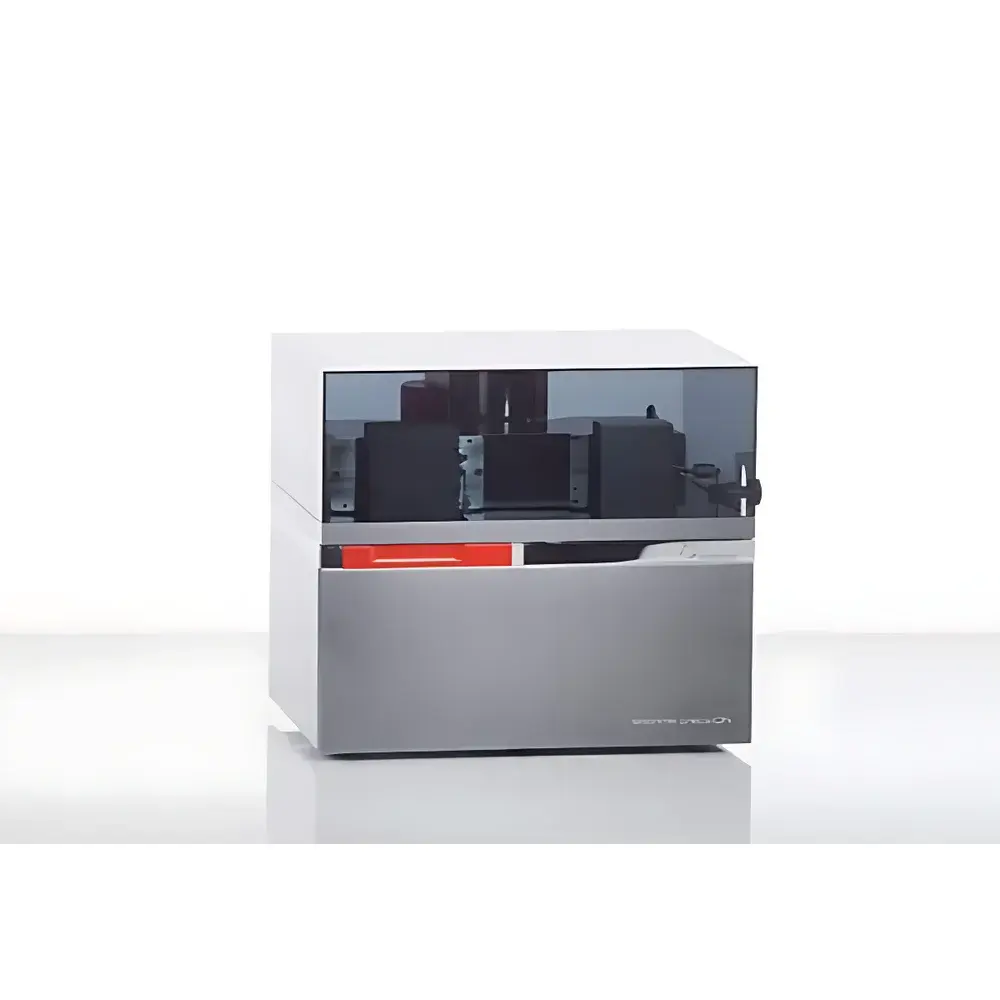
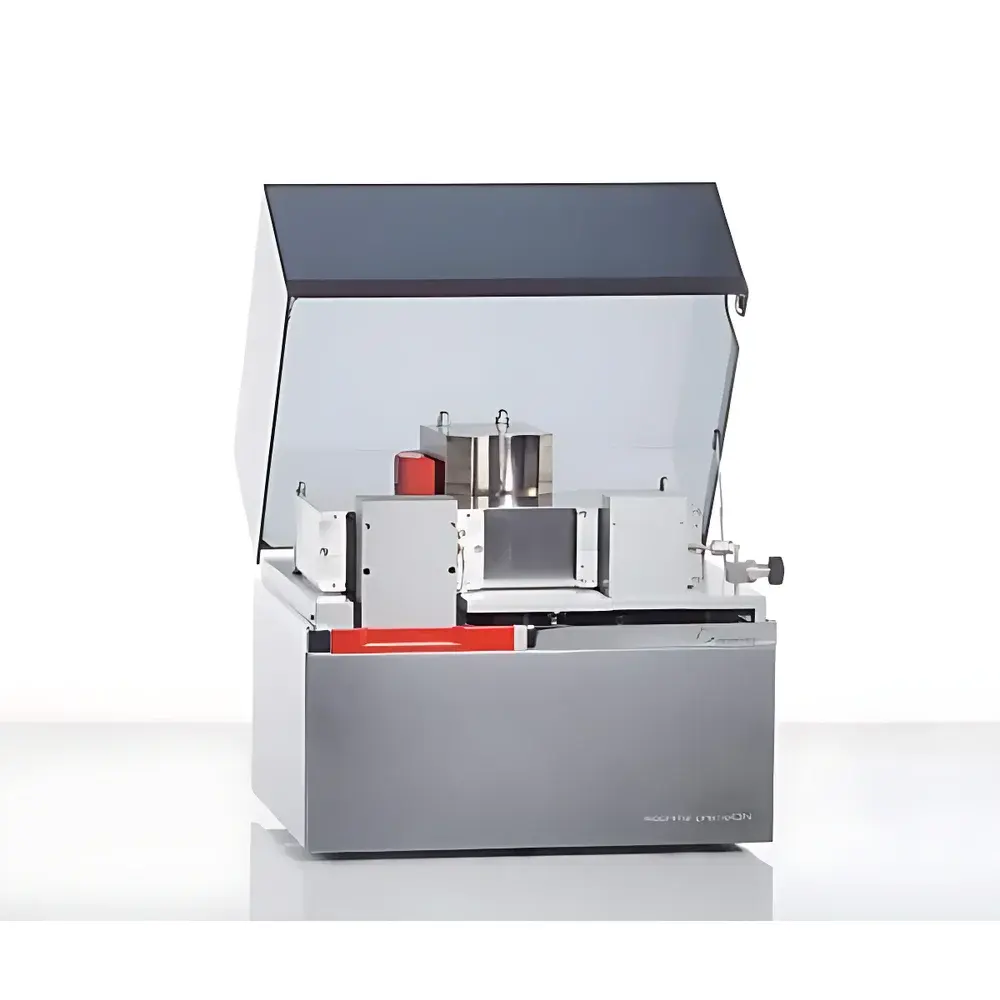
Elementar isoprime precisION Stable Isotope Ratio Mass Spectrometer
| Brand | Elementar |
|---|---|
| Origin | United Kingdom |
| Manufacturer Type | Authorized Distributor |
| Origin Category | Imported Instrument |
| Model | precisION |
| Instrument Type | Stable Gas-Phase Isotope Ratio Mass Spectrometer |
| Measurement Precision | δ¹³C ≤ 0.06‰, δ¹⁵N ≤ 0.06‰ (1σ, long-term reproducibility) |
| Measured Isotopes | ¹³C, ¹⁵N, ¹⁸O, ²H, ³⁴S |
| Mass Range | Up to 96 Da |
| Resolution | >110 m/Δm (10% valley definition) |
| Sensitivity | 800 CO₂ molecules per ion (Direct Ionization mode, DI) |
Overview
The Elementar isoprime precisION is a high-performance, single-collector stable isotope ratio mass spectrometer (IRMS) engineered for precision, stability, and operational flexibility in gas-phase isotopic analysis. Based on magnetic sector mass spectrometry with Faraday cup detection, the system employs double-focusing geometry (electric and magnetic sectors) to achieve high mass resolution and exceptional signal-to-noise performance. It is specifically optimized for continuous-flow (CF-IRMS) and dual-inlet (DI-IRMS) configurations, enabling rigorous δ-value determinations of light stable isotopes—including carbon, nitrogen, oxygen, hydrogen, and sulfur—in organic and inorganic matrices. Designed for laboratories requiring trace-level isotopic fidelity across environmental, geochemical, biogeochemical, food authenticity, and forensic applications, the precisION delivers metrologically traceable results aligned with international reference materials (e.g., IAEA, USGS, NIST standards) and supports compliance with ISO/IEC 17025 method validation requirements.
Key Features
- High-dynamic-range 100 V preamplifier with automatic resistor switching (10⁹ Ω / 10¹¹ Ω), enabling accurate measurement of both major and minor isotopic ratios without manual gain adjustment.
- Upgradable multi-collector configuration supporting up to 10 Faraday cups—ideal for simultaneous detection of multiple isotopes or internal standard monitoring during high-throughput runs.
- Enhanced mass resolution exceeding 110 m/Δm (10% valley definition), ensuring baseline separation of adjacent peaks such as 17O12C16O⁺ and 13C16O16O⁺ in CO₂ analysis.
- lyticOS® control software providing full instrument automation—including vacuum sequencing, ion source tuning, peak centering, and data acquisition—with audit-trail logging compliant with FDA 21 CFR Part 11 and GLP/GMP documentation frameworks.
- centrION continuous-flow interface integration supporting up to six reference gas inputs and five sample introduction systems (e.g., elemental analyzers, gas chromatographs, laser fluorination units, or thermal conversion modules).
- Ultra-high-vacuum stainless-steel analyzer chamber with bake-out capability (up to 120 °C), minimizing memory effects and improving long-term signal stability for demanding multi-day campaigns.
- Customizable Dual Amplifier Configuration (DAC) allowing independent optimization of amplifier gain settings for non-standard isotope pairs—critical for rare-isotope studies such as 17O/18O or 33S/34S.
- Real-time status feedback via color-coded LED indicators (green = ready, amber = warm-up, red = fault), facilitating rapid diagnostics and reducing instrument downtime.
Sample Compatibility & Compliance
The precisION accommodates diverse sample types through compatible peripheral instrumentation: elemental analyzers (e.g., vario ISOTOPE cube) for bulk C/N/H/O/S analysis; gas chromatography-combustion interfaces (GC-IRMS) for compound-specific δ¹³C and δ¹⁵N; high-temperature conversion (HTC) or laser fluorination systems for oxygen and sulfur isotope analysis in silicates and sulfates; and cryogenic trapping modules for atmospheric trace gas studies. All configurations adhere to ASTM D7882–18 (δ¹³C in biofuels), ISO 11290-2 (isotopic profiling in food authentication), and EA-IRMS protocols defined by the IUPAC Commission on Isotopic Abundances and Atomic Weights. System validation includes linearity assessment, drift correction using bracketing standards, and uncertainty propagation per GUM (Guide to the Expression of Uncertainty in Measurement).
Software & Data Management
lyticOS® serves as the central platform for method development, real-time monitoring, and post-acquisition data reduction. It supports automated peak integration, baseline correction, and delta-value calculation using user-defined reference gas calibrations. Raw data files are stored in vendor-neutral formats (e.g., .csv, .txt) alongside metadata-rich .lyt archives containing instrument parameters, calibration history, and operator annotations. Built-in reporting tools generate ISO/IEC 17025-compliant certificates of analysis, including expanded uncertainty estimates (k=2), CRM traceability statements, and QC flagging for outliers. Data export is compatible with LIMS integration via OPC UA or RESTful API endpoints, ensuring seamless workflow alignment in regulated environments.
Applications
- Biogeochemical cycling studies: Quantifying carbon sequestration pathways via δ¹³C and δ¹⁸O in soil CO₂ and dissolved inorganic carbon.
- Food origin verification: Detecting adulteration in honey, olive oil, and wine using multi-isotope fingerprinting (δ²H, δ¹⁸O, δ¹³C, δ¹⁵N).
- Environmental forensics: Tracing nitrate sources in groundwater via δ¹⁵N–δ¹⁸O dual-isotope plots.
- Paleoclimatology: Reconstructing past temperature and hydrological conditions from δ¹⁸O and δD in ice cores and speleothems.
- Pharmaceutical metabolism: Tracking 13C-labeled drug metabolites using GC-IRMS coupled to LC separation.
- Ecological trophic studies: Resolving dietary niche partitioning in wildlife using δ¹³C and δ¹⁵N in collagen and keratin.
FAQ
What sample preparation methods are compatible with the precisION?
The system accepts gaseous analytes generated by elemental analyzers, gas chromatographs, thermal conversion units, or offline purification lines. Solid/liquid samples require prior conversion to target gases (e.g., CO₂, N₂, SO₂, H₂) using combustion, pyrolysis, or chemical reaction protocols.
Does the precisION support dual-inlet (DI) mode for highest-precision δ-value determination?
Yes—the instrument includes a dedicated DI inlet with high-precision leak valves, cryo-trapping, and pressure-controlled sample/reference gas alternation, achieving long-term reproducibility better than ±0.03‰ for δ¹³C under optimal conditions.
Can lyticOS® be validated for use in regulated pharmaceutical or clinical labs?
Yes—lyticOS® provides electronic signatures, change control logs, and audit trails meeting FDA 21 CFR Part 11 and EU Annex 11 requirements when deployed on validated IT infrastructure.
Is vacuum烘烤 (bake-out) required for routine operation?
Bake-out is optional but recommended after extended downtime or following analysis of high-boiling-point contaminants; it reduces background hydrocarbon signals and improves baseline stability over multi-week campaigns.
How is sensitivity quantified, and what does “800 molecules CO₂/ion” mean?
This specification reflects the minimum detectable number of CO₂ molecules yielding one ion detected at the Faraday cup under direct ionization (DI) conditions—corresponding to sub-picomole injection levels and enabling high-precision analysis of microscale samples.
Related Products






