
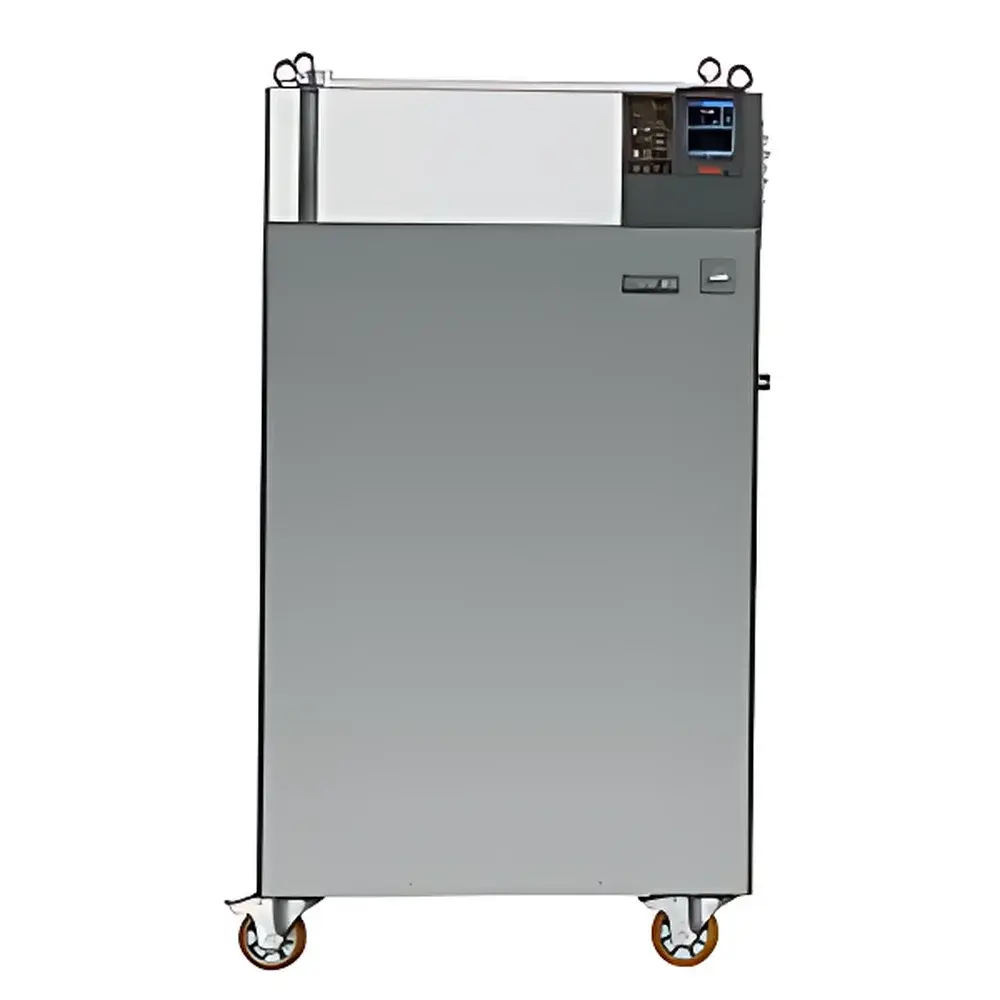
Huber Unistat 920w Dynamic Temperature Control System
| Brand | Huber |
|---|---|
| Origin | Germany |
| Model | Unistat 920w |
| Temperature Range | -90 to 200 °C |
| Temperature Stability | ±0.01 °C |
| Bath Volume | 12 L |
| Circulation Type | Internal & External |
| Cooling Method | Water-Cooled |
| Heating Power | 11 kW (at -90 °C) to 11 kW (at 20 °C) |
| Refrigeration Stages | Two-stage (R507 + R23) |
| Pump Flow Rate | Up to 90 L/min, Max Pressure 2.5 bar |
| Controller | Pilot ONE E-grade "Professional", 5.7" Color Touchscreen |
| Interface | RS232, Ethernet, Dual USB (Host/Device), Optional Analog I/O via Com.G@te |
| Safety Rating | Protection Class III / FL, IP20 |
| Dimensions (W×D×H) | 950 × 1205 × 1650 mm |
| Weight | 855 kg |
| Ambient Operating Temperature | 5–40 °C |
| Sound Pressure Level | 72 dB(A) |
Overview
The Huber Unistat 920w is a high-performance, dual-stage dynamic temperature control system engineered for precision thermal management in demanding laboratory and pilot-scale process applications. Based on Huber’s proprietary thermodynamic control architecture, the Unistat 920w integrates active heating and cryogenic cooling within a single, sealed hydraulic circuit—enabling continuous, stable operation across an exceptionally wide temperature range of –90 °C to +200 °C without requiring heat transfer fluid replacement. Its core principle relies on adaptive PID control combined with real-time thermal load compensation, ensuring minimal overshoot and rapid thermal equilibration during both heating and cooling transitions. Unlike conventional bath circulators, the Unistat 920w employs a closed-loop, oil-sealed refrigeration system with two independent refrigerant circuits (R507 for primary stage, R23 for ultra-low secondary stage), eliminating oxidative degradation of heat transfer media and extending fluid service life significantly. Designed for unattended 24/7 operation, it meets stringent safety and reliability requirements for GLP-compliant environments and regulated industrial processes.
Key Features
- Two-stage cascade refrigeration system (R507 + R23) enabling stable operation down to –90 °C with water-cooled condensation
- Pilot ONE E-grade “Professional” controller with 5.7-inch color touchscreen, intuitive graphical interface, and multi-point touch navigation
- Real-time temperature curve visualization, programmable setpoint ramps, and automatic self-optimization of control parameters
- High-capacity, electronically regulated circulation pump (up to 90 L/min, 2.5 bar max pressure) with soft-start function to protect glass reactors and sensitive equipment
- Integrated energy management logic minimizing power consumption while maintaining ±0.01 °C temperature stability at setpoint
- Comprehensive safety architecture: Class III protection, FL rating, acoustic/optical alarm system, emergency shutdown circuit, and continuous status monitoring
- Dual USB ports (Host/Device), Ethernet, and RS232 interfaces supporting remote control, firmware updates, and time-stamped data logging
- Sealed hydraulic system with 29 L expansion reservoir, preventing oxidation and vapor loss of heat transfer fluids (e.g., silicone oils, synthetic esters)
Sample Compatibility & Compliance
The Unistat 920w supports external temperature control of diverse sample vessels—including jacketed glass reactors (1–50 L), calorimeters, spectroscopic cells, and analytical instrumentation—via flexible external circulation loops. Its M38×1.5 AG male pump outlet and Pt100 sensor input ensure compatibility with standard lab fittings and third-party temperature probes. The system complies with IEC 61000-6-2 (immunity) and IEC 61000-6-4 (emission) standards, and its electrical design conforms to EN 61010-1 for laboratory equipment safety. While not inherently FDA 21 CFR Part 11 compliant, audit-ready data export (CSV via USB/Ethernet), electronic signature support via optional software modules, and full traceability of setpoints, actual temperatures, alarms, and operational states enable integration into GMP/GLP workflows when deployed with validated SOPs and qualified network infrastructure.
Software & Data Management
Data acquisition and system supervision are enabled through Huber’s optional Com.G@te interface module, which provides analog input/output channels for external process signals (e.g., reactor jacket temperature feedback, pressure transducer output) and enables closed-loop cascade control configurations. All operational parameters—including setpoint history, real-time temperature traces, pump speed, compressor status, and alarm logs—are timestamped and stored locally on the Pilot ONE controller. Export is supported in CSV format via USB or Ethernet, facilitating post-run analysis in MATLAB, Python, or LIMS platforms. Remote access is achievable using standard TCP/IP protocols; no proprietary client software is required. Firmware updates and configuration backups are performed securely over HTTPS or local USB connection, preserving calibration integrity and revision control per ISO/IEC 17025 documentation requirements.
Applications
- Low-temperature kinetic studies and cryo-reaction optimization in pharmaceutical process development
- Temperature-controlled crystallization and polymorph screening under tightly regulated thermal profiles
- Jacketed reactor temperature management for exothermic hydrogenation, Grignard, or lithiation reactions
- Calibration and verification of reference thermometers, RTDs, and thermocouples per ASTM E74 and ISO 17025
- Thermal preconditioning of materials prior to mechanical testing (e.g., tensile, impact) per ASTM D638 or ISO 527
- Stabilization of optical benches, interferometers, and laser sources requiring sub-0.02 °C thermal drift suppression
- Process validation support for scale-up from lab to pilot plant, including Design of Experiments (DoE) thermal profiling
FAQ
What is the minimum allowable heat transfer fluid volume for safe operation?
The system requires a minimum fill volume of 12 L in the bath reservoir and operates optimally with a total system volume of 29 L (including expansion tank). Underfilling compromises thermal inertia and may trigger low-level alarms or pump cavitation.
Can the Unistat 920w be integrated into a SCADA or DCS environment?
Yes—via optional Com.G@te analog I/O modules or native Modbus TCP support over Ethernet, enabling bidirectional communication with industrial control systems for centralized monitoring and setpoint orchestration.
Is external cooling water quality specified?
Yes: deionized or softened water with ≤100 ppm total dissolved solids (TDS), pH 6.5–8.5, and corrosion inhibitor treatment per VDI 2047 is recommended. Minimum inlet pressure differential is 3 bar; maximum 6 bar.
Does the system support automatic calibration verification?
While not equipped with built-in reference standards, the Unistat 920w accepts external Pt100 inputs with NIST-traceable calibration certificates. Its high-resolution display (0.01 °C) and stable thermal platform make it suitable for periodic in-situ verification against certified reference probes.
What maintenance intervals are recommended for long-term reliability?
Compressor oil analysis every 2,000 operating hours; refrigerant leak check annually; heat exchanger cleaning every 12 months (depending on cooling water quality); touchscreen calibration verification semiannually.



