
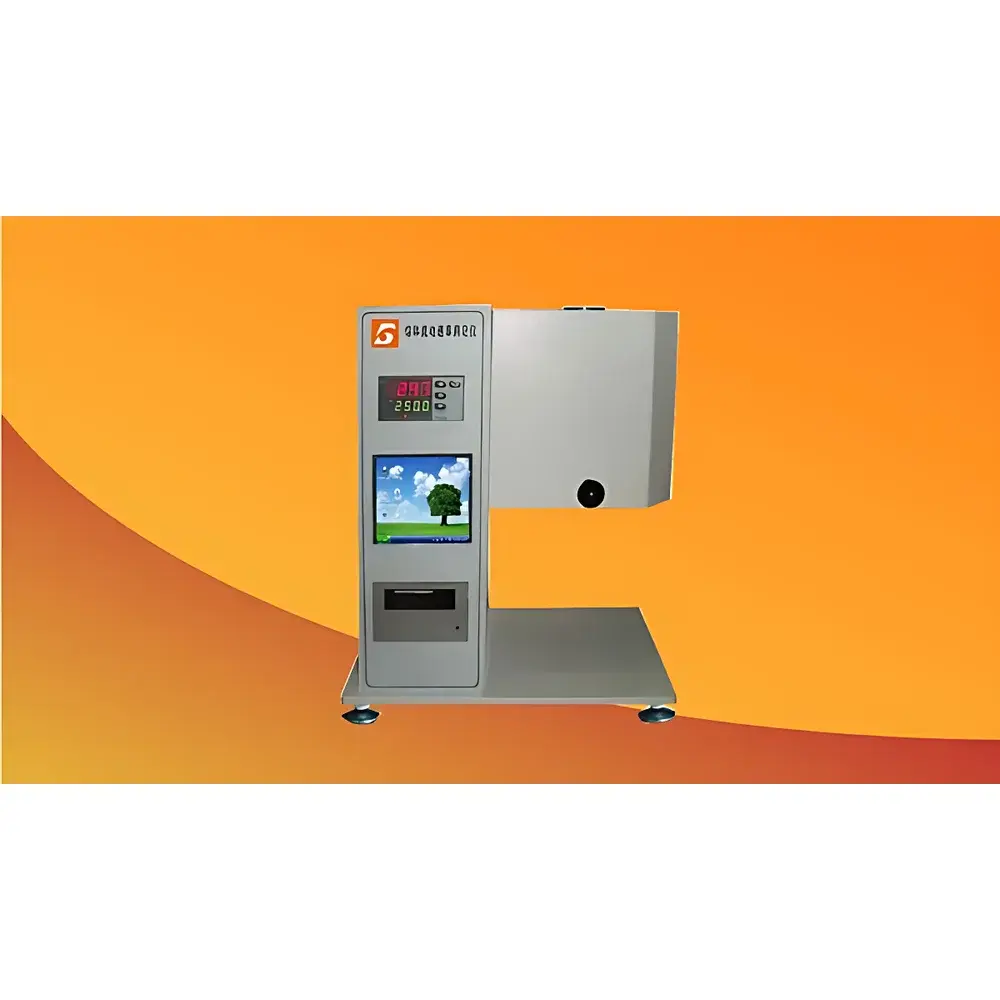
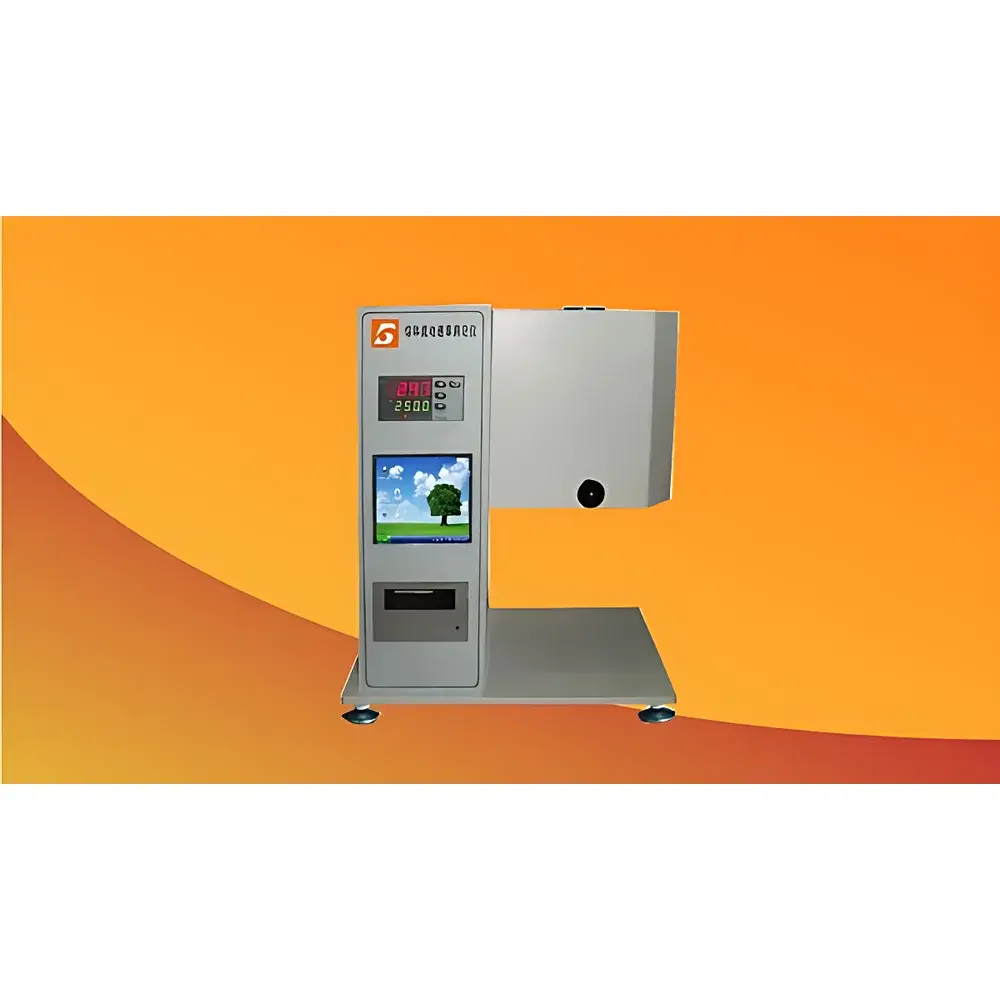
Beijing North Guang Precision Instruments HRZ-400B Melt Flow Indexer
| Brand | Beijing North Guang Precision Instruments |
|---|---|
| Origin | Beijing, China |
| Manufacturer Type | Direct Manufacturer |
| Model | HRZ-400B |
| Temperature Control Range | Ambient to 450 °C |
| Temperature Accuracy | ±0.2 °C |
| Temperature Resolution | 0.1 °C |
| Max Power Consumption | ≤500 W |
| Temperature Recovery Time | ≤4 min |
| Piston Stroke Detection (for MVR) | 30 mm |
| Displacement Accuracy | ±0.1 mm |
| MFR/MVR Test Range | 0.03–450 g/10 min |
| Barrel ID | 9.55 ± 0.025 mm |
| Piston Head Diameter | 9.475 ± 0.015 mm |
| Piston Head Length | 6.35 ± 0.1 mm |
| Die Orifice | 2.095 ± 0.005 mm (standard) |
| Standard Weights | 0.325 kg, 0.875 kg, 0.960 kg, 1.200 kg, 1.640 kg (±0.5% tolerance) |
Overview
The Beijing North Guang Precision Instruments HRZ-400B Melt Flow Indexer is a precision-controlled thermal extrusion instrument engineered for the standardized determination of melt mass flow rate (MFR) and melt volume flow rate (MVR) of thermoplastic polymers under defined load and temperature conditions. It operates on the principle of gravimetric or volumetric extrusion through a standardized capillary die—complying with ISO 1133-1:2011, ASTM D1238-22, and GB/T 3682.2–2018 (equivalent to ISO 1133-2). The instrument subjects a pre-conditioned polymer sample to controlled heating within a precisely dimensioned barrel, followed by extrusion under calibrated dead-weight loading. Mass or volume of extrudate collected over a fixed time interval is used to compute MFR (g/10 min) or MVR (cm³/10 min), respectively—key indicators of polymer processability, molecular weight distribution, and batch-to-batch consistency in compounding and extrusion processes.
Key Features
- Microprocessor-based closed-loop temperature control with dual high-stability PID controllers, achieving ±0.2 °C accuracy across a 0–450 °C operating range.
- High-thermal-mass heating block fabricated from nickel-chromium alloy castings—eliminating conventional resistance wire degradation and ensuring long-term thermal stability at elevated temperatures.
- Integrated touch-screen HMI with 65,535-color TFT display, supporting multilingual UI (including optional English firmware), real-time graphical temperature profiling, and step-by-step voice-guided operation.
- Automated cutting mechanism capable of severing high-viscosity or semi-crystalline extrudates—including rigid polyolefins and engineering thermoplastics—without manual intervention.
- Dual-mode measurement capability: gravimetric (A method per ISO 1133-1) and volumetric (B method per ISO 1133-2), enabled by optional optical encoder-based piston displacement sensing with ±0.1 mm positional resolution.
- Full data logging with timestamped test records stored internally; exportable via USB mass storage to external PCs for long-term archival and statistical analysis (e.g., X̄–R charts, CPK evaluation).
- RS-232 and USB device interfaces support bidirectional communication with PC-based lab management software—enabling remote parameter configuration, automated report generation, and compliance-ready audit trails.
Sample Compatibility & Compliance
The HRZ-400B accommodates standard-compliant specimens of polyethylene (PE), polypropylene (PP), polystyrene (PS), ABS, polyamide (PA6/PA66), polyacetal (POM), fluoropolymers (e.g., PTFE, PVDF), polycarbonate (PC), and acrylic resins. Its barrel, piston, and die geometry strictly adhere to ISO 1133 Annex A dimensional tolerances (barrel ID = 9.55 ± 0.025 mm; piston head OD = 9.475 ± 0.015 mm; die orifice = 2.095 ± 0.005 mm). Optional 1.18 mm dies are available for high-MFR materials. All standard weights meet ISO 1133 Annex B mass tolerances (±0.5%). The system supports GLP/GMP-aligned workflows through configurable user access levels, electronic signatures, and FDA 21 CFR Part 11–compatible software modules (available as optional upgrade).
Software & Data Management
Embedded firmware provides full test sequencing—including preheat stabilization, material loading confirmation, dwell timing, automatic cut initiation, and post-test cooling protocols. All parameters (temperature setpoint, soak time, cut interval, weight selection, MFR/MVR mode) are user-definable with password-protected administrator access. Internal memory retains ≥1,000 test records with metadata (operator ID, date/time, material lot, calibration certificate ID). USB export generates CSV files compatible with Excel, LIMS, and statistical process control (SPC) platforms. Optional PC software offers advanced features: automated calibration validation reports, trending dashboards, multi-instrument fleet monitoring, and PDF/Excel report templates compliant with ISO/IEC 17025 documentation requirements.
Applications
This indexer serves critical quality assurance functions across polymer R&D, production QC, and supplier qualification. Typical use cases include: incoming raw material verification against technical datasheets; in-process monitoring during extrusion grade development; release testing of compounded pellets prior to injection molding; comparative MFR screening of recycled vs. virgin resin blends; and regulatory submission support for medical-grade polymers (e.g., USP Class VI plastics). Its reproducibility (≤1.5% RSD for replicate PE tests per ISO 1133 repeatability criteria) makes it suitable for accredited laboratories seeking ISO/IEC 17025 scope accreditation for melt flow testing.
FAQ
Does the HRZ-400B comply with ASTM D1238 Condition E (230 °C / 2.16 kg) for polyethylene?
Yes—the instrument’s temperature stability and weight calibration meet all requirements for ASTM D1238 Conditions A–J, including E and F.
Can the system perform MVR measurements without operator intervention?
Yes—when equipped with the optical encoder displacement sensor and configured in B-method mode, volumetric flow is calculated autonomously using piston travel distance and known die geometry.
Is firmware upgradable in the field?
Yes—firmware updates are delivered via USB stick and installed through the touchscreen interface without requiring service technician dispatch.
What maintenance is required to sustain metrological integrity?
Annual verification of temperature uniformity (per ISO 1133 Annex C), die dimensional inspection, and weight calibration traceable to NIST or equivalent national standards body is recommended.
Is English-language documentation and software included as standard?
English user manuals and on-screen prompts are provided as standard; full English firmware and PC software are available upon request at no additional cost.




