
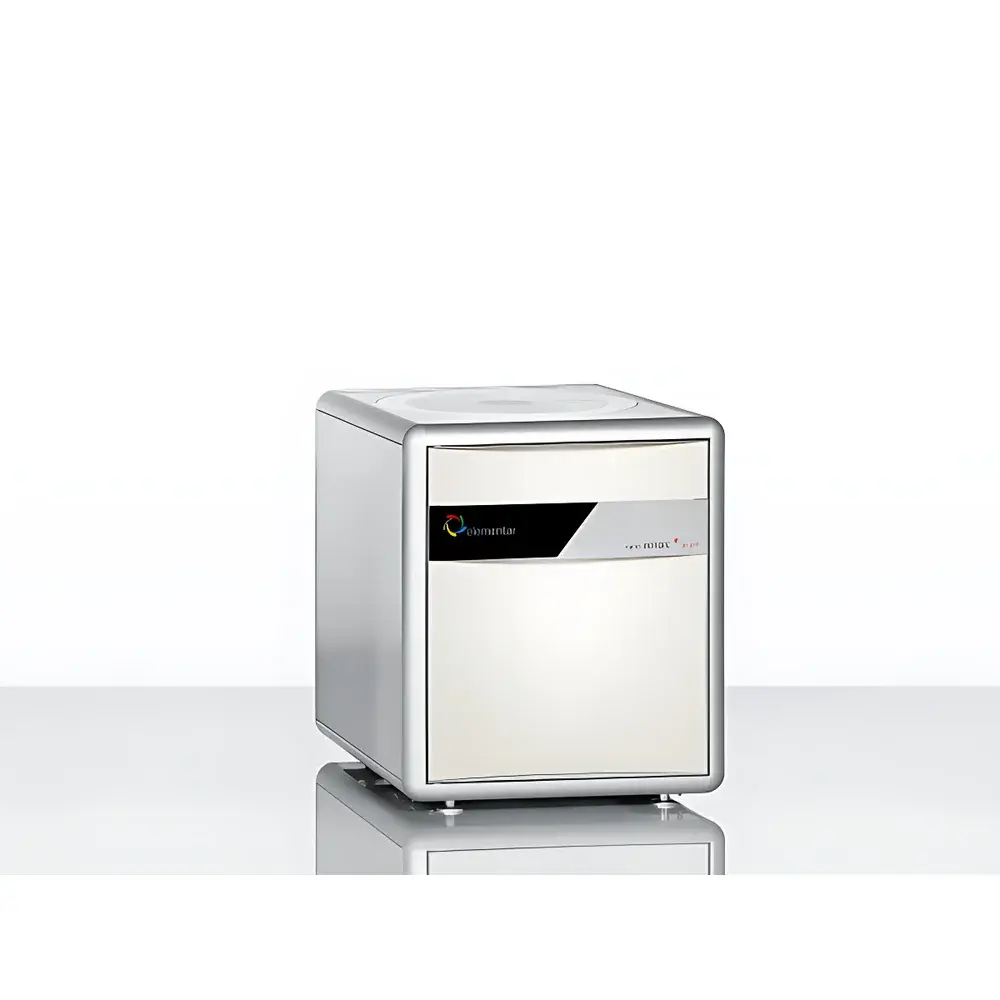
Elementar vario ISOTOPE select Stable Isotope Ratio Elemental Analyzer
| Brand | Elementar |
|---|---|
| Origin | Germany |
| Model | vario ISOTOPE select |
| Detection Principle | Combustion–TPD–IRMS Coupled Stable Isotope Ratio Analysis (δ¹³C, δ¹⁵N, δ³⁴S, δ¹⁸O) |
| Sample Throughput | Up to 120 samples unattended |
| Combustion Temperature | Up to 1,200 °C |
| Isotope Precision (1σ) | ≤ 0.1‰ for δ¹³C and δ¹⁵N (n ≥ 10, 0.5–2 mg organic matrix) |
| Gas Separation | Single-programmed TPD column for complete baseline-resolved CO₂, N₂, SO₂, CO separation |
| Compliance | Fully compatible with IRMS interfaces (e.g., IsoPrime, Delta V, Nu Instruments) |
Overview
The Elementar vario ISOTOPE select is a high-performance, benchtop stable isotope ratio elemental analyzer engineered for precise, routine determination of δ¹³C, δ¹⁵N, δ³⁴S, and δ¹⁸O in solid and liquid organic matrices. It operates on the principle of high-temperature flash combustion (up to 1,200 °C) followed by patented thermal programmed desorption (TPD) gas chromatography and interfacing with an isotope ratio mass spectrometer (IRMS). Unlike conventional dual-column or cryogenic separation systems, the vario ISOTOPE select achieves full baseline resolution of CO₂, N₂, SO₂, and CO — all derived from a single combustion event — using one integrated TPD column. This eliminates cross-contamination risks, reduces system complexity, and enhances long-term reproducibility. Designed for laboratories entering stable isotope analysis for the first time — as well as those scaling up throughput — the instrument delivers metrologically traceable results aligned with international reference materials (IAEA-CH-6, USGS40, IAEA-N-1), making it suitable for environmental forensics, food authenticity, geochemical tracing, and clinical research applications.
Key Features
- Single-TCD-based combustion module with 10-year warranty on furnace and thermal conductivity detector — validated for >100,000 analytical cycles under routine operation
- Patented TPD gas separation technology enabling simultaneous, baseline-resolved elution of CO₂, N₂, SO₂, and CO without cryogens or switching valves
- Integrated 120-position autosampler with programmable sample weighing support and inert atmosphere handling for hygroscopic or volatile samples
- Tool-free quartz tube clamping system ensuring leak-tight integrity across pressure cycles (0.1–2 bar operating range) and eliminating O-ring degradation-related downtime
- Sliding furnace architecture allowing rapid access to combustion tube, catalyst bed, and reduction column — maintenance completed in <8 minutes without disassembly
- Modular IRMS interface compatibility with IsoPrime 100/200, Thermo Scientific Delta V Plus, and Nu Instruments Panorama systems via standardized H₂/He carrier gas routing and analog/digital signal protocols
Sample Compatibility & Compliance
The vario ISOTOPE select accommodates a broad spectrum of organic and semi-organic matrices without derivatization or pre-treatment: certified reference materials (CRMs), soils, sediments, plant tissues, powdered foods, beverages (after freeze-drying), petrochemicals, pharmaceutical intermediates, and synthetic polymers. Sample mass range spans 0.1–10 mg (C/N/S) and 0.5–5 mg (O), with reliable sub-milligram precision maintained through dynamic calibration referencing and internal standard normalization (e.g., acetanilide, sulfanilamide, cellulose). The system meets method validation requirements per ISO/IEC 17025:2017 and supports audit-ready documentation for GLP environments. Optional software modules provide electronic signatures, audit trails, and 21 CFR Part 11 compliance for regulated laboratories engaged in FDA-submitted studies or EU pharmacopeia testing.
Software & Data Management
Control and data processing are managed via Elementar’s isodat™ NG software suite — a Windows-based platform supporting real-time chromatogram visualization, peak integration with manual override, multi-point bracketing calibration, and automated δ-value calculation against user-defined reference gases (e.g., VPDB, AIR-N₂, VCDT, VSMOW). Raw data files (.isd) are stored in open HDF5 format, enabling third-party scripting (Python/MATLAB) for custom QA/QC workflows. Batch reporting templates comply with ISO 14040 LCA reporting standards and include uncertainty propagation (k=2) per GUM guidelines. All acquisition parameters, calibration history, and operator logs are embedded in metadata — ensuring full traceability from sample ID to final isotopic ratio.
Applications
- Environmental science: Source apportionment of nitrogen pollution (δ¹⁵N-NO₃⁻), carbon sequestration tracking (δ¹³C-soil organic matter), sulfur cycling in wetlands (δ³⁴S-SO₄²⁻)
- Food authenticity: Detection of honey adulteration (δ¹³C-C₄ sugar), origin verification of olive oil (δ²H/δ¹⁸O), geographical labeling of wine (δ¹⁸O-H₂O)
- Geochemistry: Paleoclimate reconstruction from foraminifera (δ¹⁸O-CaCO₃), volcanic gas fingerprinting (δ³⁴S-SO₂)
- Pharmaceutical R&D: Metabolic pathway tracing using ¹³C-labeled APIs, stability-indicating assays for degradants
- Agricultural research: Nitrogen use efficiency in cereals (δ¹⁵N-fertilizer uptake), mycorrhizal carbon allocation (δ¹³C-transfer)
FAQ
What isotopes can be measured simultaneously in one run?
δ¹³C, δ¹⁵N, δ³⁴S, and δ¹⁸O can be quantified from a single combustion event when configured with appropriate IRMS detection and gas routing modules.
Is offline oxygen isotope analysis supported?
Yes — the system includes dedicated pyrolysis mode (1,400 °C Ni/C reactor) for quantitative conversion of organic O to CO, compatible with dual-inlet or continuous-flow IRMS configurations.
How often does the TPD column require replacement?
Under normal usage (≤500 samples/week), the TPD column maintains performance for ≥24 months; lifetime is monitored via retention time stability and peak asymmetry metrics in isodat™ NG.
Can the instrument be upgraded for compound-specific isotope analysis (CSIA)?
No — the vario ISOTOPE select is designed exclusively for bulk elemental isotope ratios; CSIA requires coupling to GC- or LC-IRMS, which is outside its architecture.
Does Elementar supply certified calibration standards?
Yes — traceable CRMs (IAEA-600, USGS40, IAEA-NO-3) and in-house secondary standards (Elementar Reference Set ERS-1 to ERS-5) are available with full CoA including homogeneity and stability data.






