
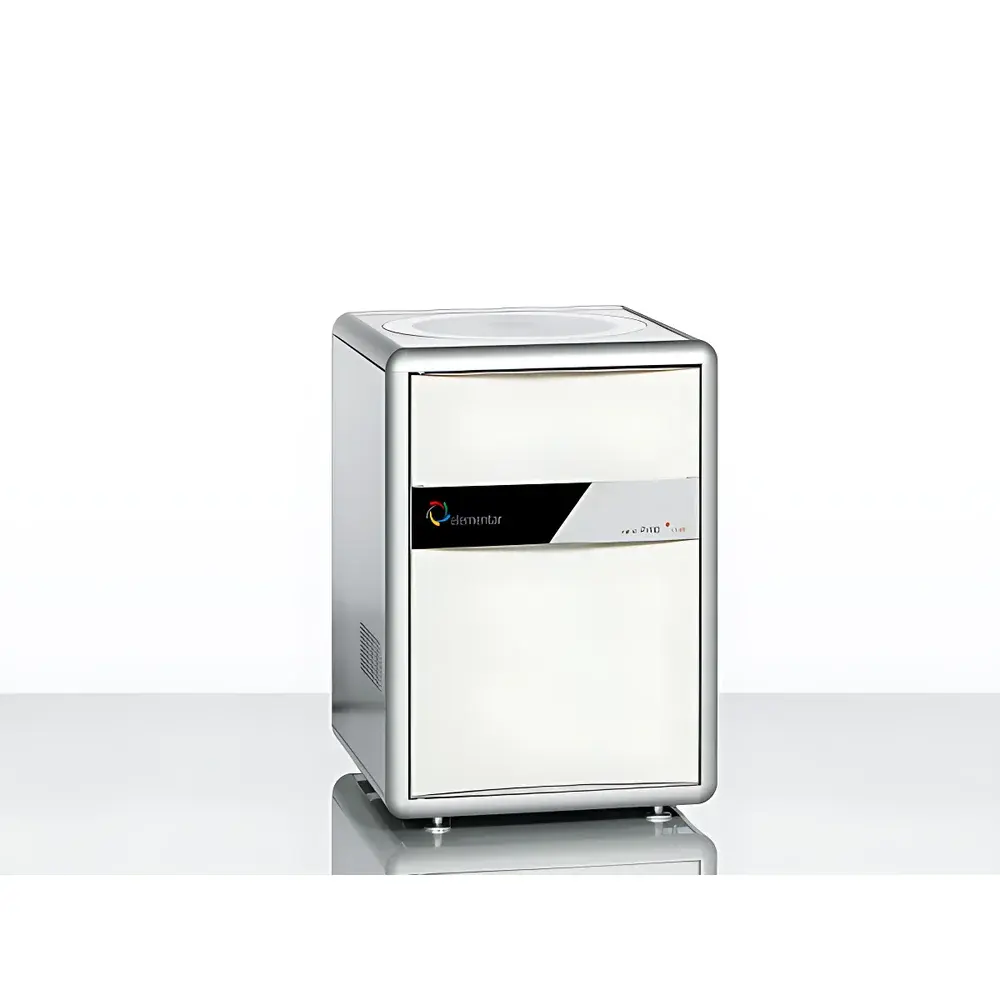
Elementar vario PYRO cube Organic Elemental Analyzer for EA-IRMS Coupling
| Brand | Elementar |
|---|---|
| Origin | Germany |
| Model | vario PYRO cube |
| Application | High-Temperature Elemental Analysis Coupled to Isotope Ratio Mass Spectrometry (EA-IRMS) |
| Sample Throughput | Up to 120 Samples (Integrated Autosampler) |
| Operating Modes | O/H and C/N/S Dual-Mode Configuration |
| Combustion Temperature | Up to 1800 °C |
| Detection Principle | Thermal Decomposition / High-Temperature Conversion Followed by Gas Chromatographic Separation and IRMS Detection |
| Compliance | Designed for GLP/GMP Environments |
Overview
The Elementar vario PYRO cube is a high-temperature elemental analyzer engineered specifically for seamless coupling with isotope ratio mass spectrometers (IRMS), enabling precise, reproducible determination of stable isotope ratios (δ2H, δ18O, δ13C, δ15N, δ34S) in organic matrices. Unlike conventional CHNS/O analyzers, the vario PYRO cube operates on a dual-path thermal conversion principle: oxygen and hydrogen isotopes are quantified via high-temperature pyrolysis (up to 1800 °C) in a helium atmosphere, while carbon, nitrogen, and sulfur isotopes are measured via flash combustion at optimized temperatures (950–1150 °C). This architecture eliminates cross-mode interference and ensures matrix-independent calibration across diverse sample types—from milligram-scale plant tissues to complex sedimentary organic matter. The system is built around a modular, service-oriented platform that prioritizes long-term operational stability, minimal consumable dependency, and compliance-ready data integrity.
Key Features
- True zero-blank pyrolysis reactor with integrated graphite/ceramic crucible design, eliminating memory effects and background O/H contamination during δ18O and δ2H analysis
- Patented column purge technology that removes residual water and CO2 from separation columns between runs, ensuring baseline stability and reproducibility over extended sequences
- Dual-component high-temperature reaction zone: separate optimized zones for pyrolysis (O/H) and combustion (C/N/S), minimizing thermal cross-talk and enhancing precision (RSD < 0.2‰ for δ18O, < 0.3‰ for δ2H)
- APT (Advanced Peak Tracking) gas separation technology, extending linear dynamic range from sub-μg to >30 mg C/N/S/O content per sample without manual dilution or method reconfiguration
- Self-diagnostic firmware with real-time monitoring of furnace temperature profiles, carrier gas flow stability, valve actuation cycles, and reactor aging indicators—enabling predictive maintenance scheduling
- Patented ball-valve sample introduction system ensuring quantitative, inert-gas-shielded transfer of solid samples into the reaction zone—critical for volatile or hygroscopic materials
- Integrated 120-position autosampler with programmable temperature-controlled sample trays and optional robotic sample weighing integration
Sample Compatibility & Compliance
The vario PYRO cube accommodates a broad spectrum of solid and homogenized organic materials without derivatization or pre-treatment: environmental samples (soils, sediments, peat), botanical tissues (leaves, roots, wood), food and feed matrices (grains, dairy powders, meat homogenates), pharmaceutical excipients, fossil and biofuels (coal, lignite, biodiesel), and synthetic polymers. All sample introduction pathways comply with ISO/IEC 17025:2017 requirements for testing laboratories. When operated with IRMS systems certified to ISO 17025 and configured with audit-trail-enabled software (e.g., Isoprime IonOS), the full EA-IRMS workflow supports 21 CFR Part 11 compliance—including electronic signatures, user access control, and immutable raw data archiving. Method validation documentation aligns with ASTM D7653 (standard test method for elemental analysis of petroleum products) and ISO 10628 (diagrammatic representation of chemical processes).
Software & Data Management
Control and data acquisition are managed via Elementar’s proprietary UNICORN-based instrument control suite, which provides synchronized timing for IRMS signal acquisition, peak integration, and offline correction algorithms (e.g., linear drift compensation, blank subtraction, multi-point normalization). Raw chromatographic and mass spectral data are stored in vendor-neutral .mzML format, compatible with third-party processing tools such as IsoCor, Eureka, or custom Python-based isotope correction pipelines. Batch reporting includes full traceability: sample ID, run timestamp, operator login, calibration curve parameters, intermediate diagnostic logs, and uncertainty propagation per IUPAC Technical Report guidelines. Data export supports CSV, PDF, and LIMS-integrated XML schema for enterprise laboratory information management systems.
Applications
The vario PYRO cube serves core research and regulatory applications across geochemistry (paleoclimate reconstruction via δ18O in biogenic carbonates), agricultural science (N-use efficiency tracking via δ15N in fertilizers and crops), food authenticity (geographic origin verification using δ2H/δ18O in wines and honey), environmental forensics (petrogenic vs. biogenic hydrocarbon source attribution via δ13C/δ34S), and pharmaceutical development (isotopic labeling recovery studies in ADME assays). Its ability to switch between O/H and C/N/S modes within a single analytical session—without hardware reconfiguration—makes it uniquely suited for multi-isotope tracer experiments requiring coordinated measurement of metabolic fluxes.
FAQ
What IRMS systems are compatible with the vario PYRO cube?
The instrument is optimized for direct coupling with Isoprime family IRMS systems (e.g., Isoprime 100, Prometheus, or Gemini), though it supports standard GC-IRMS interfaces meeting IUPAC-recommended pressure and flow specifications (He carrier, 1.2–1.8 mL/min, 0.8–1.2 bar inlet pressure).
Can the vario PYRO cube analyze liquid samples directly?
No—samples must be solid or freeze-dried homogenates. Liquids require pre-concentration onto inert substrates (e.g., cellulose powder or quartz wool) or lyophilization prior to analysis.
How often does the pyrolysis reactor require replacement?
Under typical usage (5–10 samples/day), the dual-zone reactor sustains >3,000 analyses before performance degradation; lifetime is monitored automatically via diagnostic firmware and confirmed by routine blank assessment.
Is method validation support available from Elementar?
Yes—Elementar provides application notes, certified reference material protocols (IAEA-600, USGS40, NIST SRM 1577c), and on-site IQ/OQ/PQ documentation packages aligned with GxP and ISO 17025 requirements.
Does the system support unattended overnight operation?
Yes—the 120-position autosampler, coupled with automated gas cylinder changeover logic and thermal stabilization routines, enables fully autonomous 24-hour operation with configurable alarm thresholds and remote status monitoring via Ethernet interface.




