
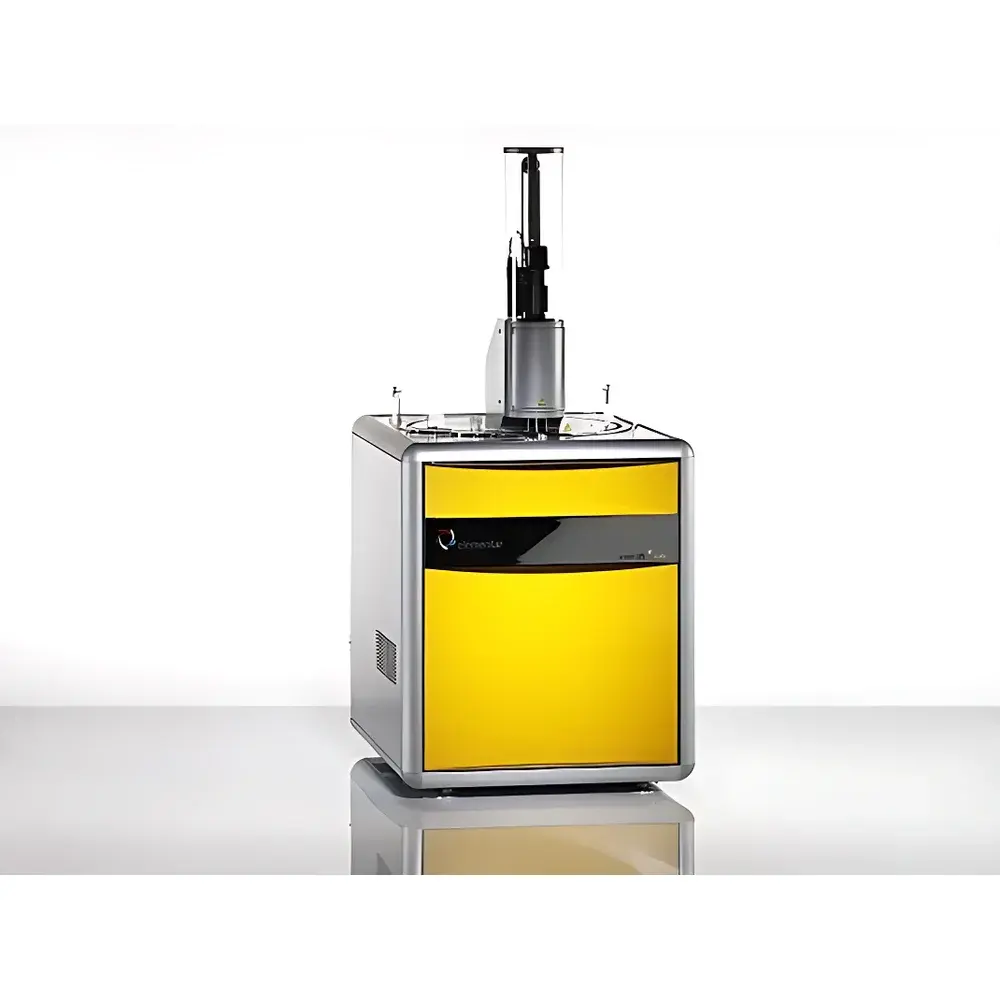
Elementar trace SN cube Sulfur and Nitrogen Analyzer
| Brand | Elementar |
|---|---|
| Origin | Germany |
| Model | trace SN cube |
| Detection Limit (S) | 6 ppb |
| Detection Limit (N) | 15 ppb |
| Sample Types | Liquids, Liquefied Petroleum Gas (LPG), Gases, Solids |
| Analysis Time | 3–5 min per sample |
| Autosampler Capacity | 60 positions |
| Detection Principles | UV Fluorescence (S), Chemiluminescence (N) |
| Compliance | ASTM D5453, D7183, ISO 20846, ISO 20884, EN ISO 17025 |
Overview
The Elementar trace SN cube is a high-precision, dual-channel combustion-based elemental analyzer engineered for the simultaneous or independent quantification of sulfur (S) and nitrogen (N) in petroleum products, liquid organic matrices, gaseous fuels, liquefied petroleum gas (LPG), and solid samples. It operates on the principle of high-temperature catalytic combustion followed by selective detection: sulfur oxides (SO2) are measured via ultraviolet fluorescence (UVF), while nitrogen oxides (NOx) are detected using chemiluminescence (CLD). This orthogonal detection architecture eliminates cross-sensitivity between S and N signals—particularly critical in high-nitrogen, low-sulfur matrices—and ensures metrological integrity across wide dynamic ranges. Designed and manufactured in Germany, the trace SN cube meets the most stringent international regulatory requirements—including ASTM D5453 (for S in light hydrocarbons), ASTM D7183 (for S in middle distillates), ISO 20846 and ISO 20884 (for automotive fuels)—and supports full compliance with ISO/IEC 17025 accredited laboratory practices.
Key Features
- Dual independent combustion tubes: Enables element-specific optimization of oxidation temperature, oxygen flow, and catalyst configuration—maximizing recovery for both S and N without compromise.
- Patented catalytic combustion technology: Uses proprietary high-activity catalysts to achieve complete, soot-free oxidation of challenging samples—even at sub-100 µL liquid injections—reducing maintenance frequency and eliminating clogging risks.
- NExcess module: A hardware-integrated interference correction system that physically separates SO2 adsorption and NO decay kinetics, enabling accurate sulfur quantification even when nitrogen exceeds 100 mg/kg (e.g., in amine-treated feedstocks or nitro-containing additives).
- Ultra-low detection limits: 6 ppb for sulfur and 15 ppb for nitrogen—validated per ICH Q2(R2) guidelines—ensuring robust performance against evolving global fuel specifications (e.g., Euro 6/VII, U.S. EPA Tier 3, China VI).
- 60-position programmable autosampler: Supports heterogeneous sample formats (vials, gas-tight syringes, solid boats) with integrated leak-check routines and pressure-controlled gas injection for LPG and compressed gases.
- Robust thermal management: Active cooling and precision furnace control maintain ±0.5 °C stability during extended sequences—critical for long-term baseline reproducibility in routine QC environments.
Sample Compatibility & Compliance
The trace SN cube accepts a broad spectrum of sample types without derivatization or pre-concentration: gasoline, diesel, jet fuel, biodiesel blends, lubricants, crude oil fractions, refinery intermediates, polymer additives, pharmaceutical solvents, and environmental extracts. Solid samples—including catalysts, spent sorbents, and particulate filters—are introduced via ceramic crucibles compatible with automated ashing protocols. All measurement workflows align with GLP/GMP data integrity expectations: audit trails record operator ID, method version, calibration history, and raw detector voltage traces. The system supports 21 CFR Part 11-compliant electronic signatures when paired with Elementar’s UNICORN LIMS-ready software suite.
Software & Data Management
Control and evaluation are performed through Elementar’s UNICORN software platform—a validated, multi-user application supporting method templates, automatic calibration curve generation (linear and quadratic), spike recovery calculation, and uncertainty propagation per GUM (JCGM 100:2008). Raw chromatograms and detector baselines are stored in vendor-neutral HDF5 format. Integrated reporting modules generate PDF certificates compliant with ISO 17025 clause 7.8.2, including measurement uncertainty estimates derived from replicate analysis, calibration standard uncertainty, and instrument repeatability (RSD < 1.2% at 10 ppb S). Remote diagnostics and firmware updates are delivered via encrypted TLS 1.3 channels.
Applications
- Refinery quality assurance: Real-time monitoring of hydrotreater effluent sulfur breakthrough and denitrification efficiency.
- Fuel certification labs: Accredited testing for EN 590, ASTM D975, and GB 17930 compliance reporting.
- R&D of low-sulfur lubricants and biofuels: Quantifying residual heteroatoms after purification processes.
- Emissions research: Speciation of S/N-containing compounds in exhaust condensates and particulate matter.
- Pharmaceutical excipient screening: Verification of elemental impurities per ICH Q3D thresholds.
FAQ
Does the trace SN cube require helium carrier gas?
No—only ultra-high-purity oxygen (≥99.999%) and synthetic air are required for combustion and detector operation.
Can it analyze hydrogen sulfide (H2S) in natural gas directly?
Yes, using the optional gas sampling module with pressure-regulated loop injection and cryo-trapping for volatile sulfur species.
Is method validation support available?
Elementar provides IQ/OQ/PQ documentation packages, certified reference material recommendations (e.g., NIST SRM 2724c), and on-site installation qualification services.
How often does the UV fluorescence cell require cleaning?
Under normal operation with clean fuels, optical cell maintenance is recommended every 6 months—or after 2,000 analyses—using manufacturer-supplied solvent protocols.
Does the system meet EPA Method 1664B requirements for sulfur in wastewater?
While optimized for hydrocarbon matrices, trace SN cube can be adapted for aqueous extracts via solvent extraction and micro-distillation—method transfer assistance is available upon request.




