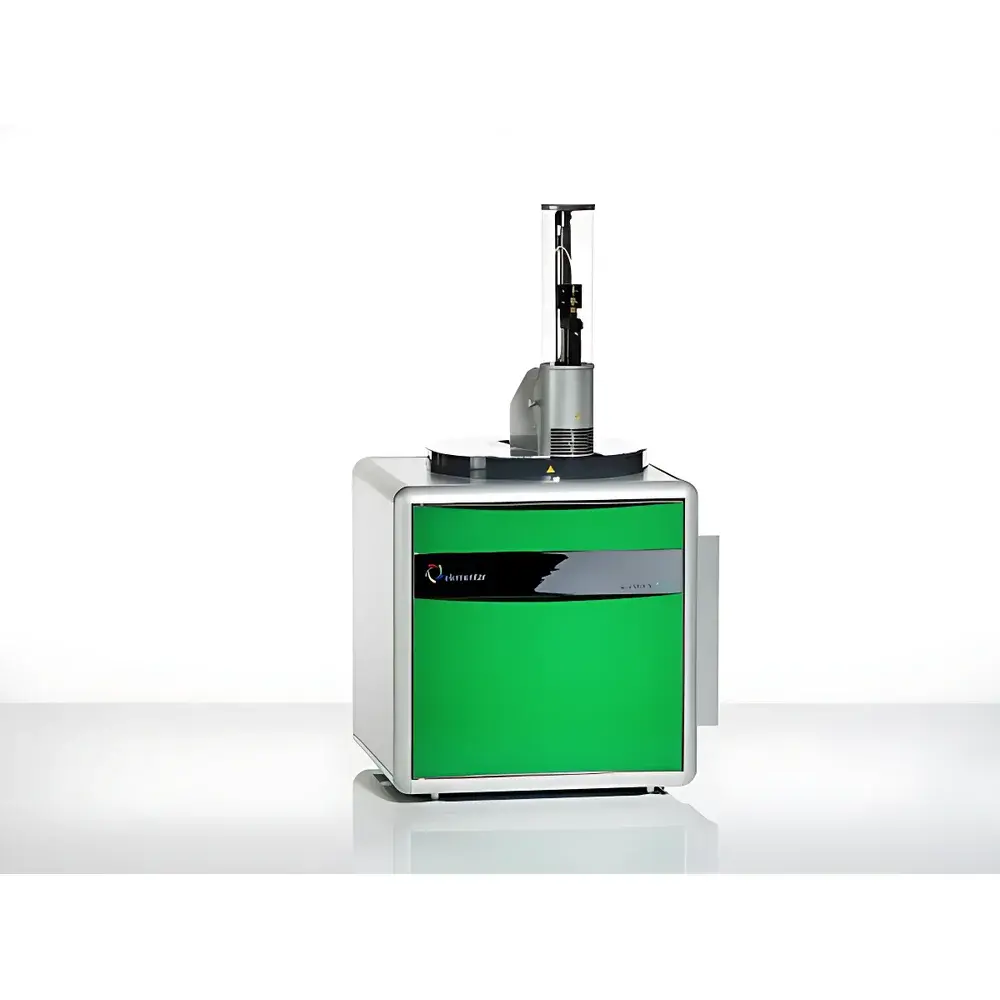
Elementar rapid MAX N exceed Dumas Nitrogen Analyzer
| Brand | Elementar |
|---|---|
| Origin | Germany |
| Model | rapid MAX N exceed |
| Application Category | Fully Automated Protein Determinator |
| Measurement Principle | Dumas High-Temperature Combustion |
| Nitrogen Range | 0–500 mg N |
| Repeatability | ±0.05% abs |
| Detection Limit | 20 ppm |
| Recovery Rate | 100% |
| Sample Throughput | up to 300 samples/day |
| Analysis Time | ~5 min/sample |
| Carrier Gas | Argon (Helium optional) |
| EAS REGAINER® Technology | Yes |
| EAS REDUCTOR® Reduction Tube Lifetime | >1,000 analyses |
| Sample Introduction | Vertical Crucible Feed System |
| Compliance | ISO 16634-1, ISO 16634-2, ISO 14891, ICC 167, EBC 9.9.1, AOAC 99003, AOAC 99215, AOAC 99223, AOAC 99313, DIN, GB 5009.5-2010, GB 29518-2013, GB/T 24318-2009, SNT 2115-2008 |
| Sample Types | Liquid foods (milk, beer, soft drinks, juice, soy sauce), solid foods, animal feed, pet food, fertilizers, dietary supplements |
Overview
The Elementar rapid MAX N exceed is a fully automated Dumas nitrogen analyzer engineered for high-throughput, regulatory-compliant total nitrogen and protein quantification in food, feed, and agricultural laboratories. It implements high-temperature combustion (950–1,100 °C) in an oxygen-rich environment, followed by catalytic reduction, gas chromatographic separation, and thermal conductivity detection — a robust, physics-based methodology standardized under ISO 16634 and AOAC official methods. Unlike Kjeldahl digestion, the Dumas principle eliminates hazardous acid handling, glassware-intensive workflows, and toxic waste generation. The instrument’s vertical crucible feed system enables stable, matrix-insensitive combustion of both viscous liquids and heterogeneous solids without pre-dilution or homogenization. Its architecture supports unattended 24/7 operation with integrated safety interlocks, real-time gas flow monitoring, and redundant temperature control — meeting GLP/GMP operational expectations for routine QC environments.
Key Features
- EAS REGAINER® technology: Enables continuous regeneration of the copper oxide combustion catalyst, extending service intervals and ensuring long-term baseline stability across >1,000 analyses.
- Vertical crucible introduction: Eliminates sample spillage and ensures reproducible positioning of liquid, paste, or solid specimens — critical for low-viscosity beverages (e.g., milk, juice) and high-fat feeds.
- Second-stage combustion zone: Integrated post-combustion oxidation ensures complete conversion of refractory nitrogen compounds (e.g., nitrates, nitrites, heterocyclics) into NOx, minimizing matrix interference and improving recovery accuracy.
- Modular EAS REDUCTOR® reduction tube: Converts all nitrogen oxides quantitatively to molecular nitrogen (N2) using heated copper, with verified linearity across 0.02–500 mg N and <0.05% absolute repeatability.
- Argon carrier gas standard: Reduces operational cost versus helium; helium compatibility available for specialized applications requiring higher resolution or lower background noise.
- Automated calibration and diagnostics: On-board reference standards, leak detection, and self-monitoring of furnace temperature gradients ensure traceable performance per ISO/IEC 17025 requirements.
Sample Compatibility & Compliance
The rapid MAX N exceed accepts samples ranging from 0.5 mg to 1,000 mg mass — including whole milk, fermented dairy, plant-based beverages, cereal flours, rendered animal meals, pelleted feed, organic fertilizers, and dietary supplements. Its combustion chamber design accommodates variable carbon content and volatile profiles without manual adjustment. The system complies with over 20 international and national standards, including ISO 16634-1 (cereals and milled products), ISO 16634-2 (animal feed), AOAC 99003 (dairy), AOAC 99215 (fertilizers), and GB 5009.5-2010 (Chinese food safety standard). All method parameters are pre-configured in the software library and auditable for FDA 21 CFR Part 11 compliance when paired with Elementar’s LIMS-integrated software suite.
Software & Data Management
Control and data acquisition are managed via the Windows-based vario ELEMENTAR Control Center (vECC), supporting multi-user role-based access, electronic signatures, and full audit trail logging. Raw chromatograms, peak integration parameters, calibration curves, and QC reports are stored with time-stamped metadata. Export formats include CSV, PDF, and XML for seamless integration with laboratory information management systems (LIMS) and enterprise QA databases. Method validation templates align with ICH Q2(R2) guidelines, and uncertainty budgets can be generated per GUM principles. Data integrity safeguards include write-protection of raw files, automatic backup to network drives, and configurable retention policies.
Applications
Primary use cases span regulated quality control in food manufacturing (protein labeling compliance), feed formulation (crude protein equivalence), fertilizer certification (total N content), and R&D in nutraceutical development. The instrument delivers validated results for AOAC Official Methods such as 99003 (fluid milk), 99223 (soy protein isolates), and 99313 (pet food). It is routinely deployed in contract testing labs serving USDA-FSIS, EFSA, and China’s SAMR, where throughput, method transferability, and regulatory defensibility are mandatory.
FAQ
What sample preparation is required prior to analysis?
Minimal preparation: solids are weighed directly into quartz crucibles; liquids are pipetted into pre-weighed crucibles with capillary wicks. No acid digestion, dilution, or derivatization is needed.
Can the instrument analyze volatile or high-moisture samples without loss?
Yes — the vertical crucible orientation and programmable pre-drying step (up to 150 °C) remove surface moisture while retaining thermally labile nitrogen species.
Is method validation support available?
Elementar provides application notes, certified reference materials (CRMs), and IQ/OQ/PQ documentation packages aligned with ISO/IEC 17025 and FDA 21 CFR Part 11.
How is calibration traceability maintained?
Calibration uses NIST-traceable acetanilide and urea standards; drift correction is performed automatically using internal reference peaks and dual-point linear regression.
What maintenance intervals are recommended?
EAS REDUCTOR® tube replacement every ~1,200 analyses; combustion catalyst regeneration is continuous; quarterly furnace inspection and annual GC column replacement are advised per SOP.