
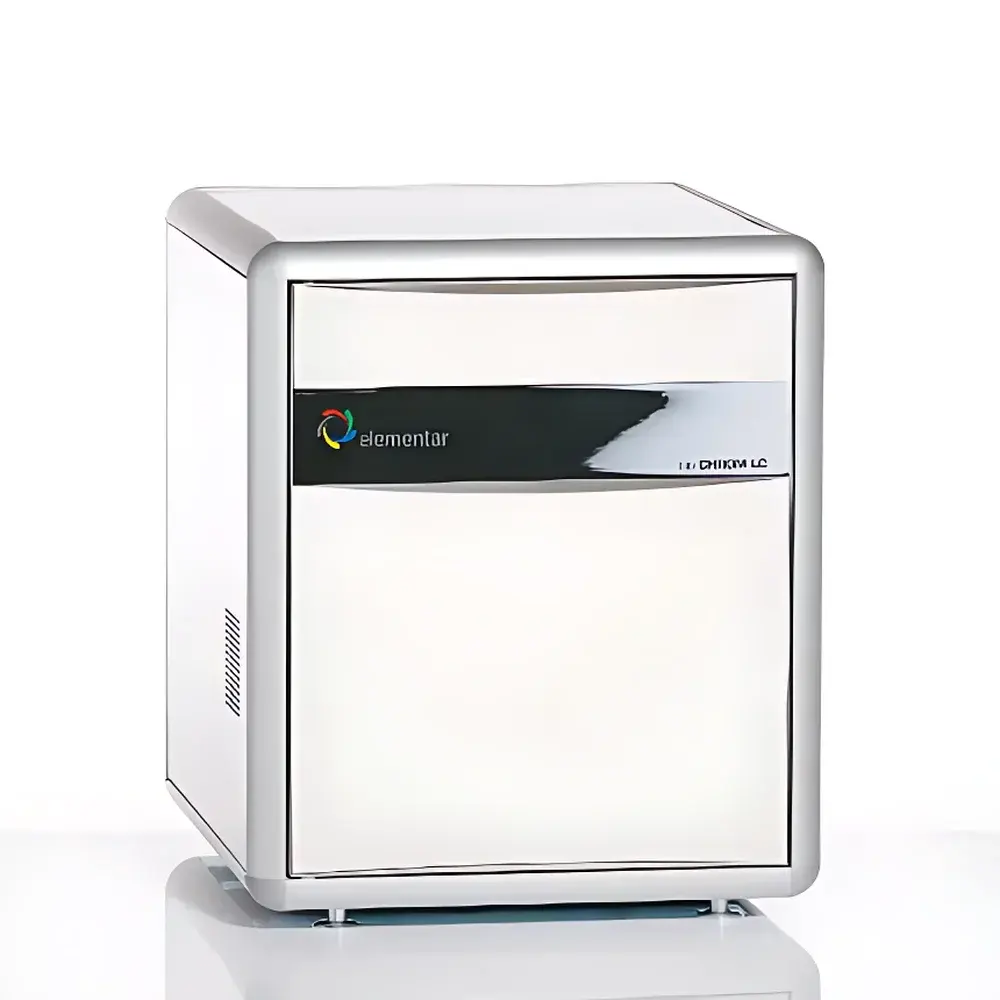
Elementar iso CHROM LC Cube for HPLC-IRMS Coupling
| Brand | Elementar |
|---|---|
| Origin | Germany |
| Model | iso CHROM LC Cube |
| Application | Continuous-Flow Liquid Chromatography–Isotope Ratio Mass Spectrometry (LC-IRMS) Interface |
| Principle | High-Temperature Catalytic Combustion (1050 °C) |
| Conversion | Quantitative Oxidation of Organic Carbon → CO₂ |
| Compatibility | Universal HPLC Systems (All Makes & Models) |
| Peak Broadening | <5% Added Bandwidth vs. Direct UV Detection |
| Isotopic Fidelity | No Measurable Isotopic Fractionation (δ¹³C and δ¹⁵N preserved within ±0.2‰, per ASTM D7639-22 validation protocols) |
| Compliance | Designed for GLP/GMP Environments |
Overview
The Elementar iso CHROM LC Cube is a high-temperature continuous-flow interface engineered to bridge high-performance liquid chromatography (HPLC) with isotope ratio mass spectrometry (IRMS) for compound-specific stable isotope analysis (CSIA) of carbon and nitrogen. Unlike legacy LC-IRMS interfaces relying on wet chemical oxidation (e.g., persulfate or potassium permanganate digestion), the iso CHROM LC Cube employs a robust, dual-zone ceramic reactor operating at 1050 °C under controlled helium/oxygen carrier gas flow. In this environment, organic analytes eluting from the HPLC column undergo quantitative, stoichiometric combustion: carbon atoms are converted quantitatively to CO₂; nitrogen atoms are reduced quantitatively to N₂. This thermally driven, catalyst-free process eliminates isotopic fractionation during conversion—ensuring that measured δ¹³C and δ¹⁵N values reflect true isotopic composition of individual chromatographic peaks, not artifacts of incomplete or kinetically biased reaction pathways.
Key Features
- Quantitative, fractionation-free conversion of organic C → CO₂ and N → N₂ via high-temperature catalytic combustion (1050 °C)
- Minimal peak dispersion: adds ≤5% extra bandwidth relative to baseline HPLC-UV chromatograms—preserving resolution and enabling accurate integration of isotopic signals across narrow peaks
- Universal HPLC compatibility: accepts standard 1/16″ stainless steel or fused silica transfer lines; operates with isocratic or gradient elution, reversed-phase, HILIC, or ion-pairing separations
- Robust thermal architecture: ceramic reactor core with integrated quartz liner ensures long-term stability (>12 months continuous operation without recalibration)
- Real-time gas-phase monitoring: integrated pressure and temperature sensors feed closed-loop control to maintain optimal combustion stoichiometry across variable flow rates (0.2–1.5 mL/min)
- No consumables beyond standard IRMS carrier gases (He, O₂); no reagents, no catalyst replacement, no acid waste generation
Sample Compatibility & Compliance
The iso CHROM LC Cube supports aqueous and organic-solvent-based mobile phases commonly used in modern HPLC methods—including acetonitrile, methanol, water, ammonium acetate, and formic acid buffers (≤0.5% v/v). It accommodates typical analytical column dimensions (2.1–4.6 mm ID, 50–250 mm length) and flow rates ranging from 0.2 to 1.5 mL/min. The system complies with ISO 17025 requirements for method validation in accredited laboratories and is routinely deployed in regulatory contexts requiring traceable isotopic data—such as environmental forensics (ASTM D7639-22), food authenticity testing (ISO 21708:2018), and pharmaceutical metabolite tracing (ICH M3(R2)). Its hardware design and firmware support full audit-trail logging, electronic signature enforcement (per FDA 21 CFR Part 11), and integration into GLP-compliant LIMS environments.
Software & Data Management
Control and synchronization are managed via Elementar’s isodat™ LC software suite, which provides bidirectional communication between the HPLC autosampler, pump, and IRMS detector. The software enables real-time alignment of chromatographic retention time with isotopic signal acquisition, automatic peak detection using derivative-based algorithms, and batch processing of δ¹³C and δ¹⁵N values with internal standard normalization (e.g., glycine or urea reference injections). All raw ion-current data, calibration curves, and instrument metadata are stored in vendor-neutral .CDF format, compatible with third-party chemometric tools (e.g., MATLAB, R, Python pandas). Export options include CSV, Excel, and XML for integration into enterprise data warehouses.
Applications
- Compound-specific δ¹³C and δ¹⁵N analysis of amino acids, peptides, nucleobases, and small-molecule metabolites in biological fluids
- Source apportionment of nitrate contamination in groundwater using δ¹⁵N–δ¹⁸O dual-isotope fingerprinting of extracted nitrate post-HPLC separation
- Authentication of natural vs. synthetic vanillin, caffeine, or citric acid in food matrices
- Metabolic flux studies in cell cultures via ¹³C-glucose or ¹⁵N-ammonium labeling, tracked through resolved intermediates
- Environmental fate studies of pharmaceuticals and pesticides—quantifying biodegradation pathways via isotopic enrichment trends in transformation products
FAQ
Can the iso CHROM LC Cube be used for sulfur or oxygen isotope analysis?
No—it is specifically optimized for carbon and nitrogen isotope ratio determination. Sulfur requires SO₂ generation (typically via pyrolysis or CuO combustion), and oxygen isotopes demand specialized conversion to CO or CO₂ under inert conditions; neither is supported by this interface.
What is the minimum detectable amount of carbon/nitrogen per peak for reliable δ-value measurement?
With standard 2.1 mm ID columns and 1 µL injection volumes, reproducible δ¹³C and δ¹⁵N measurements require ≥20 ng C or ≥5 ng N per resolved peak (based on 10–15 Hz data acquisition and 30-point peak integration).
Does the interface require daily maintenance or calibration?
No routine calibration is needed. System suitability is verified weekly using certified reference materials (e.g., USGS40 glutamic acid); drift correction is applied automatically during data reduction using co-injected standards.
Is it possible to switch between carbon-only and nitrogen-only analysis during a single run?
Yes—via software-controlled valve sequencing, the system can alternate between CO₂ and N₂ collection modes on-the-fly, enabling dual-element analysis without hardware reconfiguration.





