
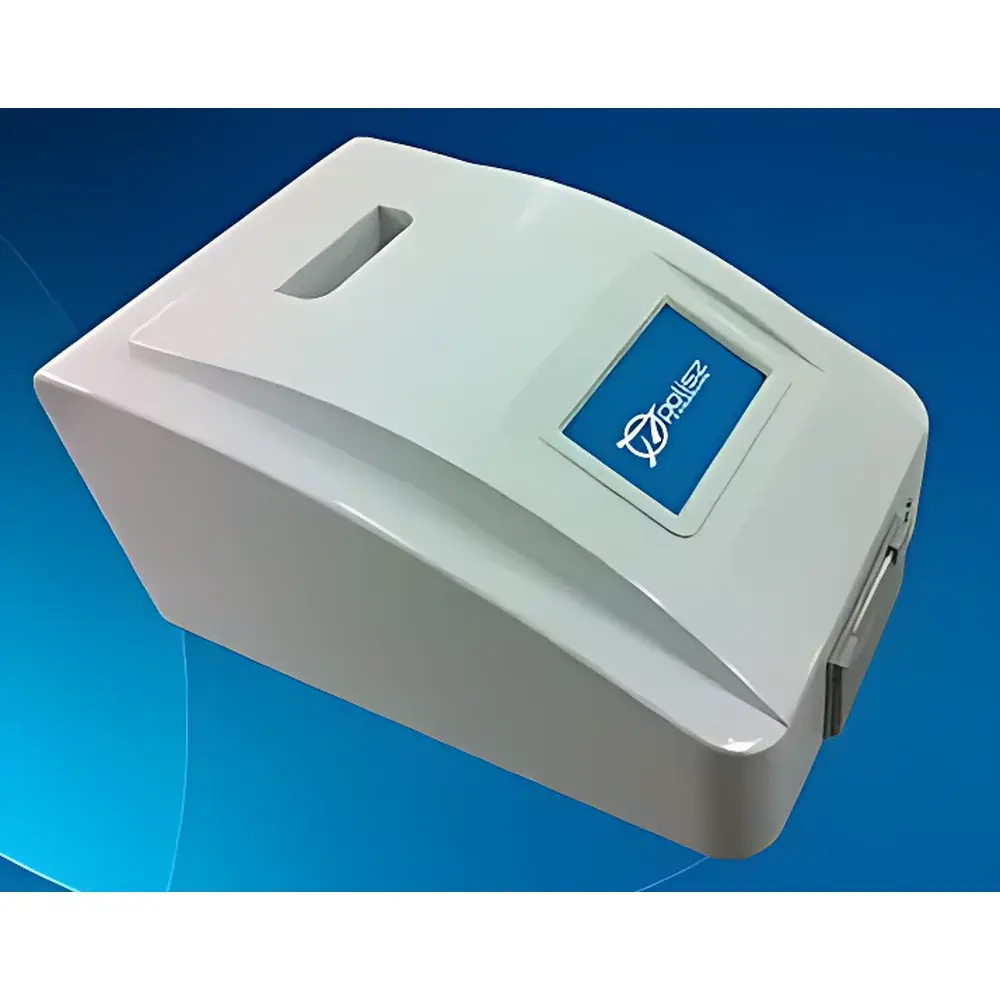
Beijing North Guang Precision Instruments BC-40A TOC Analyzer
| Brand | Beijing North Guang Precision Instruments |
|---|---|
| Origin | Beijing, China |
| Manufacturer Type | OEM Manufacturer |
| Country of Origin | China |
| Model | BC-40A |
| Power Supply | AC 220 V ± 10%, 50 Hz ± 1 Hz |
| Power Consumption | 95 W |
| Dimensions (W × D × H) | 340 × 390 × 145 mm |
| Weight | 15 kg |
| TOC Measurement Range | 0.001–1.000 mg/L |
| Detection Limit | 0.001 mg/L |
| Accuracy | ±4% (at 0.5 mg/L), ±5% (full range) |
| Repeatability | ≤3% RSD |
| Linearity Error | ±5% |
| Analysis Time | ≤4 min per sample |
| Response Time | ≤6 min (to 90% of final value) |
| Sample Flow Rate | 0.5 mL/min |
| Sample Temperature Range | 1–95 °C |
| Ambient Temperature Range | 10–40 °C |
| Relative Humidity | ≤85% RH (non-condensing) |
| Data Storage Capacity | 6 months of timestamped results |
| Interface | RS232 serial port, external thermal printer port |
| Compliance | Chinese Pharmacopoeia 2010 Edition, Appendix VIII R |
Overview
The Beijing North Guang Precision Instruments BC-40A TOC Analyzer is a benchtop and optionally online-capable total organic carbon analyzer engineered for regulated pharmaceutical, biotechnology, semiconductor, and power generation water quality laboratories. It employs a dual-wavelength ultraviolet (UV) oxidation method—utilizing 185 nm and 254 nm UV lamps in combination with titanium dioxide (TiO₂) photocatalysis—to achieve complete mineralization of non-purgeable organic compounds into carbon dioxide (CO₂). The instrument quantifies TOC via differential conductivity detection: it measures the electrical conductivity of the sample before and after UV/TiO₂ oxidation, calculating TOC as the difference between total carbon (TC) and total inorganic carbon (TIC), in strict accordance with the principle TC − TIC = TOC. This methodology satisfies the fundamental requirement outlined in Chinese Pharmacopoeia 2010 Edition, Appendix VIII R, and aligns with the scientific basis of USP , EP 2.2.44, and JP 17 methods—where oxidation efficiency, system suitability, and detection sensitivity (≤0.05 mg/L) are mandatory validation criteria.
Key Features
- Integrated dual-wavelength UV oxidation reactor with TiO₂ catalyst for >95% oxidation efficiency across diverse organic matrices, including recalcitrant compounds common in purified water and WFI.
- Differential conductivity detection architecture—no carrier gas, no reagents, no consumables beyond UV lamps and peristaltic pump tubing—minimizing operational cost and maintenance complexity.
- Tool-free UV lamp and pump tube replacement: designed for rapid field service without disassembly of the main chassis or recalibration.
- 640 × 480 pixel true-color resistive touchscreen interface with embedded real-time OS; supports one-touch analysis, automated system rinse cycles, and user-defined alarm thresholds (e.g., configurable upper limit alert with relay output).
- Onboard data management: stores ≥10,000 timestamped results with sample ID, operator ID, analysis time, and QC flags; exportable via RS232 to LIMS or CSV-compatible software.
- Flexible deployment modes: selectable offline (batch vial mode) or online (flow-through cell with 1/4″ compression fittings); compatible with sanitary tri-clamp adapters for GMP-compliant water loop integration.
Sample Compatibility & Compliance
The BC-40A is validated for use with low-conductivity aqueous matrices typical of pharmaceutical water systems: purified water (PW), water for injection (WFI), and sterile compressed air condensate. It accommodates sample temperatures from 1 °C to 95 °C and tolerates transient particulates up to 5 µm without clogging—enabling direct analysis of filtered but unpolished process streams. Regulatory alignment includes full traceability to Chinese Pharmacopoeia 2010 Edition Appendix VIII R, with built-in system suitability test (SST) routines per pharmacopeial requirements: sucrose recovery ≥85%, 1,4-benzoquinone recovery ≥75%, and blank response ≤0.05 mg/L. Optional IQ/OQ/PQ documentation packages—including installation checklists, operational protocols, performance verification reports, and electronic audit trail logs—are available to support FDA 21 CFR Part 11 and EU Annex 11 compliance readiness.
Software & Data Management
Data integrity is maintained through a deterministic embedded firmware architecture that enforces write-once, read-many (WORM) storage logic for all analytical records. Each result entry includes immutable metadata: date/time stamp (RTC-synchronized), operator login ID (with optional password protection), method version, calibration status flag, and raw conductivity values pre- and post-oxidation. Historical data retention spans six months at default logging intervals; extended storage is achievable via periodic manual export. The RS232 interface supports ASCII-based command-response protocol for integration with SCADA, MES, or laboratory information management systems (LIMS). No proprietary drivers or cloud dependencies are required—ensuring long-term interoperability and cybersecurity resilience in air-gapped environments.
Applications
- Pharmaceutical water system monitoring: continuous TOC verification of PW/WFI distribution loops, still/steam condensate, and point-of-use outlets per FDA Guidance for Industry (2022) and EU GMP Annex 1.
- Clean-in-place (CIP) and cleaning validation: quantitative assessment of residual organics on equipment surfaces using swab-extract analysis (optional Swab-Test module).
- Semiconductor ultrapure water (UPW) qualification: meeting SEMI F63-0218 specifications for TOC ≤ 1 ppb in sub-28 nm node fabrication.
- Power plant demineralized water surveillance: early detection of organic ingress from ion exchange resin degradation or condenser leaks.
- Biopharmaceutical buffer and media preparation QC: verification of organic impurity carryover during formulation steps.
FAQ
Does the BC-40A require carrier gas or chemical oxidants?**
No. It operates exclusively on UV/TiO₂ photocatalysis and differential conductivity detection—eliminating dependence on persulfate, ozone, or compressed air supplies.
Is the instrument compliant with 21 CFR Part 11 for electronic records?**
The base configuration supports audit-trail-enabled operation; full Part 11 compliance—including electronic signatures, role-based access control, and encrypted database backups—requires optional firmware upgrade and documented SOP implementation.
Can the BC-40A be integrated into a distributed control system (DCS)?**
Yes. Its RS232 port supports Modbus RTU protocol mapping upon request, enabling analog output simulation (4–20 mA) and discrete alarm signaling for PLC-level integration.
What is the recommended calibration frequency?**
Pharmacopeial guidance recommends daily system suitability testing; full multi-point calibration using certified KHP and NaHCO₃ standards is advised weekly or after maintenance events.
Is temperature compensation applied during conductivity measurement?**
Yes. All conductivity readings are automatically compensated to 25 °C using built-in NIST-traceable thermistor feedback, ensuring accuracy across the full 1–95 °C sample temperature range.



