
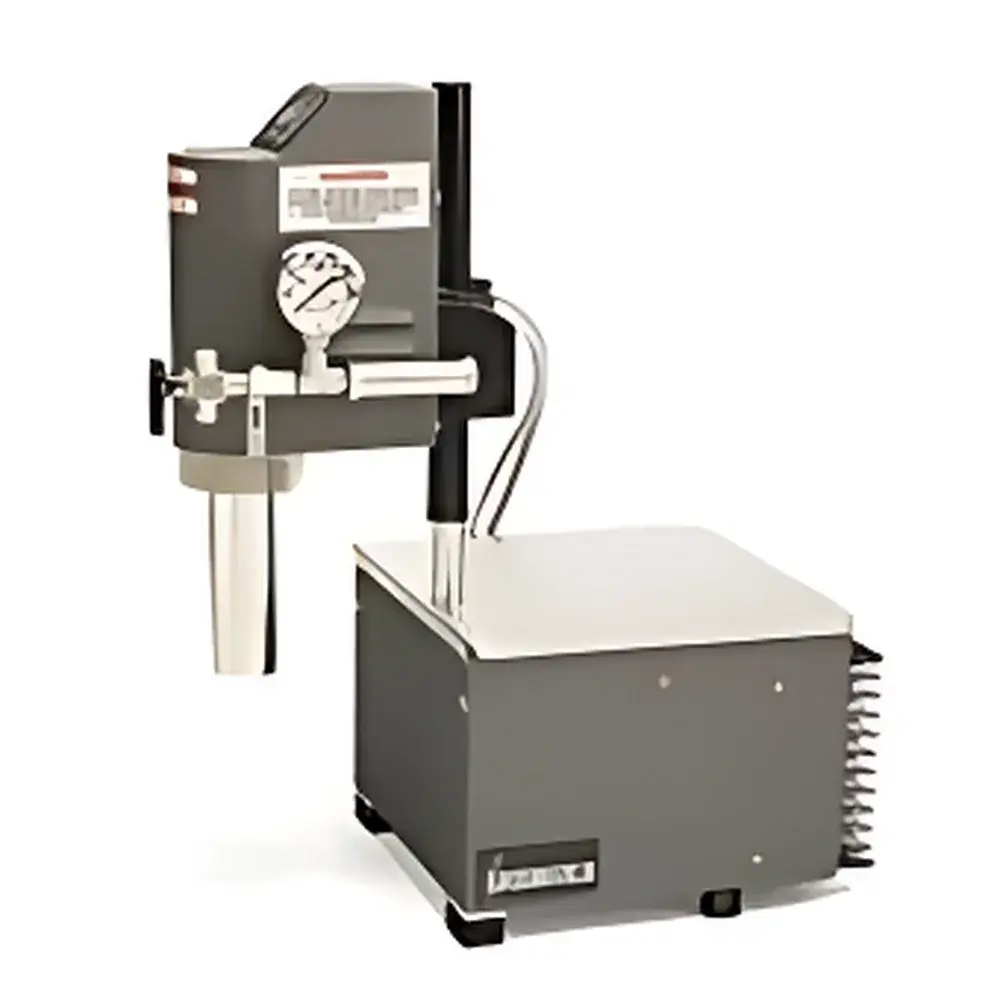
Brookfield PVS Portable Viscometer/Rheometer
| Brand | Brookfield |
|---|---|
| Origin | USA |
| Model | PVS |
| RPM Range | 0.05 – 1000 rpm |
| Minimum Shear Rate | 0.02 s⁻¹ |
| Operating Temperature | −40 °C to +200 °C |
| Pressure Range | Vacuum to 1000 psi |
| Sample Cup & Rotor Material | Hastelloy® |
| Portability | Hand-carried field instrument |
Overview
The Brookfield PVS Portable Viscometer/Rheometer is a purpose-engineered rotational rheological measurement system designed for field-deployable, high-fidelity viscosity and flow behavior characterization under extreme process conditions. Unlike benchtop rheometers constrained to climate-controlled laboratories, the PVS operates on the Couette principle—measuring torque required to rotate a cylindrical spindle (rotor) within a concentric sample cup at precisely controlled angular velocities. This geometry ensures well-defined shear fields and enables direct calculation of shear stress and shear rate, supporting both Newtonian and non-Newtonian fluid modeling (e.g., power-law, Herschel-Bulkley). Its ruggedized architecture, sealed measurement chamber, and Hastelloy® wetted components allow reliable operation across upstream oilfield, chemical manufacturing, and pulp & paper environments where temperature extremes, pressure differentials, and aggressive media are routine.
Key Features
- True portable design: Compact footprint, integrated battery option (optional), and lightweight chassis enable rapid deployment to remote well sites, offshore platforms, or production lines without requiring fixed infrastructure.
- Hastelloy® sample cup and rotor assembly: Resists corrosion from H₂S, CO₂-saturated brines, organic solvents, caustic black liquor, and oxidizing acid systems—validated per ASTM G31 immersion testing protocols.
- Wide operational envelope: Certified performance from −40 °C to +200 °C with optional external temperature control jackets; compatible with pressure-rated enclosures supporting vacuum to 1000 psi (6.9 MPa) static pressure.
- Ultra-low shear capability: Achieves shear rates down to 0.02 s⁻¹ via precision stepper motor control and high-resolution encoder feedback—critical for yield stress evaluation and gel structure analysis in drilling muds and fracturing fluids.
- Sealed, vapor-tight measurement cell: Prevents volatilization losses during testing of low-boiling-point hydrocarbons, monomers, or solvent-based coatings—ensuring mass-consistent rheological data per ISO 2555 and ASTM D1084.
- Rapid setup protocol: Tool-free rotor insertion, snap-fit cup alignment, and auto-zeroing calibration reduce time-to-first-measurement to under 3 minutes—minimizing downtime during QC checks or troubleshooting.
Sample Compatibility & Compliance
The PVS accommodates heterogeneous, particulate-laden, and thermally unstable samples commonly encountered in petroleum services and industrial processing—including water-based and oil-based drilling fluids, crosslinked guar gels, synthetic-based muds, crude emulsions, spent caustic streams, and concentrated black liquor. Its geometry supports representative sampling volumes (typically 15–25 mL) while maintaining laminar flow fidelity across the full shear rate range. Instrument compliance aligns with industry-relevant standards: test procedures adhere to ASTM D2196 (non-Newtonian fluids), ISO 3219 (rheological terms), and API RP 13B-1 (drilling fluid rheology). Data acquisition meets GLP documentation requirements, with timestamped metadata traceable to NIST-traceable torque and temperature sensors.
Software & Data Management
The PVS interfaces via USB or Bluetooth to Brookfield’s Rheo3000 software platform, which provides real-time viscosity vs. shear rate curve generation, yield point estimation (Casson, Bingham, or Herschel-Bulkley fitting), and thixotropy loop analysis. All raw sensor data—including temperature, pressure (when transducer-equipped), torque, and angular displacement—is logged at ≥10 Hz with embedded audit trail functionality compliant with FDA 21 CFR Part 11 for electronic records and signatures. Export formats include CSV, Excel (.xlsx), and XML for integration into LIMS or MES systems. Software validation packages (IQ/OQ documentation) are available upon request for regulated environments.
Applications
- Oilfield services: On-site rheological profiling of fracturing fluids pre- and post-crosslinking; real-time monitoring of thermal degradation in HT/HP wellbore fluids.
- Drilling operations: Field verification of yield point, plastic viscosity, and gel strength per API RP 13B-1 specifications—reducing reliance on offsite lab turnaround.
- Pulp & paper: Viscosity stability assessment of alkaline black liquor during evaporation and recovery cycles—supporting digester control and energy optimization.
- Chemical manufacturing: In-process quality assurance of volatile organic formulations (e.g., adhesives, resins) without sample transfer artifacts.
- Environmental remediation: Rheological screening of contaminated slurry suspensions prior to dewatering or thermal treatment.
FAQ
Is the PVS suitable for yield stress determination?
Yes—the instrument’s sub-0.1 s⁻¹ shear rate capability, combined with controlled ramp-and-hold protocols in Rheo3000 software, enables robust yield stress quantification using multiple regression models.
Can it be used in explosive atmospheres?
The base PVS unit is not intrinsically safe; however, it may be operated inside certified explosion-proof enclosures (Class I, Division 1) when paired with appropriate barrier systems and pressure-rated viewports.
Does it support automated temperature ramping?
Temperature control is externally managed via compatible circulators or heating jackets; the PVS reports real-time temperature but does not drive thermal units directly.
How is calibration verified in the field?
Users perform daily torque zeroing and verify rotational accuracy using NIST-traceable reference oils (e.g., Cannon-Manning series); full calibration certificates are issued annually by authorized Brookfield service centers.
What maintenance intervals are recommended for harsh-service use?
Hastelloy® components require visual inspection after every 50 hours of exposure to corrosive media; O-rings and seals should be replaced quarterly under continuous operation in abrasive slurries.



