
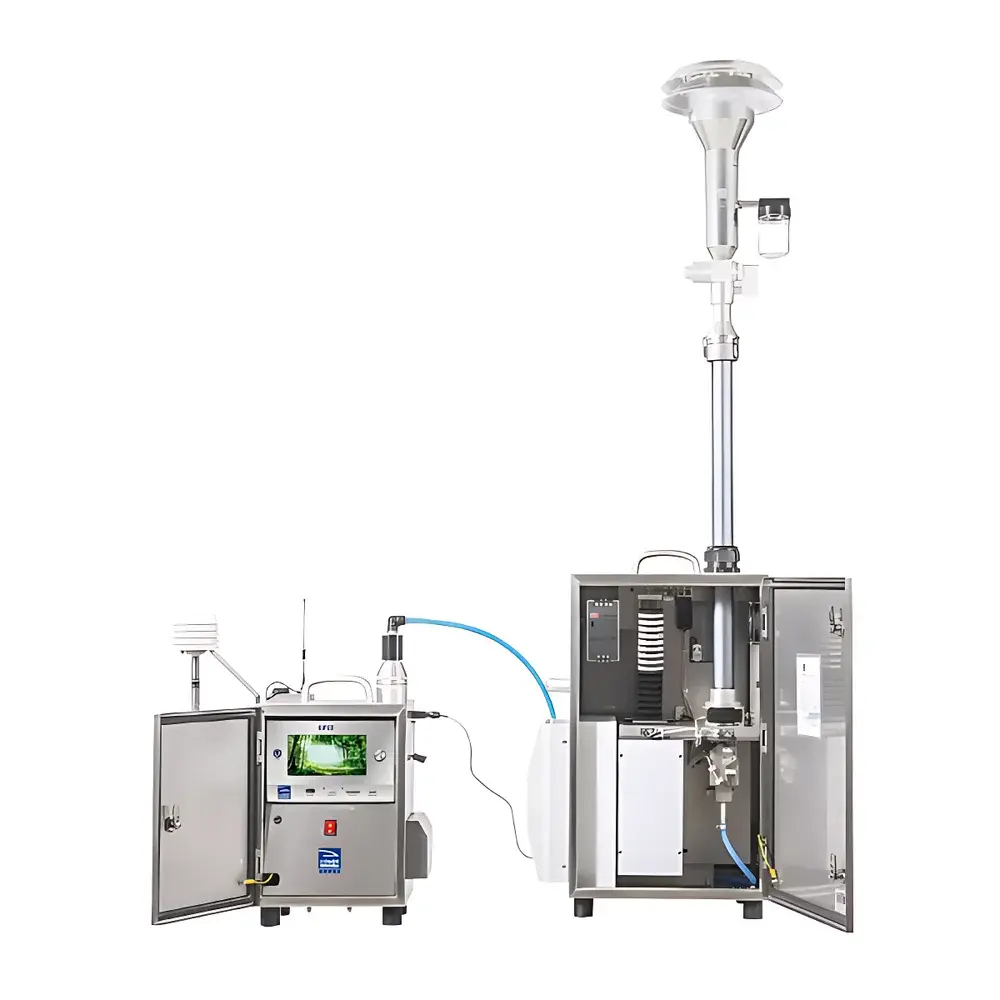
Derenda LVS+AFC Split-Configuration Automated Filter-Changing Particulate Matter Sampler
| Brand | Derenda |
|---|---|
| Origin | Germany |
| Model | LVS+AFC |
| Flow Range | 1.0–3.5 m³/h (adjustable) |
| Vacuum Pressure | >800 hPa |
| Flow Stability | ≤2.0% deviation over 24 h |
| Maximum Flow Error | ≤±2.0% |
| Operating Duration at Max Flow & Load | 1 min–999 h |
| Service Life at Max Flow & Load | >50,000 h |
| Filter Diameter | 47 mm |
| Power Supply | 220 V ±10%, 50 Hz |
| Power Consumption | 350 VA (without Peltier cooling) / 470 VA (with cooling) |
| Dimensions (LVS) | 300 × 250 × 450 mm |
| Dimensions (AFC) | 440 × 310 × 700 mm |
| Weight (LVS) | 19.5 kg |
| Weight (AFC) | 24.5 kg |
| Noise Level | <62 dB(A) (per DIN 2058, measured at 8 m) |
| Operating Temperature | −30°C to +50°C |
| Operating Humidity | 0–100% RH |
| Ingress Protection | IP55 (without Peltier module) |
Overview
The Derenda LVS+AFC Split-Configuration Automated Filter-Changing Particulate Matter Sampler is a precision-engineered, dual-unit ambient air monitoring system designed for regulatory-grade gravimetric sampling of PM10 and PM2.5. It operates on the principle of isokinetic low-to-medium flow filtration, where airborne particles are drawn through standardized 47 mm diameter filters at precisely controlled volumetric flow rates (1.0–3.5 m³/h). The system’s modular architecture—comprising the portable LVS sampler and the standalone Automatic Filter Changer (AFC)—enables both flexible field deployment and unattended long-term operation. Unlike monolithic samplers, the LVS+AFC configuration allows physical separation of the airflow unit and filter handling subsystem, reducing thermal and mechanical cross-interference while enhancing serviceability and transport logistics. Its design complies with the core physical and metrological requirements of ISO 12103-1, EN 12341, and U.S. EPA Reference Method PS-1, and is validated for conformance with Chinese national standards HJ 618-2011, HJ 656-2013, and HJ 93-2013 for manual gravimetric PM measurement.
Key Features
- True split-configuration architecture: LVS (portable sampler) and AFC (filter changer) operate independently or in tandem via dedicated pneumatic and RS-485 data interfaces.
- 16-position mechanical filter magazine: Engineered with stainless steel leaf springs and precision-machined guide rails to ensure consistent, jam-free filter positioning and retention—eliminating membrane skewing or slippage during extended campaigns.
- Integrated Peltier-cooled filter storage compartment: Maintains internal temperature ≤20°C continuously, minimizing volatilization losses of semi-volatile organic compounds (SVOCs), ammonium nitrate, and other thermally labile species per EPA OTM-11 and EU PM2.5 speciation guidance.
- RFID-enabled filter cassette identification: Each 47 mm filter holder embeds a passive UHF RFID tag; the AFC reads and logs filter ID, pre- and post-sampling mass metadata, and timestamped installation/removal events—ensuring full chain-of-custody traceability.
- Dual GNSS positioning (GPS + BeiDou): Delivers sub-5 m horizontal accuracy under open-sky conditions and maintains positional integrity in urban canyons and high-latitude regions.
- Real-time environmental parameter logging: Onboard sensors record ambient temperature, relative humidity, and barometric pressure at 1-minute intervals, with synchronized graphical display and exportable time-series data.
- Robust environmental resilience: IP55-rated enclosure (AFC), −30°C to +50°C operational range, and <62 dB(A) acoustic emission support deployment in remote stations, roadside sites, and industrial fence-line monitoring networks.
Sample Compatibility & Compliance
The LVS+AFC accommodates standard 47 mm quartz fiber, Teflon®, cellulose ester, and polyvinyl chloride (PVC) filters used in regulatory PM mass and chemical speciation analysis. Its flow control system meets the dynamic pressure and stability criteria defined in HJ 93-2013 and EN 12341 Annex B for reference samplers. All firmware and data handling routines are structured to support audit-ready documentation per GLP and ISO/IEC 17025 requirements. Optional meteorological sensor integration (wind speed/direction, precipitation) enables co-located analysis of PM concentration dynamics against local dispersion conditions—facilitating source apportionment modeling and receptor modeling workflows compliant with EMEP/EEA and U.S. EPA Guideline on PM Source Apportionment.
Software & Data Management
The system runs embedded Linux-based firmware with secure TLS 1.2 communication protocols. Field configuration, mission scheduling, and real-time status monitoring are performed via a web-based dashboard accessible over 3G/4G LTE or Ethernet. All sampling events—including filter swaps, flow deviations, temperature excursions, and power interruptions—are logged with cryptographic timestamps and stored locally (8 GB onboard eMMC) and redundantly in encrypted cloud storage. Data exports comply with CF-NetCDF and EPA Air Quality System (AQS) format specifications. Remote firmware updates are digitally signed and validated prior to installation. Audit trails include user login history, parameter change logs, and electronic signatures aligned with FDA 21 CFR Part 11 principles for regulated environments.
Applications
- Long-term ambient air quality monitoring networks requiring >16-day unattended operation without manual filter intervention.
- Source characterization studies where temporal resolution of PM composition (e.g., sulfate, nitrate, elemental carbon) demands strict sample integrity across diurnal cycles.
- Method validation and intercomparison exercises between reference, equivalent, and indicative PM monitors under ISO 5725 and EURAMET CG-18 frameworks.
- Indoor/outdoor exposure assessment in occupational health settings, leveraging the system’s portability and low-noise operation.
- Mobile monitoring platforms (e.g., vehicle-mounted or drone-deployed auxiliary units) using the compact LVS unit alone for targeted short-duration sampling.
FAQ
Does the LVS+AFC support multi-filter sequential sampling for different analytical endpoints (e.g., IC, ICP-MS, OC/EC)?
Yes—each filter position in the AFC can be assigned a unique analytical purpose via the scheduler interface. Predefined filter types and target analytes are linked to individual cassettes, enabling automated assignment of appropriate substrates (e.g., quartz for thermal-optical carbon analysis, Teflon for ion chromatography).
How is flow calibration traceability maintained?
The LVS incorporates a NIST-traceable thermal mass flow sensor calibrated against primary standards at accredited laboratories. Daily zero/span checks and quarterly full-range verification are supported via built-in diagnostics and external calibrator port compatibility (e.g., DryCal DC Series).
Can the system operate autonomously during grid power outages?
With optional external 12 V DC battery bank (not included), the LVS+AFC sustains operation for up to 72 hours at 1.0 m³/h flow. Internal supercapacitors preserve RAM state and clock integrity during brief interruptions.
Is the RFID system compatible with laboratory LIMS platforms?
Yes—the system exports RFID event logs in CSV and XML formats with ISO/IEC 15962-compliant encoding. API endpoints allow direct ingestion into major LIMS vendors (e.g., Thermo Fisher SampleManager, LabVantage) via RESTful webhooks.
What maintenance intervals are recommended for long-term reliability?
Filter carriage mechanism inspection every 6 months; pump diaphragm replacement every 10,000 operating hours; annual recalibration of flow sensor and environmental sensors by an authorized Derenda service center.
Related Products







