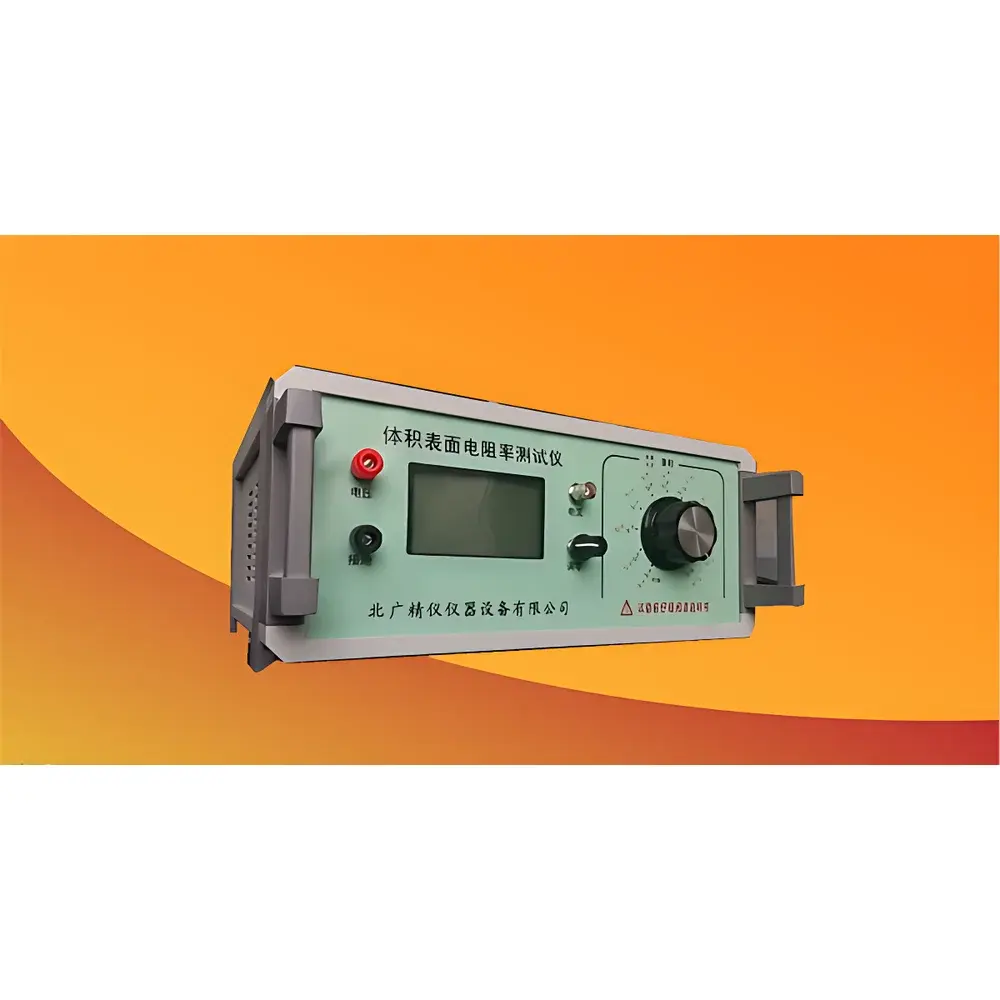
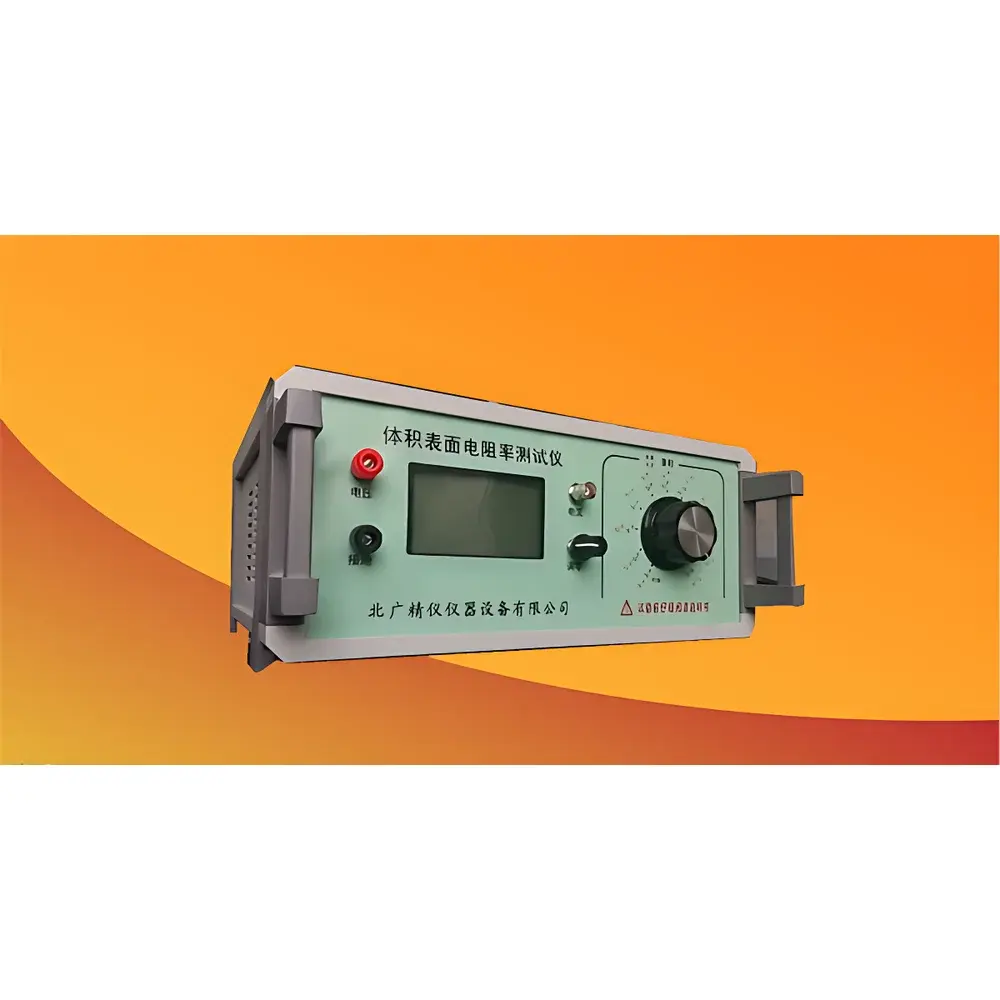
Beiguang Jingyi BEST-121 High-Resistance Meter for Volume & Surface Resistivity Measurement in Rubber, Plastic, and Electrostatic-Control Materials
| Brand | Beiguang Jingyi / All Precision Instrument |
|---|---|
| Origin | Beijing, China |
| Manufacturer Type | Direct Manufacturer |
| Product Origin | Domestic (China) |
| Model | BEST-121 |
| Test Voltage Range | 10 V, 50 V, 100 V, 250 V, 500 V, 1000 V DC |
| Resistance Measurement Range | 1×10⁴ Ω to 1×10¹⁸ Ω |
| Current Measurement Range | 2×10⁻⁴ A to 1×10⁻¹⁶ A |
| Accuracy | ±1% (typical, per selected voltage/range combination) |
| Input Impedance | >10¹⁵ Ω |
| Power Supply | AC 220 V ±10%, 50 Hz |
| Power Consumption | ~5 W |
| Dimensions (L×W×D) | 355 mm × 320 mm × 145 mm |
| Weight | ~6 kg (main unit) |
| Compliance | GB/T 1410-2006, ASTM D257, ISO 3915, IEC 62631-3-1 |
Overview
The Beiguang Jingyi BEST-121 High-Resistance Meter is a precision digital instrument engineered for the accurate measurement of volume resistivity (ρv) and surface resistivity (ρs) in solid insulating and electrostatic-dissipative materials. Designed specifically for R&D laboratories, QC departments, and compliance testing facilities in the rubber, plastic, electronics, textile, and protective equipment industries, it operates on the principle of direct current (DC) voltage application and simultaneous high-impedance current sensing. Unlike analog megohmmeters relying on mechanical deflection, the BEST-121 employs a dual-channel, microprocessor-controlled architecture that measures both applied test voltage (V) and resulting current (I) in real time, computes R = V/I via high-resolution A/D conversion, and displays resistance values digitally—eliminating nonlinearity errors inherent in traditional analog scales. Its input impedance exceeds 10¹⁵ Ω, ensuring minimal loading error even at ultra-high resistance levels up to 1×10¹⁸ Ω (tested at 1000 V DC). The instrument supports standardized three-electrode configurations per GB/T 1410-2006 and ASTM D257, enabling reproducible measurements of bulk conductivity, interfacial leakage, and charge dissipation characteristics critical for ESD-safe material qualification.
Key Features
- Dual digital display: Simultaneous 3½-digit LED readouts for resistance (Ω) and current (A), enabling real-time correlation of electrical response under variable bias.
- Adjustable DC test voltages: Six precisely regulated output levels—10 V, 50 V, 100 V, 250 V, 500 V, and 1000 V—selected manually to match material type, thickness, and standard requirements.
- Extended measurement range: Covers 14 decades of resistance (1×10⁴ Ω to 1×10¹⁸ Ω) and 12 decades of current (2×10⁻⁴ A to 1×10⁻¹⁶ A), supporting both conductive composites and Class I insulators.
- High-input-impedance amplifier: Integrated electrometer-grade front-end with >10¹⁵ Ω input impedance minimizes measurement drift and ensures stability during long-duration tests.
- Three-terminal measurement architecture: Compatible with guarded electrode systems (e.g., concentric ring, parallel plate) to isolate surface conduction from bulk conduction per IEC 62631-3-1.
- Low power consumption (~5 W) and compact footprint (355 × 320 × 145 mm): Optimized for benchtop integration in controlled lab environments without thermal or spatial constraints.
Sample Compatibility & Compliance
The BEST-121 is validated for use with diverse material forms including vulcanized rubber sheets, polymer films, antistatic flooring tiles, conductive fibers, ESD-safe garments, insulating coatings, liquid plasticizers, and composite laminates. It fully supports test protocols defined in GB/T 1410-2006 (equivalent to IEC 60093), ASTM D257, ISO 3915 (resistivity of conductive plastics), and IEC 62631-3-1 (dielectric properties of solid insulating materials). Its design aligns with GJB 3007A-2009 (ESD control in defense electronics), GB 50611-2010 (electronic facility grounding), and GB/T 22042-2008 (garment surface resistivity). When paired with temperature-controlled environmental chambers or water baths, it enables resistivity vs. temperature profiling per GB/T 10581-2006, supporting accelerated aging and thermal stability assessments.
Software & Data Management
While the BEST-121 operates as a standalone benchtop instrument with no embedded PC interface, its analog-compatible output signals (0–1 V proportional to log R or I) support integration with external data acquisition systems (e.g., National Instruments DAQ, LabVIEW) for automated logging, statistical process control (SPC), and GLP-compliant audit trails. All measurements adhere to traceable calibration practices per ISO/IEC 17025; factory calibration certificates include uncertainty budgets referenced to NIM (National Institute of Metrology, China) standards. For regulated environments, users may implement manual SOP-driven documentation aligned with FDA 21 CFR Part 11 principles—though native electronic signature or audit trail functionality is not built-in.
Applications
- Quality assurance of antistatic rubber compounds used in conveyor belts, gaskets, and cleanroom footwear per GB 4385-1995 and GB/T 18864-2002.
- Volume resistivity verification of carbon-black-filled polyethylene cables and insulating sheaths per GB/T 12703.4-2010 and IEC 60811-3-1.
- Surface resistivity mapping of ESD-safe work surfaces, floor tiles (GB 26539-2011), and semiconductor handling trays.
- Conductivity screening of conductive adhesives, antistatic coatings (GJB 5104-2004), and corrosion-resistant polymer composites (GB/T 26825-2011).
- Research-grade characterization of dielectric breakdown precursors in high-performance insulation systems for aerospace and energy applications.
FAQ
Does the BEST-121 comply with international ESD standards such as ANSI/ESD S20.20?
Yes—it meets the instrumentation requirements for resistance verification per ANSI/ESD STM11.11 (surface resistance) and STM11.12 (volume resistance), when used with certified electrodes and calibrated reference resistors.
Can it measure liquids like plasticizers or solvents?
Yes, when used with a dedicated liquid cell compliant with GB 1672-8 and ASTM D1169; temperature-controlled bath integration is recommended for viscosity-sensitive samples.
Is guard terminal (G) connection supported for leakage suppression?
Yes—the instrument includes a dedicated guard terminal to shunt surface leakage currents, essential for accurate volume resistivity measurement of hygroscopic or contaminated specimens.
What is the typical calibration interval?
Annual calibration is recommended per ISO/IEC 17025 guidelines; internal zero and span checks should be performed before each test session using open-circuit and short-circuit verification.
Does it support automated test sequencing or pass/fail thresholds?
No—the BEST-121 is a manual-operated, operator-interpreted instrument. Automated decision logic requires external programmable logic controllers or SCADA integration via analog outputs.