
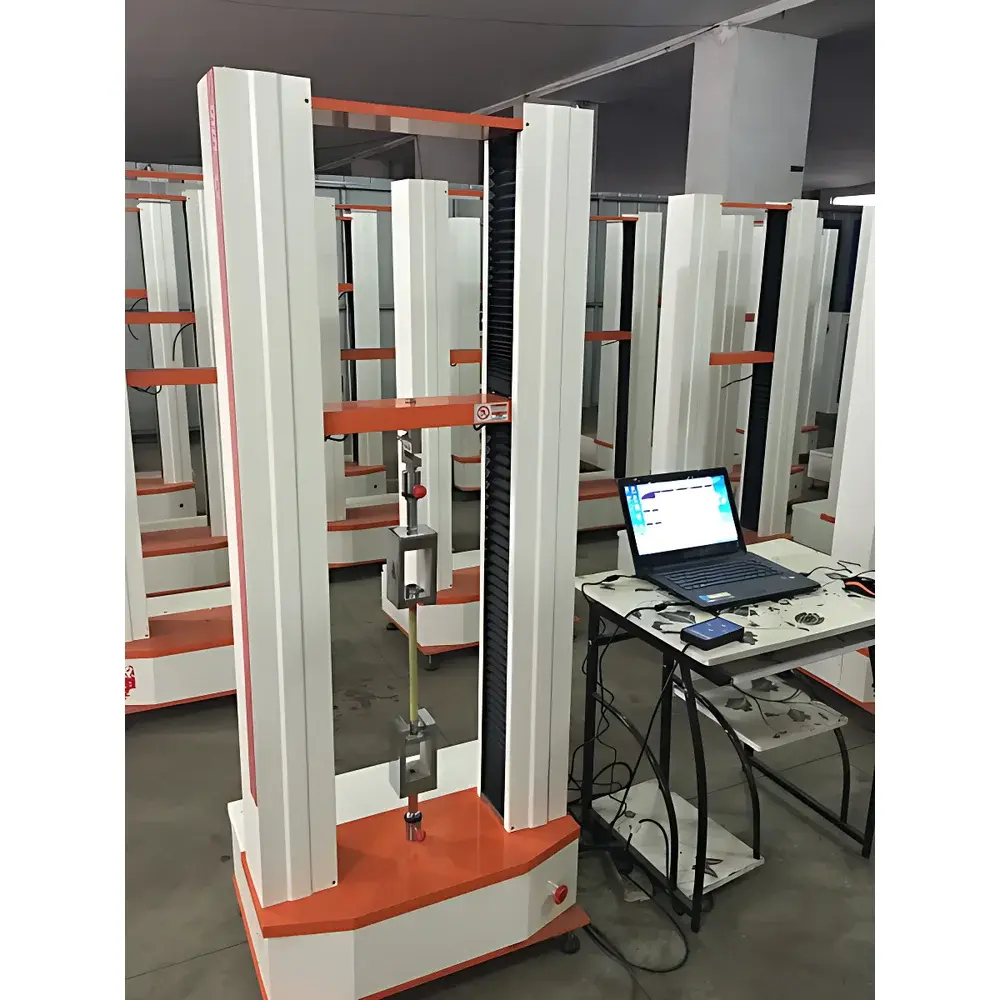
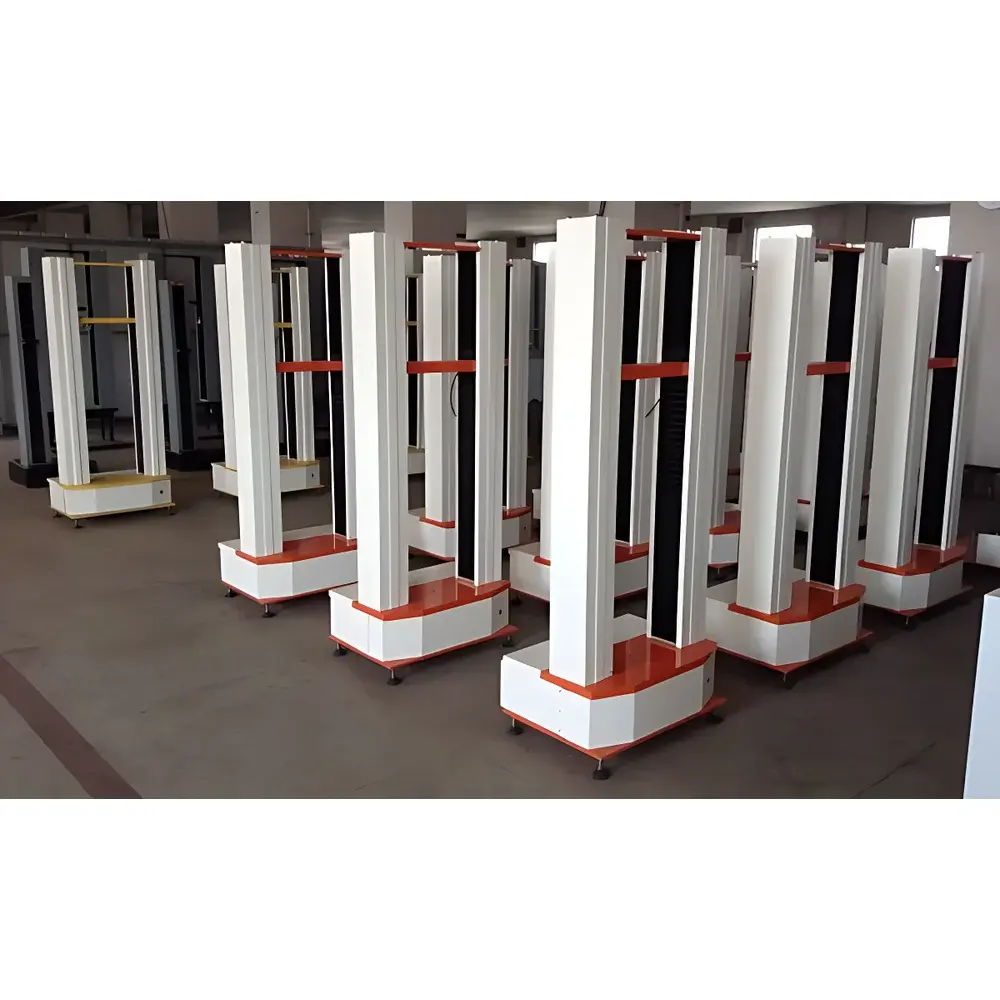
Beiguang Jingyi BG-10KN Nano-Materials Tensile Testing Machine
| Brand | Beiguang Jingyi / All Precision Instrument |
|---|---|
| Origin | Beijing, China |
| Manufacturer Type | Direct Manufacturer |
| Instrument Type | Electromechanical Universal Testing Machine |
| Model | BG-10KN |
| Load Capacity | 10 kN |
| Force Accuracy | ≤0.5% FS |
| Force Resolution | 1/10000 |
| Displacement Accuracy | ≤0.5% FS |
| Displacement Resolution | 1/1000 |
| Extensometer Accuracy (Metal) | ≤0.5% FS |
| Large-Deformation Extensometer Accuracy | ±1 mm |
Overview
The Beiguang Jingyi BG-10KN Nano-Materials Tensile Testing Machine is an electromechanical universal testing system engineered for high-fidelity mechanical characterization of nanoscale and microstructured materials under uniaxial loading conditions. It operates on the principle of controlled displacement-driven force measurement, utilizing a precision ball-screw actuation system coupled with high-stability load cell feedback (5 kN optional range) and real-time encoder-based position tracking. Designed to meet the stringent metrological demands of nanomaterial research—such as carbon nanotube films, graphene oxide membranes, electrospun nanofibers, and polymer-nanocomposite thin films—the system delivers reproducible stress–strain response data across low-force, high-resolution regimes where conventional UTM platforms often lack sensitivity or stability. Its modular architecture supports ISO 527, ASTM D638, ASTM D882, ISO 179, and GB/T 1040-compliant test protocols while maintaining compliance readiness for GLP environments through audit-trail-capable software logging.
Key Features
- Electromechanical drive system with closed-loop pulse-command control, enabling speed regulation from 0.01 to 500 mm/min with <0.1% speed stability over full range.
- Seven-segment automatic force range switching (×1 to ×100), eliminating manual gain adjustment and ensuring optimal signal-to-noise ratio across sub-newton to 10 kN loads.
- High-resolution optical encoder (2500 P/R, quadrature output) delivering 0.001 mm displacement resolution and robust noise immunity via LINE DRIVE interface.
- Dual extensometry support: clip-on metal extensometer (≤0.5% accuracy) and non-contact large-deformation sensor (±1 mm absolute accuracy) for strain measurement up to 1000% elongation.
- Integrated safety architecture including overload emergency stop, mechanical travel limit switches, earth-leakage protection, and auto-stop at break detection.
- Modular crosshead adjustment with coarse/fast and fine/slow dual-mode positioning for rapid specimen alignment and repeatable gauge length setup.
Sample Compatibility & Compliance
The BG-10KN accommodates specimens ranging from freestanding nanofiber mats (width: 1–20 mm, thickness: <10 µm) to macro-scale composite laminates (up to 400 mm wide × 950 mm traverse). Standard fixtures include pneumatic tensile grips, peel/adhesion fixtures (90°/180°), compression platens, and three-point bending assemblies. Optional accessories include environmental chambers (−40°C to +200°C), video extensometers, and digital image correlation (DIC) integration kits. The system complies with mechanical safety standards IEC 61000-6-2/6-4 and meets electromagnetic compatibility (EMC) Class B requirements. Software functionality aligns with FDA 21 CFR Part 11 for electronic records and signatures when configured with user authentication, audit trail, and electronic signature modules.
Software & Data Management
The UTM107-WIN XP–based control suite provides full traceability and regulatory adaptability. It features modular test standard libraries (ASTM, ISO, DIN, JIS, GB), customizable formula editing for derived parameters (e.g., Young’s modulus, toughness integral), and dual-reporting capability—native PDF export plus direct Excel (.xlsx) data dump with timestamped metadata. Graphical display supports synchronized multi-curve overlays (load–displacement, stress–strain, load–time), dynamic autoscaling, and real-time switching between plot types during active tests. All raw data—including analog A/D samples at 200 Hz—are stored in structured binary archives with SHA-256 checksum validation. Backup is configurable to any local or network-mounted volume. Language support includes English, Simplified Chinese, and Traditional Chinese, with UI elements fully localized per ISO/IEC 15897 conventions.
Applications
This instrument serves academic, industrial, and standards-laboratory applications requiring quantitative mechanical assessment of advanced materials. Typical use cases include: tensile property mapping of CVD-grown graphene monolayers; interfacial adhesion strength evaluation in nano-coated biomedical implants; creep and relaxation behavior analysis of shape-memory polymer nanocomposites; fracture energy quantification in self-healing hydrogels; and modulus gradient profiling across electrospun nanofiber scaffolds. It is also employed in quality assurance workflows for battery separator films, flexible electronics substrates, and aerospace-grade nanoreinforced resins—where batch-to-batch consistency must be verified against internal specifications or third-party certification criteria (e.g., UL 94, MIL-STD-810).
FAQ
What is the minimum measurable force resolution at full 10 kN capacity?
The system achieves 1 N effective resolution at 10 kN full scale, corresponding to 0.01% of capacity, enabled by 24-bit A/D conversion and seven-range auto-switching.
Can the software generate reports compliant with ISO/IEC 17025 documentation requirements?
Yes—when operated with enabled audit trail, user role management, and electronic signature modules, the software satisfies clause 7.8.2 (reporting results) and clause 8.9 (nonconforming work) documentation traceability requirements.
Is calibration certificate included with shipment?
A factory-issued calibration report traceable to CNAS-accredited reference standards is provided; optional UKAS or NIST-traceable certificates are available upon request.
Does the system support third-party extensometers via analog or digital interface?
Yes—RS232 and analog ±10 V outputs are available for integration with external video extensometers or laser Doppler sensors.
What is the typical lead time for OEM branding or custom firmware modifications?
Standard delivery is 1–2 business days for in-stock units; OEM labeling adds 5–7 working days; firmware-level customization requires formal specification review and typically extends lead time by 3–4 weeks.



