
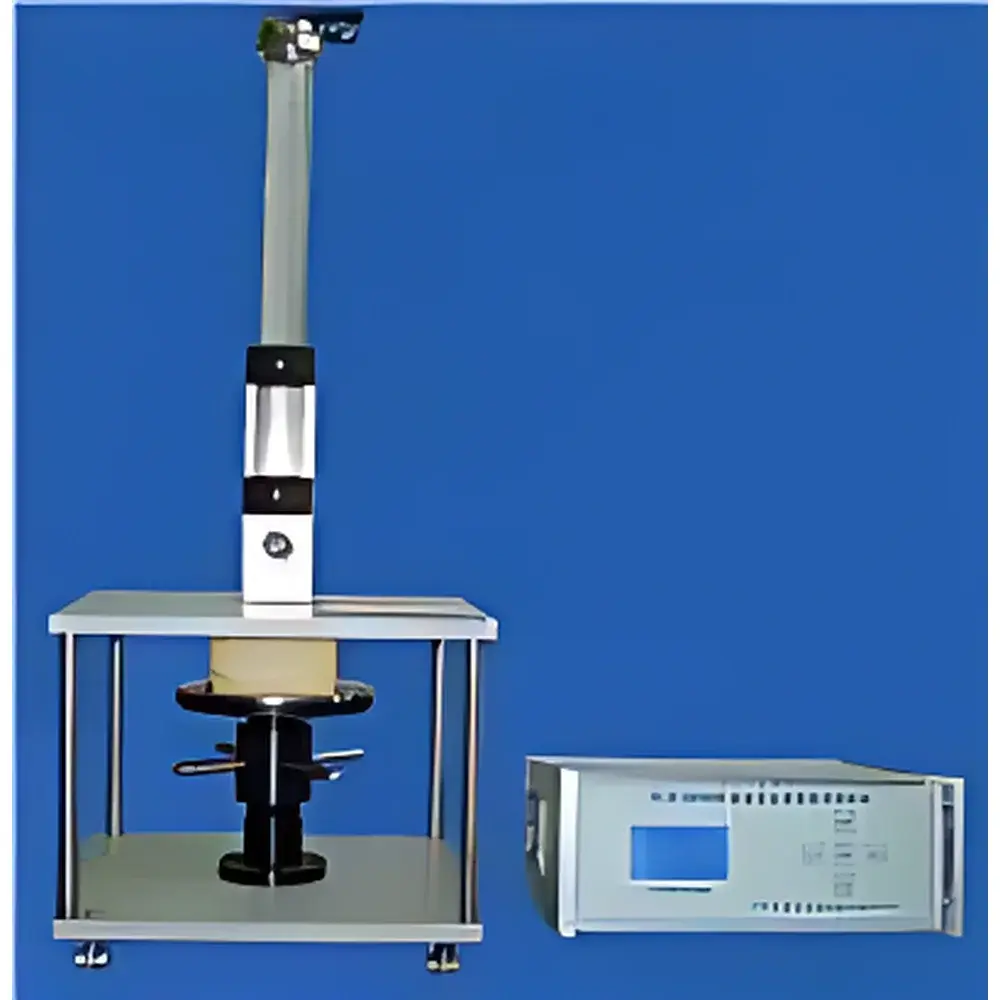
North Guang Precision Instrument LQ-500 Falling Ball Rebound Tester for Flexible Polyurethane Foam
| Brand | North Guang Precision Instrument / All Precision Instrument |
|---|---|
| Origin | Beijing, China |
| Manufacturer Type | Direct Manufacturer |
| Product Origin | Domestic (China) |
| Model | LQ-500 |
| Price | USD 980 (FOB Beijing, ex-factory) |
| Drop Height | 460 ± 0.5% mm (GB/T 6670-2008) / 500 ± 0.5% mm (ASTM D3574 & ISO 8307) |
| Steel Ball Diameter | Ø16.00 ± 0.05 mm |
| Ball Mass | 16.0 ± 0.1 g (standardized per ASTM/ISO) |
| Sample Dimensions | 100 × 100 × 100 mm (L × W × H) |
| Rebound Rate Accuracy | < ±1.5% (relative standard deviation across ≥5 repeated drops) |
| Display | LCD with Chinese/English bilingual interface |
| Data Output | Built-in thermal printer |
| Control System | Embedded microprocessor with automatic averaging of rebound height and rebound percentage |
Overview
The North Guang Precision Instrument LQ-500 Falling Ball Rebound Tester is an engineered solution for quantifying the elastic recovery behavior of flexible polymeric foams—primarily soft polyurethane (PU) and viscoelastic polyether/polyester foams—according to internationally harmonized mechanical testing standards. It operates on the fundamental principle of gravitational energy conversion: a standardized steel ball is released from a precisely controlled height onto a horizontally positioned foam specimen; the maximum rebound height is optically or sensor-assisted measured, and the rebound ratio (rebound height ÷ drop height × 100%) is calculated as the primary performance metric. This method directly correlates with the material’s internal energy dissipation characteristics, crosslink density, and cell wall resilience—parameters critical in automotive seating, mattress comfort layer design, packaging cushioning validation, and medical support surface qualification. The LQ-500 complies with GB/T 6670–2008, ASTM D3574 (Test Method B), and ISO 8307, ensuring data comparability across global R&D labs, QC departments, and third-party certification bodies.
Key Features
- High-precision drop height control: Dual-height configuration (460 mm for GB/T compliance; 500 mm for ASTM/ISO alignment), each maintained within ±0.5% tolerance via CNC-machined guide column and pneumatic release mechanism.
- Calibrated impact mass: Spherical steel ball (Ø16.00 ± 0.05 mm, 16.0 ± 0.1 g) manufactured to ISO 3290 Grade 1 tolerances, traceable to NIM (National Institute of Metrology, China) certified reference standards.
- Optical rebound detection: Non-contact infrared sensor array captures peak rebound displacement with sub-millimeter resolution, eliminating parallax error associated with manual scale reading.
- Automated statistical processing: Microprocessor computes mean rebound height, coefficient of variation (CV%), and final rebound percentage across up to 10 consecutive drops—fully compliant with ASTM D3574 repeatability requirements (n ≥ 5).
- Bilingual LCD interface: Real-time display of individual drop height, rebound height, rebound %, CV%, and pass/fail status relative to user-defined specification limits.
- Integrated thermal printer: Generates audit-ready test reports including date/time stamp, operator ID, sample ID, environmental conditions (optional external hygrothermograph input), and raw measurement logs.
Sample Compatibility & Compliance
The LQ-500 accommodates standard test specimens measuring 100 mm × 100 mm × 100 mm (L × W × H), conforming to dimensional requirements in all three referenced standards. Specimens must be conditioned at 23 ± 2 °C and 50 ± 5% RH for minimum 16 hours prior to testing (per ISO 291 and ASTM D618). The instrument supports comparative evaluation of slabstock, molded, and rebonded foams—including flame-retardant, bio-based, and nanocomposite variants—provided surface flatness meets ≤0.5 mm deviation over the 100 mm contact area. Compliance documentation includes factory calibration certificates (traceable to SI units), verification protocols aligned with ISO/IEC 17025 clause 6.5, and compatibility with GLP/GMP laboratory workflows requiring instrument qualification (IQ/OQ/PQ) packages.
Software & Data Management
While the LQ-500 operates as a standalone embedded system, its printed output conforms to FDA 21 CFR Part 11–compatible record formats when integrated into validated laboratory information management systems (LIMS). Raw data fields—including timestamp, drop sequence number, measured rebound height (mm), calculated rebound %, and operator confirmation code—are structured for direct import into Excel, Minitab, or JMP for SPC analysis. Optional RS-232 or USB-to-serial interface enables automated data logging to networked PCs running custom Python- or LabVIEW-based acquisition scripts. Audit trails are preserved via sequential print log numbering and non-erasable thermal paper archives—supporting ISO 9001:2015 Clause 8.5.2 and IATF 16949 traceability mandates.
Applications
- Quality control of flexible PU foam batches in Tier-1 automotive seating suppliers (e.g., evaluating seat cushion resilience vs. long-term compression set).
- R&D screening of novel foam formulations—such as silicone-modified or halogen-free flame-retarded systems—for rebound consistency under accelerated aging (70 °C/96 h per ASTM D3574 Section 8).
- Regulatory submission support for medical device cushioning (ISO 10993-10 biocompatibility adjunct testing) and bedding product certifications (CPSIA, OEKO-TEX Standard 100).
- Supplier qualification audits where rebound % thresholds define contractual acceptance criteria (e.g., ≥55% for premium mattress cores; ≥40% for cost-optimized packaging foams).
- Educational laboratories teaching polymer viscoelasticity fundamentals using time-resolved rebound decay analysis (via optional high-speed camera add-on).
FAQ
Does the LQ-500 meet ASTM D3574 Section B requirements for falling ball rebound?
Yes—the instrument implements the exact 500 mm drop height, Ø16 mm steel ball, and specimen conditioning protocol specified in ASTM D3574–17 Test Method B.
Can test data be exported digitally for statistical process control (SPC)?
Yes—printed reports follow fixed-field formatting suitable for OCR parsing; optional serial interface enables real-time CSV export.
Is calibration traceable to national metrology institutes?
All factory calibrations include NIM-traceable certificates for drop height, ball geometry, and sensor linearity.
What maintenance is required to sustain measurement accuracy?
Quarterly verification of guide column verticality (±0.1°), annual ball surface inspection (no pitting >0.1 µm Ra), and biannual sensor alignment check using certified gauge blocks.
Can the LQ-500 test non-rectangular or curved foam samples?
No—only flat-faced, prismatic specimens meeting the 100 × 100 × 100 mm dimension and parallelism specifications are valid per standard methodology.



