
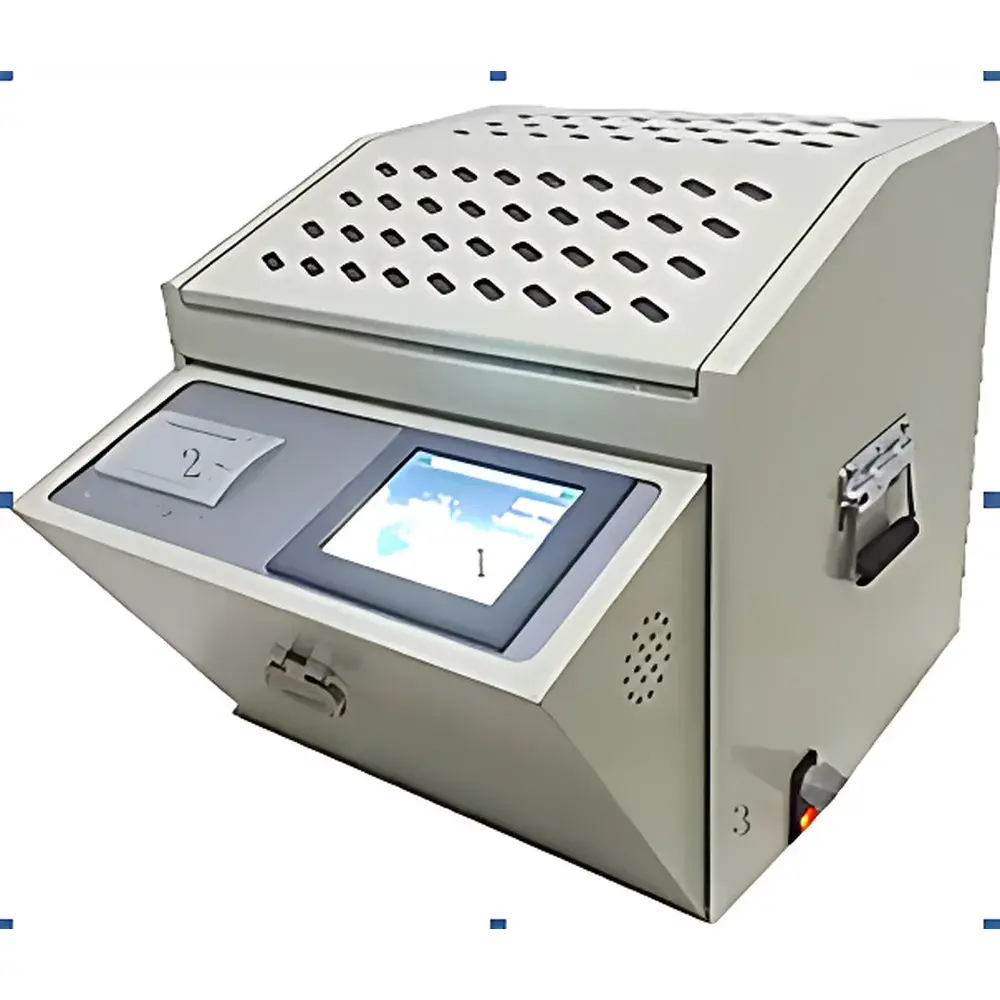
Beijing North Guang Precision Instruments BG-0 Insulating Oil Dielectric Loss & Volume Resistivity Tester
| Brand | Beijing North Guang Precision Instruments |
|---|---|
| Origin | Beijing, China |
| Manufacturer Type | Manufacturer |
| Country of Origin | China |
| Model | BG-0 |
| Breakdown Voltage | 50 kV |
| Capacitance Range | 5–200 pF |
| Relative Permittivity Range | 1.000–30.000 |
| Dissipation Factor Range | 1×10⁻⁵–100 |
| Volume Resistivity Range | 2.5 MΩ·m to 20 TΩ·m |
| Temperature Control Range | 0–125 °C |
| Temperature Accuracy | ±0.5 °C |
| AC Test Voltage | 0–2000 V (50 Hz, continuously adjustable) |
| DC Test Voltage | 0–500 V (continuously adjustable) |
| Power Consumption | ≤100 W |
| Dimensions | 420 × 380 × 385 mm |
| Weight | 21 kg |
Overview
The Beijing North Guang Precision Instruments BG-0 Insulating Oil Dielectric Loss & Volume Resistivity Tester is a fully integrated, microprocessor-controlled instrument engineered for precise, traceable measurement of dielectric dissipation factor (tan δ), relative permittivity (εr), and DC volume resistivity (ρv) in liquid insulating media—primarily transformer oils, turbine oils, and other hydrocarbon-based dielectric fluids. Designed in strict compliance with GB/T 5654–2007 (“Liquid Electrical Insulating Materials — Measurement of Relative Permittivity, Dielectric Dissipation Factor and DC Resistivity”), the system implements a dual-mode test architecture: high-voltage AC bridge methodology for dielectric loss and permittivity, and guarded DC voltage application with electrometer-grade current sensing for volume resistivity. Its core measurement principle relies on precision capacitive bridge balancing under controlled thermal conditions, eliminating stray capacitance and surface leakage via a standardized three-electrode oil cup (electrode gap: 2 mm). All critical subsystems—including the SF6-filled reference capacitor, PID-driven mid-frequency induction heating module, temperature-compensated DSP/FFT signal processor, and isolated HV/DC power supplies—are co-located within a single chassis to ensure metrological integrity, inter-system synchronization, and repeatability across laboratory and field service environments.
Key Features
- Single-cycle automated testing: Simultaneous execution of temperature ramping, dielectric loss measurement, and volume resistivity determination without manual intervention.
- Three-electrode oil cup conforming to GB/T 5654–2007 geometry—designed to suppress edge effects, guard against surface conduction, and enable accurate bulk property extraction.
- Non-contact mid-frequency induction heating with adaptive PID temperature control—ensures uniform thermal distribution across the oil sample, achieving ±0.5 °C stability within the 0–125 °C operating range.
- Digital signal processing (DSP) and fast Fourier transform (FFT) algorithms for real-time harmonic rejection, noise suppression, and stable tan δ calculation at low signal-to-noise ratios.
- Hermetically sealed SF6-filled standard capacitor with intrinsic immunity to ambient humidity and temperature drift—maintains long-term calibration stability per IEC 60250 and ASTM D924 requirements.
- 7-inch full-color capacitive touchscreen with intuitive Chinese GUI; context-sensitive prompts guide operators through setup, calibration, and reporting—no specialized electrical engineering training required.
- Integrated safety interlocks: automatic HV shutdown upon oil cup lid opening, real-time electrode short-circuit detection, and audible/visual fault alerts compliant with IEC 61010-1 safety standards.
- Embedded real-time clock with ISO 8601 timestamping; environmental temperature monitoring; auto-logging of test parameters, operator ID, and ambient conditions alongside results.
- Onboard data storage for up to 100 complete test records—including raw capacitance, tan δ, εr, ρv, temperature profile, and voltage history—with USB export capability.
- Empty-cell calibration function: measures baseline capacitance and dissipation factor of the clean, dry electrode assembly—enabling correction for residual contamination or mechanical misalignment prior to sample analysis.
Sample Compatibility & Compliance
The BG-0 is validated for use with mineral-based, synthetic ester, and silicone dielectric oils meeting IEC 60296, ASTM D3487, and GB 2536 specifications. It supports routine condition monitoring, acceptance testing, and forensic analysis in substation maintenance, transformer manufacturing, and third-party calibration laboratories. The instrument’s measurement protocols align with international regulatory frameworks: dielectric loss testing satisfies IEEE C57.106 and IEC 60156 for insulating oil quality assessment; volume resistivity measurements comply with ASTM D1169 and IEC 60247 for evaluating oxidation byproducts and ionic contamination. Data acquisition and storage meet GLP audit-trail requirements, including user authentication, immutable timestamps, and change logs—facilitating FDA 21 CFR Part 11 readiness when paired with validated LIMS integration.
Software & Data Management
The embedded firmware supports direct printing via integrated thermal printer (report format includes sample ID, test date/time, temperature, applied voltage, measured values, uncertainty estimates, and pass/fail flags per GB/T 5654–2007 acceptance criteria). USB 2.0 interface enables export of CSV-formatted datasets for post-processing in MATLAB, Excel, or statistical process control (SPC) platforms. Optional PC software (BG-DataLink v3.x) provides advanced features: multi-instrument fleet management, trend analysis with Weibull reliability modeling, automated report generation per ISO/IEC 17025 templates, and digital signature support for electronic record retention. All data fields are tagged with metadata (e.g., calibration due date, sensor serial numbers, firmware revision), ensuring full traceability from measurement to certificate.
Applications
- Pre-commissioning verification of new transformer oil batches prior to energization.
- Periodic in-service oil monitoring to detect aging byproducts (e.g., sludge, acids) and moisture ingress.
- Root-cause analysis of unexpected dielectric failures in high-voltage equipment.
- Quality assurance during oil reclamation and regeneration processes.
- Research and development of next-generation bio-based insulating fluids.
- Accredited testing services supporting ISO/IEC 17025-certified laboratories.
FAQ
What standards does the BG-0 comply with for dielectric loss measurement?
It conforms to GB/T 5654–2007, IEC 60250, ASTM D924, and IEEE Std C57.106–2015 for tan δ and relative permittivity testing.
Can the instrument measure both AC and DC properties in one sequence?
Yes—temperature stabilization, AC bridge measurement (tan δ, εr), and DC resistivity determination are executed sequentially under unified control logic without sample handling.
Is external calibration required for the SF6 reference capacitor?
No—the capacitor is factory-calibrated and thermally stabilized; periodic verification using NIST-traceable standards is recommended annually.
How is measurement uncertainty quantified for volume resistivity?
Uncertainty budgets follow GUM (JCGM 100:2008) principles, incorporating contributions from voltage source stability (±0.2%), current measurement resolution (±0.5%), temperature gradient error (±0.3%), and electrode geometry tolerance (±0.1%).
Does the system support remote operation or network connectivity?
The base model operates standalone; Ethernet or RS-485 communication modules are available as optional upgrades for SCADA integration and centralized diagnostics.



