
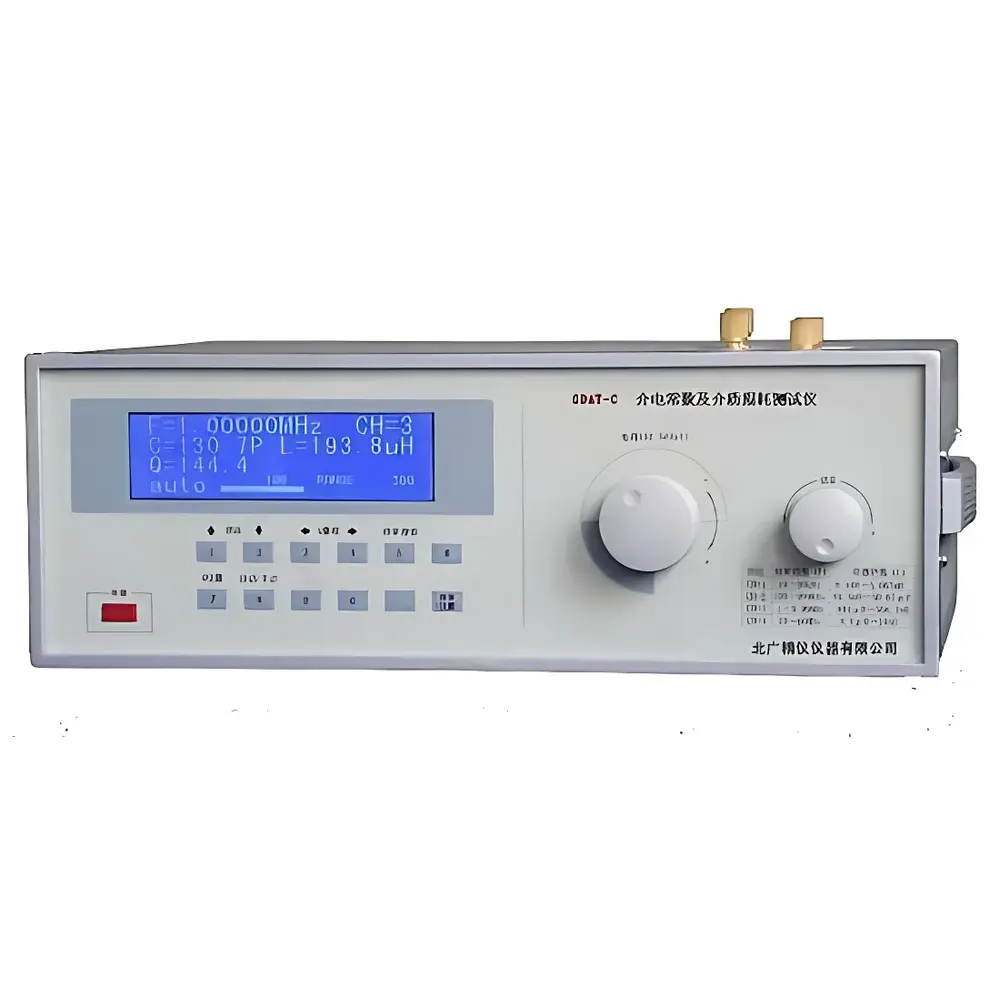
Beiguang Jingyi GDAT-A High-Frequency Dielectric Constant and Dissipation Factor Analyzer
| Brand | Beiguang Jingyi / All Precision Instrument |
|---|---|
| Origin | Beijing, China |
| Manufacturer Type | Direct Manufacturer |
| Country of Origin | China |
| Model | GDAT-A |
| Price | USD 2,800 (FOB Beijing) |
Overview
The Beiguang Jingyi GDAT-A High-Frequency Dielectric Constant and Dissipation Factor Analyzer is a precision impedance measurement instrument engineered for the quantitative characterization of dielectric properties—specifically relative permittivity (εr) and loss tangent (tan δ)—of solid and liquid insulating materials across a broad frequency spectrum. It operates on the principle of high-frequency resonance in a calibrated parallel-plate or coaxial test fixture, where the sample forms part of a tuned LC circuit. By precisely measuring the resonant frequency shift and Q-factor change induced by the dielectric specimen, the instrument calculates εr and tan δ using standardized corrections for fringing fields, electrode geometry, and residual circuit parameters. Designed to comply with GB/T 1409–2006 (“Recommended Methods for Determining Permittivity and Dielectric Loss Factor of Electrical Insulating Materials at Power, Audio, and Radio Frequencies, Including Metric Wavelength Bands”), the GDAT-A supports rigorous material qualification in R&D labs, quality control departments, and academic institutions engaged in polymer science, ceramic development, composite manufacturing, and high-frequency PCB substrate evaluation.
Key Features
- Two configurable high-frequency Q-meter architectures: Model A (25 kHz–60 MHz) and Model C (100 kHz–160 MHz), both employing direct digital synthesis (DDS) signal generation for low harmonic distortion (<–60 dBc), frequency stability (±3×10⁻⁵ ±1 digit), and amplitude consistency.
- Automated resonance detection: Capacitance-sweep or frequency-sweep modes enable rapid identification of series/parallel resonance points without manual iterative tuning.
- Dual-mode capacitance control: Model A uses high-resolution capacitive sensors for main tuning; Model C employs stepper-motor-driven variable capacitor for sub-pF resolution and repeatable positioning.
- Digital readout of all primary parameters: Q value (2–1023), inductance (4.5 nH–140 mH for Model C; 14.5 nH–8.14 H for Model A), capacitance (1–460 pF direct range), and frequency (10 kHz–160 MHz across four selectable bands).
- Q-range auto/manual switching across five decades (30, 100, 300, 1000) with built-in residual parameter correction algorithms per GB/T 1409–2006 Annex B.
- Pre-set Q pass/fail threshold (5–1000) with visual indicator for rapid go/no-go screening in production environments.
Sample Compatibility & Compliance
The GDAT-A accommodates flat solid specimens (e.g., polymer films, ceramic discs, laminated composites) and low-conductivity liquids (e.g., transformer oils, silicone gels, solvent-based resins) using interchangeable electrodes conforming to ASTM D150 and IEC 60250 geometries. Sample thickness must be uniform within ±2% across the electrode area, and surface roughness shall not exceed 0.8 µm Ra for reliable field homogeneity. The system meets electromagnetic compatibility requirements per GB/T 18268.1–2010 (IEC 61326-1) and is suitable for operation under GLP-compliant laboratory conditions (20–25 °C, <70% RH, 220 V ±10%, 50 Hz ±1%). Calibration traceability is maintained via optional LKI-1 reference inductor set (NIST-traceable nominal values), enabling periodic verification per ISO/IEC 17025 internal calibration protocols.
Software & Data Management
While the GDAT-A operates as a standalone benchtop instrument with full front-panel digital display, optional PC connectivity (RS-232 or USB-to-serial) enables automated data logging, batch reporting, and statistical process control (SPC) integration. Exported datasets include timestamped Q, C, fres, εr, and tan δ values in CSV format compatible with MATLAB, JMP, and Minitab. Audit trails—including operator ID, calibration date, fixture configuration, and environmental metadata—are retained locally and may be exported for FDA 21 CFR Part 11–aligned documentation when paired with validated third-party LIMS software. Firmware updates are provided free-of-charge for the instrument’s operational lifetime.
Applications
- Quality assurance of electrical insulation materials (epoxy resins, polyimide films, silicone rubbers) for aerospace wiring and EV battery pack encapsulation.
- Development of low-loss microwave substrates (PTFE composites, alumina ceramics) used in 5G antenna modules and RF filters.
- Characterization of moisture ingress in hygroscopic polymers via time-resolved tan δ monitoring at 1–10 MHz.
- Validation of curing kinetics in thermosetting resins through real-time εr tracking during thermal ramping.
- Comparative analysis of nanofiller dispersion efficiency in conductive polymer composites using frequency-dependent dielectric spectroscopy.
- Educational use in university physics and materials engineering laboratories for teaching complex impedance modeling and Debye relaxation theory.
FAQ
What standards does the GDAT-A directly support?
It is designed and verified for compliance with GB/T 1409–2006, and its measurement methodology aligns with ASTM D150, IEC 60250, and ISO 2577 for permittivity and dissipation factor determination.
Can the GDAT-A measure conductive or semi-crystalline polymers?
Yes—provided bulk conductivity remains below 10−6 S/m and samples are prepared as homogeneous, void-free slabs with parallel, polished surfaces. For highly conductive fillers, contact resistance correction procedures per ASTM D257 must be applied manually.
Is fixture calibration required before each test?
A one-time open/short/load calibration is recommended after initial installation or mechanical disturbance; daily verification using the supplied air-dielectric reference spacer is sufficient for routine operation.
How is residual inductance/capacitance compensated?
The instrument applies built-in correction coefficients derived from empirical measurements on standard inductors (LKI-1 set) and documented in Appendix B of GB/T 1409–2006; no user input is needed for standard configurations.
What maintenance is required to sustain measurement accuracy over time?
Annual verification against certified reference standards is advised; mechanical components require only periodic cleaning with isopropyl alcohol and lint-free wipes—no lubrication or alignment tools are necessary.



