
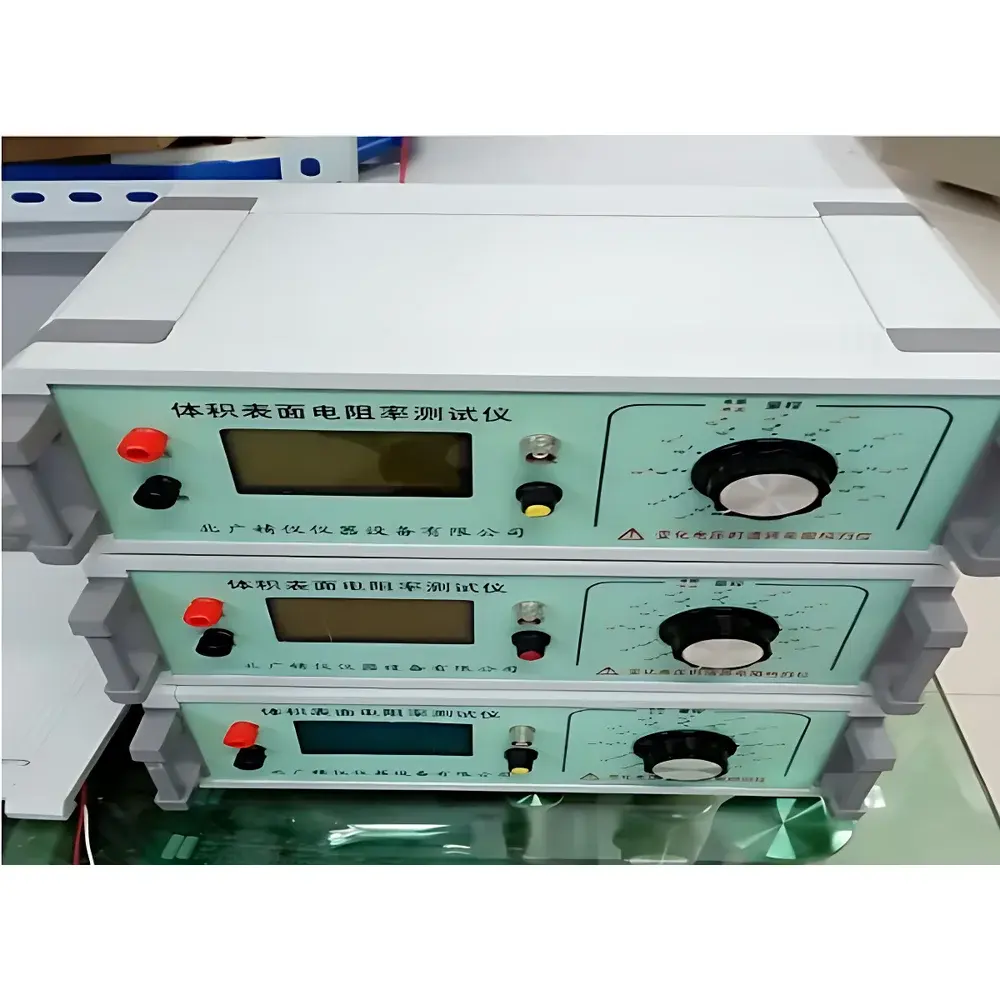
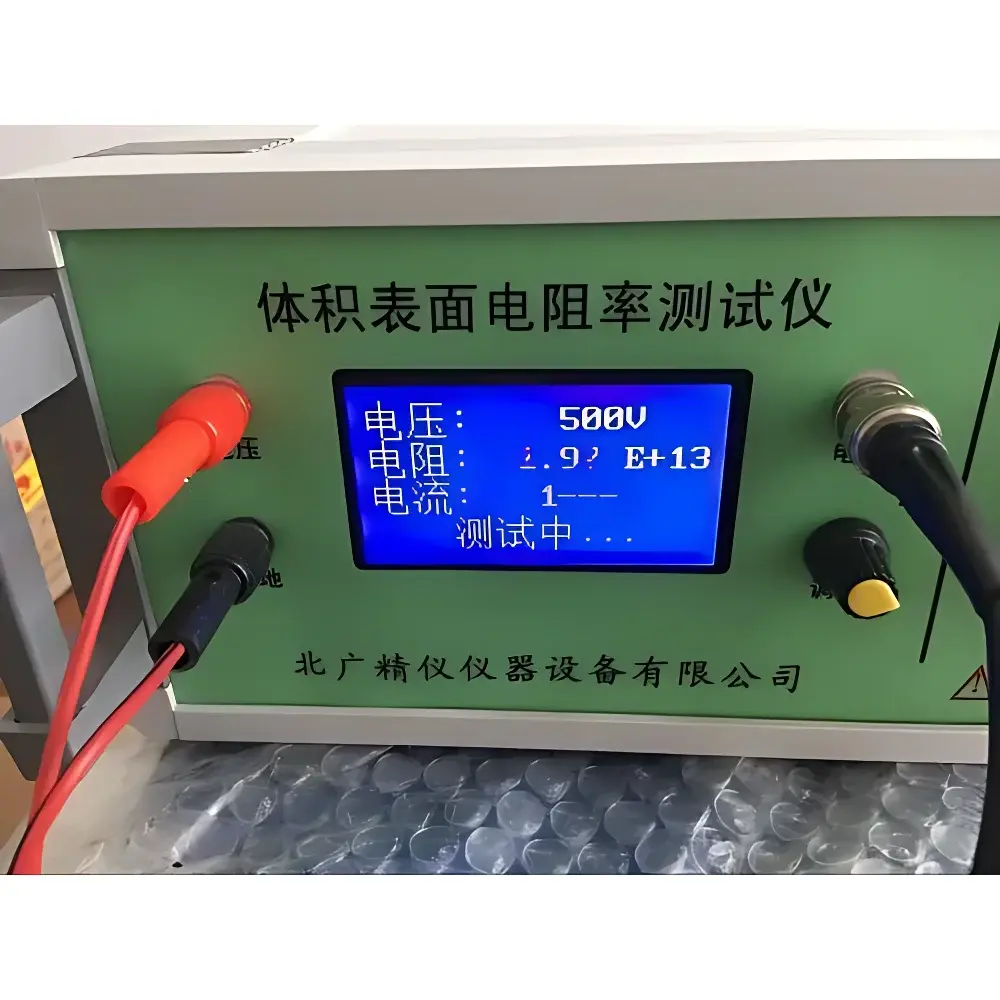
North Guang Precision Instrument BEST-380 Surface Resistivity Tester for Plastics
| Brand | North Guang Precision Instrument |
|---|---|
| Origin | Beijing, China |
| Manufacturer Type | Direct Manufacturer |
| Product Category | Domestic (PRC) |
| Model | BEST-380 |
| Price | USD 2,800 (FOB Beijing) |
Overview
The North Guang Precision Instrument BEST-380 Surface Resistivity Tester is an engineered solution for precise, traceable measurement of surface electrical resistivity and resistance of insulating and static-dissipative polymeric materials. Designed in accordance with the fundamental principles of Ohm’s Law (R = V/I), the instrument simultaneously acquires high-stability DC test voltage (10–1000 V) and ultra-low current (down to 1 × 10⁻¹⁶ A) via dual-channel synchronized sampling. Unlike conventional electrometer-based high-resistance meters that rely on fixed-voltage analog deflection or single-parameter feedback, the BEST-380 employs a proprietary digital signal processing architecture—integrating precision voltage sourcing, guarded current measurement, and real-time A/D conversion—to compute resistance values directly from concurrent V and I readings. This eliminates nonlinearity inherent in analog scales and mitigates errors caused by source drift, contact potential, or load-dependent voltage sag. The result is a calibrated, linear, and reproducible measurement system optimized for R&D labs, QC laboratories, and production environments requiring compliance with international electrostatic control standards.
Key Features
- Simultaneous digital display of surface resistance (Ω), surface resistivity (Ω/sq), and measured current (A) on a 64-bit color touchscreen interface
- Programmable DC test voltages: 10 V, 50 V, 100 V, 250 V, 500 V, and 1000 V—selectable without recalibration or manual coefficient correction
- Extended resistance measurement range: 1 × 10⁴ Ω to 1 × 10¹⁸ Ω (surface resistance); resistivity calculated automatically upon sample thickness input
- Ultra-low current measurement capability: 2 × 10⁻⁴ A to 1 × 10⁻¹⁶ A, enabling characterization of highly insulating polymers and antistatic composites
- Integrated guard terminal and triaxial input architecture to minimize leakage current and surface contamination effects
- Onboard data storage with timestamped records; USB export support for CSV-formatted results compatible with LIMS and statistical process control (SPC) software
- Compliant power supply: AC 220 V ±10%, 50 Hz; typical power consumption <5 W
Sample Compatibility & Compliance
The BEST-380 is validated for use with rigid and semi-rigid plastic sheets, films, molded components, and elastomeric surfaces where electrode contact area ≥100 mm diameter is achievable (custom electrodes available for smaller geometries). It supports standardized two-electrode and three-electrode configurations per ASTM D257 and IEC 60093. The instrument meets metrological requirements outlined in GB/T 1410–2006 (equivalent to ISO 3915 and ASTM D257), and its operational methodology aligns with test protocols referenced in GB 12158–2006 (Electrostatic Hazard Prevention), GB/T 22042–2008 (Garment Surface Resistivity), and GB/T 18044–2008 (Carpet Electrostatic Evaluation). While not certified to GLP or FDA 21 CFR Part 11 out-of-the-box, audit-ready data logs—including operator ID, test voltage, duration, ambient temperature/humidity (user-entered), and raw V/I pairs—are retained for internal quality system integration.
Software & Data Management
The embedded firmware supports direct parameter configuration, pass/fail threshold setting, and batch-mode testing with auto-incremented sample IDs. Measurement records include full metadata: date/time stamp, applied voltage, measured current, computed resistance/resistivity, user-defined sample thickness, and operator annotation field. Exported data files are plain-text CSV with UTF-8 encoding, facilitating import into Excel, MATLAB, Python pandas, or enterprise QMS platforms. No proprietary drivers or cloud dependencies are required—USB mass-storage mode enables drag-and-drop file retrieval. Optional PC-based companion software (Windows 10/11) provides graphical trend analysis, histogram generation, and automated report generation per ISO/IEC 17025 documentation templates.
Applications
- Surface resistivity validation of ESD-safe packaging films, trays, and tote boxes per ANSI/ESD S20.20
- Quality conformance testing of conductive/antistatic thermoplastics (e.g., carbon-black-filled PP, Ni-coated ABS) used in electronics enclosures
- Routine verification of static-dissipative flooring systems (vinyl, epoxy, rubber) per GB 50611–2010 and ANSI/ESD STM7.1
- Research-grade characterization of polymer nanocomposites, ionomer blends, and plasma-treated surfaces
- Verification of footwear sole resistivity per GB 4385–1995 and EN 61340–4–3
- Surface charge decay studies in conjunction with electrostatic voltmeters and Faraday cups
- Material qualification for cleanroom garments, medical device housings, and aerospace interior panels
FAQ
What is the minimum recommended sample size for accurate surface resistivity measurement?
For standard circular electrodes, samples must be ≥100 mm in diameter to ensure guard ring functionality and edge-effect minimization. Smaller specimens require custom electrode fixtures—contact technical support for dimensional specifications.
Does the BEST-380 comply with ASTM D257 or IEC 60093?
Yes—the instrument implements the core electrical architecture and procedural logic defined in both standards, including guarded electrode configuration, voltage stabilization time, and current integration methodology. Full compliance requires proper sample preparation and environmental control per clause 7 of ASTM D257.
Can the device measure volume resistivity as well?
No—the BEST-380 is configured exclusively for surface resistivity using concentric ring electrodes. Volume resistivity requires through-thickness electrode contact and is addressed by the BEST-121 dual-mode instrument.
Is calibration traceable to national standards?
Factory calibration is performed using NIST-traceable high-value resistors (10 kΩ to 100 TΩ) and precision current sources. A certificate of calibration with uncertainty budget is supplied with each unit; annual recalibration is recommended per ISO/IEC 17025 guidelines.
What maintenance is required to sustain measurement accuracy?
Routine cleaning of electrode surfaces with isopropyl alcohol and lint-free wipes is essential. Avoid abrasive cleaners. Verify open-circuit noise floor (<1 fA) and short-circuit offset (<10 nV) quarterly using the built-in self-test function.






