
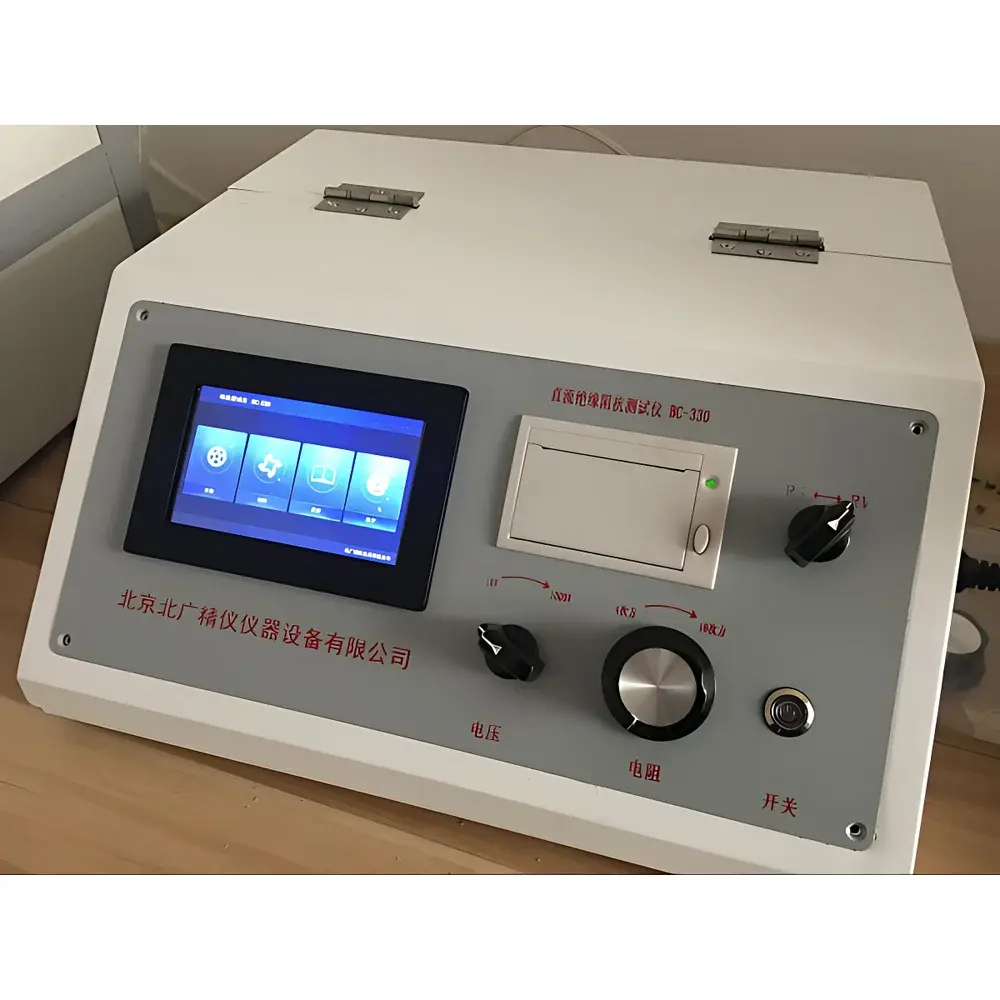
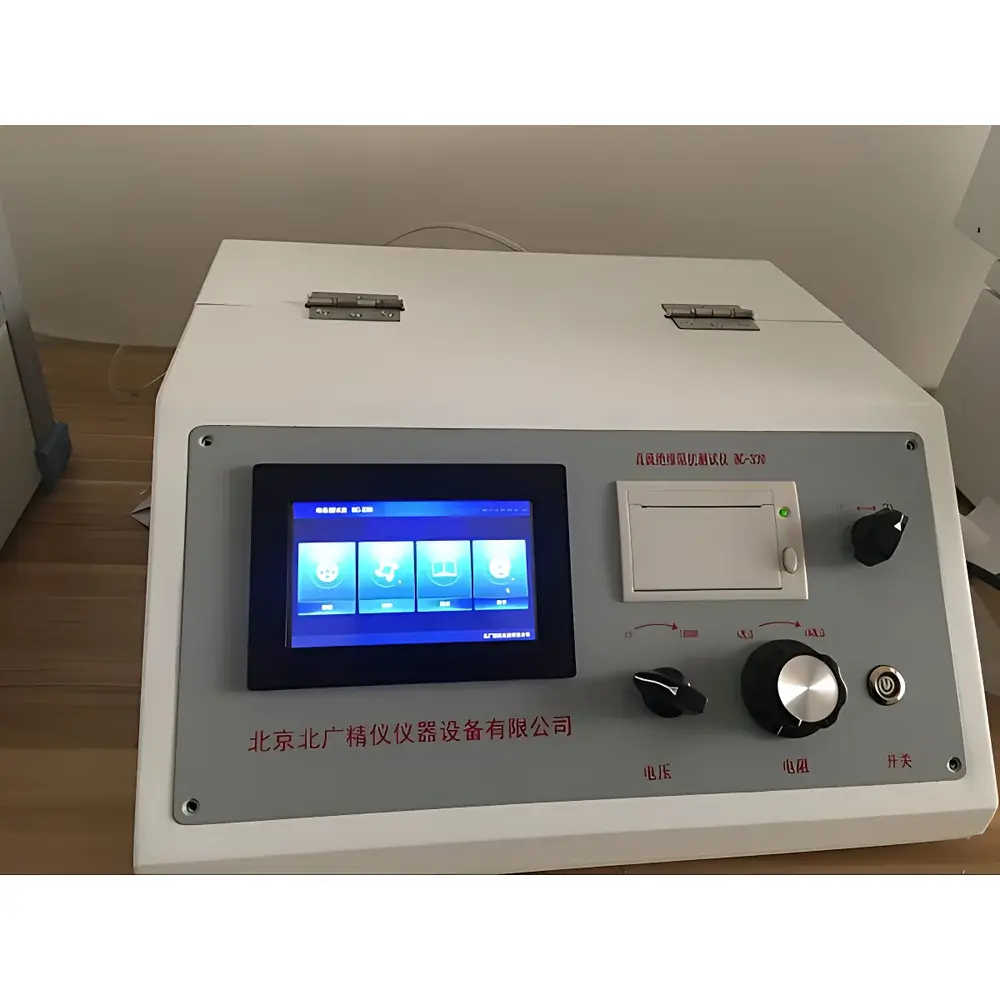
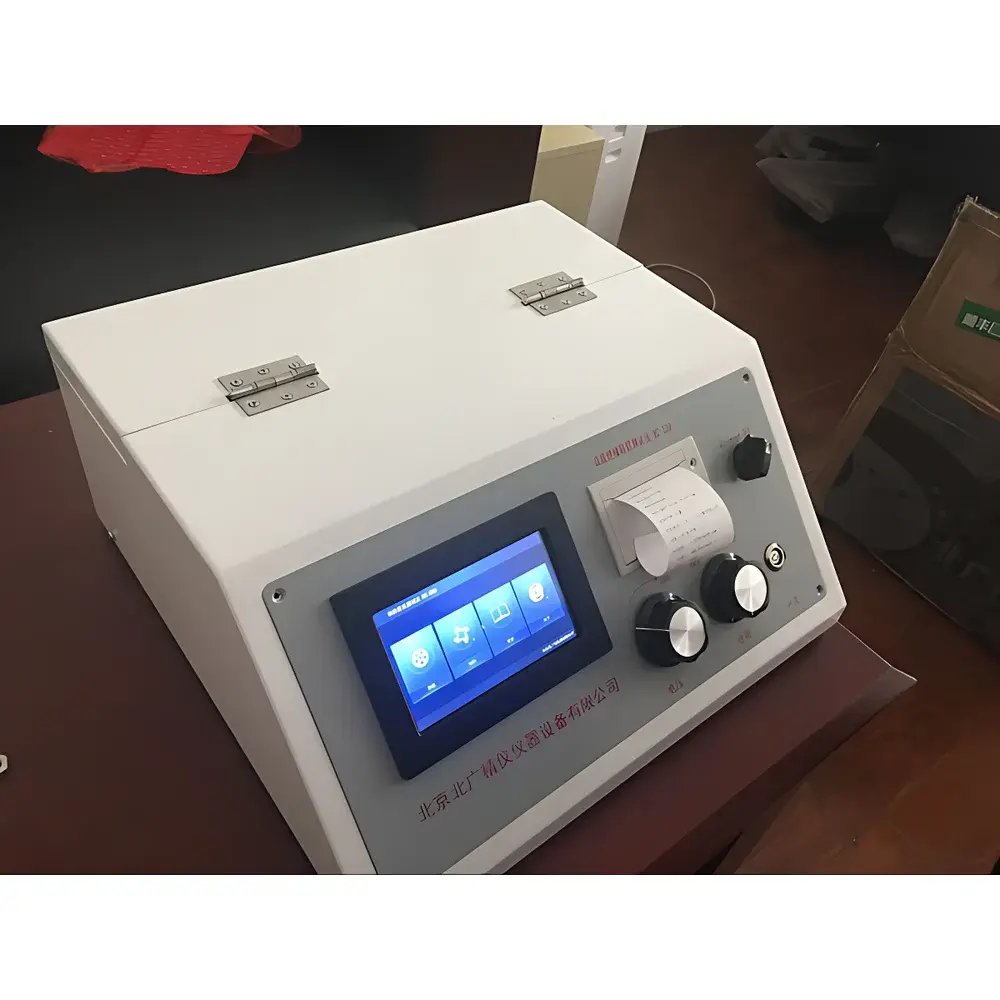
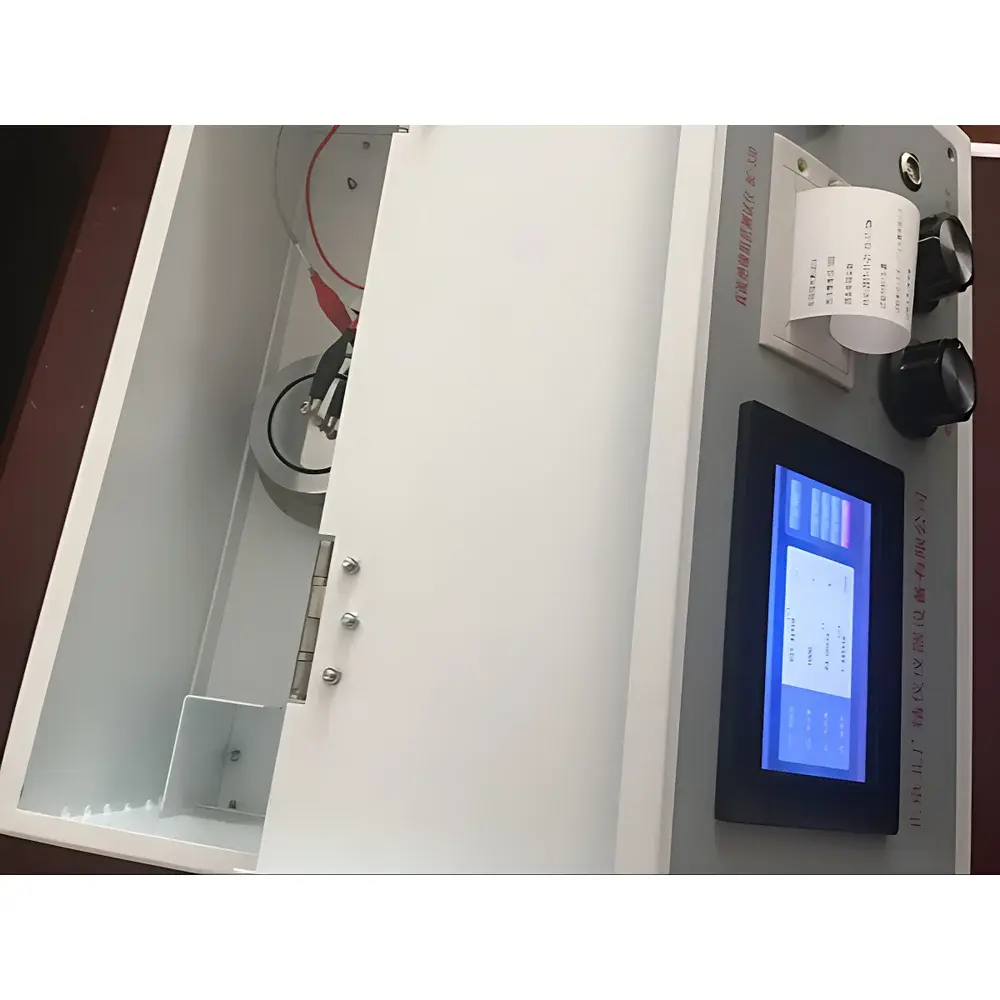
North Guang Precision Instruments BEST-330 DC Volume & Surface Resistivity Tester for Silicone Rubber
| Brand | North Guang Precision Instruments |
|---|---|
| Origin | Beijing, China |
| Manufacturer Type | Direct Manufacturer |
| Model | BEST-330 |
| Measurement Range | 10⁶ Ω to 10²⁰ Ω |
| Current Range | 10⁻⁴ A to 10⁻¹⁸ A |
| Test Voltage | 10 V–1000 V (6 selectable steps) |
| Compliance | GB/T 1410–2006, ASTM D257–99, GB/T 1692–2008, GB/T 22042–2008, GB/T 22043–2008, GJB 3007A–2009 |
| Display | Touchscreen interface with real-time voltage/resistance/current/resistivity readout |
| Data Handling | Internal timestamped storage, USB export, thermal printing |
| Power Supply | AC 220 V, 50 Hz, ~5 W |
Overview
The North Guang Precision Instruments BEST-330 DC Volume & Surface Resistivity Tester is a high-precision electrometric system engineered for the quantitative characterization of electrical insulation properties in elastomeric and polymeric materials—particularly silicone rubber compounds used in aerospace sealing, medical device encapsulation, high-voltage cable jacketing, and ESD-sensitive industrial components. It operates on the fundamental principle of direct-current (DC) resistive measurement under controlled voltage bias, applying Ohm’s law (R = V/I) to determine volume resistivity (ρ, in Ω·m) and surface resistivity (σₛ, in Ω/square) according to standardized electrode configurations defined in GB/T 1410–2006 and ASTM D257–99. The instrument employs guarded three-terminal measurement architecture to suppress leakage currents and minimize triboelectric and dielectric absorption effects—critical for achieving reproducible results on low-conductivity, high-resistivity materials where stray capacitance and polarization transients dominate signal integrity. Its design prioritizes metrological traceability, long-term stability, and compatibility with GLP-compliant laboratory workflows.
Key Features
- Ultra-high resistance measurement capability spanning 14 decades: 10⁶ Ω to 10²⁰ Ω, enabling characterization of both semiconductive elastomers and ultra-high-purity insulating grades.
- Sub-femtoampere current resolution (down to 10⁻¹⁸ A) achieved via low-noise electrometer circuitry with active guarding and shielded coaxial signal paths.
- Six-step programmable DC test voltage output (10 V, 50 V, 100 V, 250 V, 500 V, 1000 V), each calibrated per IEC 61000-4-5 surge immunity requirements and traceable to national standards.
- Integrated Faraday cage enclosure with conductive gasketing and optical isolation—eliminating external electromagnetic interference and eliminating inter-cable parasitic resistance contributions.
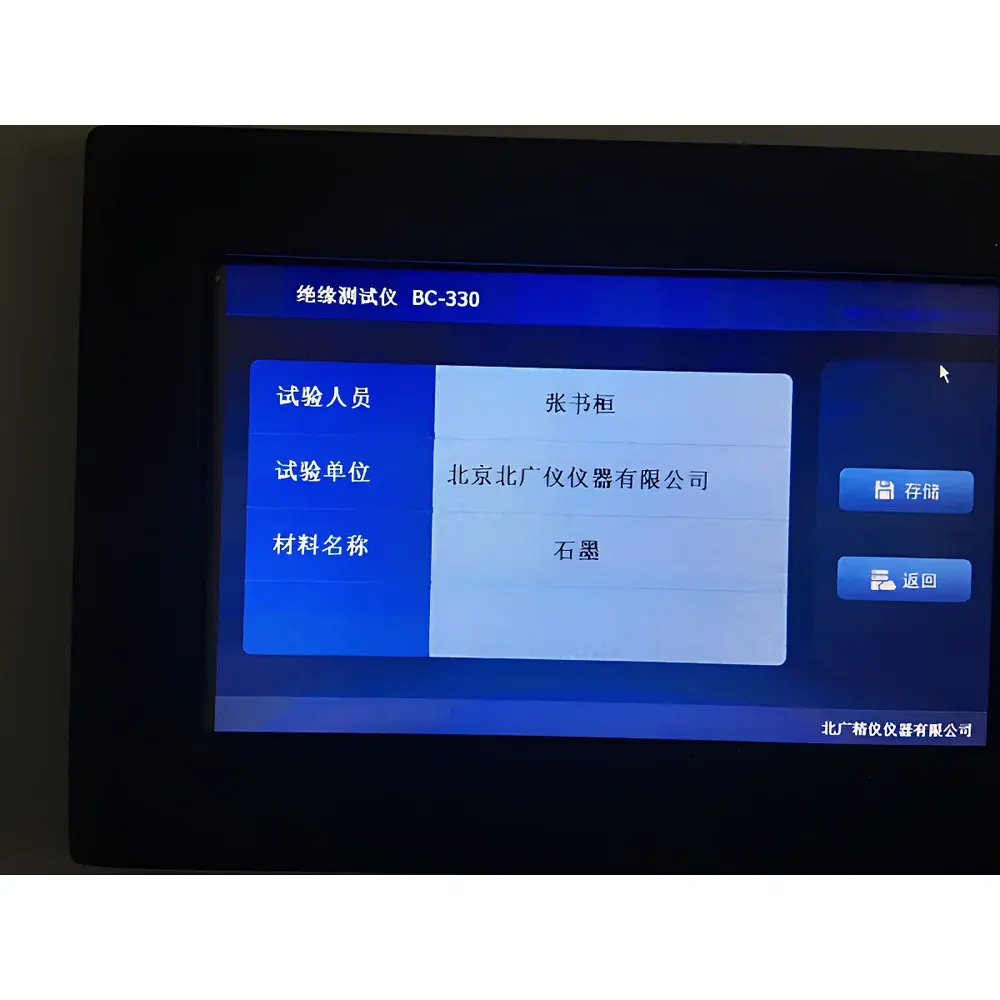
- Touchscreen HMI with intuitive workflow navigation; supports manual or automated test sequencing with user-defined pass/fail thresholds and real-time statistical feedback (mean, SD, CV%).
- Comprehensive data governance: timestamped internal memory (≥10,000 records), USB 2.0 export (CSV/Excel-compatible), and built-in thermal printer supporting ISO/IEC 17025 audit-ready reports.
Sample Compatibility & Compliance
The BEST-330 is validated for use with solid elastomers (e.g., HTV and LSR silicone rubbers), thermoplastic elastomers (TPEs), vulcanized rubber sheets, polymer films, and composite laminates. Electrode configurations include concentric ring (for surface resistivity), two-terminal parallel plate (for bulk volume resistivity), and guarded three-electrode cells compliant with ASTM D257 Annex A3. All measurements adhere to environmental conditioning protocols specified in GB/T 1410–2006: samples are conditioned at 23 ± 2 °C and 50 ± 5% RH for ≥48 h prior to testing. The system satisfies regulatory expectations for quality control in industries governed by GJB 3007A–2009 (ESD Control in Defense Electronics), GB 50611–2010 (Electronics Cleanroom ESD Design), and ISO 10993–1 (Biocompatibility Evaluation). Full compliance documentation—including factory calibration certificates, uncertainty budgets (<±1.2% at 10¹⁵ Ω), and traceability to NIM (National Institute of Metrology, China)—is provided with each unit.
Software & Data Management
The embedded firmware implements deterministic real-time sampling at 10 Hz with adaptive settling-time detection to ensure stable readings before auto-logging. All stored records include metadata: test date/time, operator ID, sample ID, electrode type, applied voltage, ambient T/RH (when paired with optional external sensor), raw current/voltage values, calculated ρ and σₛ, and measurement duration. Exported CSV files conform to ASTM E1447–21 data formatting guidelines and are directly ingestible into LIMS platforms (e.g., LabWare, Thermo Fisher SampleManager). Audit trail functionality meets FDA 21 CFR Part 11 requirements for electronic records: all parameter changes, result edits, and print/delete actions are immutably logged with user ID and timestamp. Firmware updates are delivered via signed USB image files with SHA-256 verification.
Applications
- Quality assurance of silicone rubber formulations for aerospace O-rings and thermal interface materials requiring ρ > 10¹⁶ Ω·m.
- R&D screening of carbon-black–filled conductive silicones targeting surface resistivity between 10³–10⁶ Ω/square per GB/T 18044–2008.
- Validation of antistatic additives in medical-grade liquid silicone rubber (LSR) per ISO 10993–18 biocompatibility guidance.
- Batch-to-batch consistency monitoring of extruded silicone tubing used in pharmaceutical fluid handling systems (USP , EP 3.1.11).
- Failure analysis of insulation breakdown in high-voltage silicone encapsulants subjected to humidity aging per IEC 60243–1.
- Supporting ISO/IEC 17025 accreditation for accredited testing laboratories performing EN 61340–2–3 (electrostatics) and MIL-STD-1686 (ESD control program) verification.
FAQ
What electrode configuration is required to measure volume resistivity of silicone rubber per GB/T 1410–2006?
A guarded three-electrode system with defined specimen thickness (typically 1–10 mm), where the guard electrode surrounds the measuring electrode to eliminate edge leakage currents.
Does the BEST-330 support temperature-controlled resistivity measurements?
Yes—when integrated with an external thermostatic chamber (e.g., Julabo F25) and optional RTD input module, it enables resistivity profiling from –40 °C to +125 °C per ASTM D1711.
How is measurement uncertainty quantified for high-resistivity readings above 10¹⁸ Ω?
Uncertainty is determined per GUM (JCGM 100:2008) using Type A (repeatability) and Type B (calibration, voltage accuracy, current noise floor) components; typical expanded uncertainty (k=2) is ±2.8% at 10¹⁹ Ω.
Can the instrument generate GLP-compliant test reports without third-party software?
Yes—the built-in report generator includes header fields for lab name, accreditation number, analyst signature, equipment ID, and calibration due date, fully satisfying ISO/IEC 17025 clause 7.8.2.
Is the BEST-330 suitable for measuring resistivity of uncured silicone gum stock?
No—this instrument is designed exclusively for cured, solid-state elastomers. Uncured polymers require specialized rheo-electrical coupling setups not supported by this platform.



