
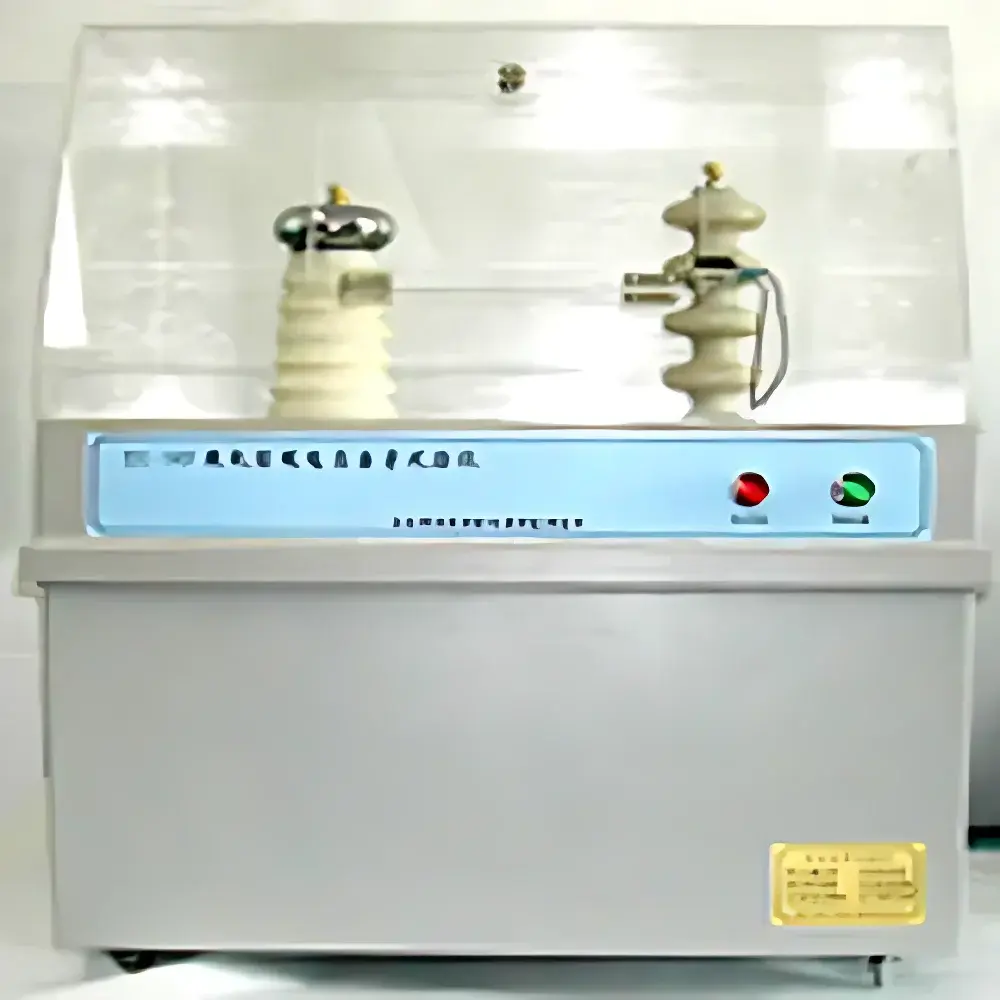
Beiguang Jingyi BDJC-100KV Industrial-Frequency Dielectric Breakdown Tester
| Brand | Beiguang Jingyi / All Precision Instrument |
|---|---|
| Origin | Beijing, China |
| Manufacturer Type | Direct Manufacturer |
| Country of Origin | China |
| Model | BDJC-100KV |
| Breakdown Voltage Range | 0–100 kV AC/DC |
| Input Voltage | 220 V AC ±10%, 50 Hz ±1% |
| Power Rating | 3 kVA |
| Voltage Accuracy | ≤ ±1% |
| Rise Rate Options | 100–5000 V/s (adjustable) |
| Current Resolution | 0.1 mA |
| Test Media | Air or Insulating Oil |
| Compliance | GB 1408.1–2006, GB/T 1695–2005, GB/T 3333, HG/T 3330, GB 12656, ASTM D149 |
| Safety Protections | Overvoltage, Overcurrent, Short-Circuit, Leakage, Door Interlock, Zero-Position Reset, Emergency HV Cut-off |
Overview
The Beiguang Jingyi BDJC-100KV Industrial-Frequency Dielectric Breakdown Tester is a precision high-voltage testing system engineered for the quantitative evaluation of dielectric strength and voltage endurance in solid insulating materials under standardized AC (50 Hz) or DC stress conditions. Based on the principle of controlled voltage ramping until electrical breakdown occurs—defined as the onset of sustained conductive current across the specimen—the instrument delivers repeatable, traceable measurements of dielectric breakdown voltage (kV) and derived dielectric strength (kV/mm). Designed for compliance with international standards including ASTM D149 and IEC 60243-1 (via equivalent national implementations), the system supports both short-term breakdown assessment and extended withstand testing, enabling rigorous quality control and material qualification in R&D, production, and certification laboratories.
Key Features
- Full-range adjustable output: 0–100 kV AC (50 Hz) and 0–100 kV DC, with continuous fine-tuning capability and ≤±1% measurement accuracy verified by NIM-accredited calibration.
- Programmable voltage ramp rates from 100 V/s to 5000 V/s, satisfying mandatory test profiles in GB 1408.1–2006 (stepwise and linear rise modes) and ASTM D149 (uniform rate requirement).
- Dual-mode operation: Supports three AC/DC test protocols—uniform ramp, stepwise ramp, and hold-time withstand—with automatic termination upon current threshold detection (≥10 mA, user-configurable).
- Integrated safety architecture: Six independent hardware interlocks—including door position sensing, zero-voltage reset verification, emergency HV disconnection, overcurrent cutoff (<50 ms response), leakage monitoring, and main power isolation—fully compliant with IEC 61010-1 Class I requirements.
- Intelligent digital voltage regulation: Solid-state, contactless thyristor-based control replaces mechanical variac systems, eliminating waveform distortion, arcing risk, and long-term drift.
- Real-time data acquisition: Simultaneous sampling of voltage (kV), leakage current (mA), and time (ms) at ≥1 kHz rate; dynamic curve plotting during test execution with color-coded session overlay for comparative analysis.
Sample Compatibility & Compliance
The BDJC-100KV accommodates standard electrode configurations per GB 1408.1 (e.g., brass disk electrodes Ø25 mm, Ø50 mm; spherical electrodes; needle-plane assemblies) and supports specimens up to 10 mm thick. Compatible materials include thermoplastics (e.g., PE, PP, PET), elastomers (silicone rubber, EPDM), laminates (G10, FR-4), ceramics, glass, mica tapes, impregnated papers (capacitor, cable), and insulating varnishes. Test environments include ambient air (IEC 60270-compliant partial discharge screening) and transformer-grade insulating oil (ASTM D877/D1816 protocol). The system meets regulatory documentation requirements for GLP and GMP environments: full audit trail logging (user ID, timestamp, parameter set, pass/fail flag), electronic signature support, and 21 CFR Part 11–ready configuration options (when paired with validated software version).
Software & Data Management
The proprietary Windows-based control suite provides ISO/IEC 17025-aligned test management. Each test generates an encrypted .bdj binary file containing raw waveform data, metadata (operator, sample ID, electrode geometry, ambient T/RH), and final report parameters. Functions include: multi-session curve superposition for repeatability assessment; manual validity flagging during acquisition; post-test editing of pass/fail criteria; customizable report templates (PDF/Excel export); password-protected access tiers (admin, operator, viewer); and automated backup to network drives or NAS. Calibration certificates—traceable to China National Institute of Metrology (NIM) or customer-designated ISO/IEC 17025 accredited labs—are stored within the software archive and linked to instrument serial number.
Applications
This tester serves critical roles in polymer formulation validation (e.g., filler dispersion impact on dielectric strength), quality assurance of wire & cable insulation extrusion batches, qualification of printed circuit board substrates under humid aging, and failure analysis of high-voltage capacitor films. It is routinely deployed in third-party testing labs supporting CCC, UL, and CE conformity assessments, as well as academic research on nanocomposite dielectrics and space-charge dynamics. Its dual AC/DC capability enables direct comparison of polarization-dependent breakdown mechanisms—essential for evaluating materials destined for HVDC transmission components or pulsed-power applications.
FAQ
What standards does the BDJC-100KV directly support?
It implements test methodologies defined in GB 1408.1–2006, GB/T 1695–2005, ASTM D149, and related national standards for solid insulators. Full compliance documentation—including test procedure mapping and uncertainty budgets—is provided with each unit.
Can the system perform tests in insulating oil?
Yes. Two dedicated oil baths (ASTM D877-compliant geometry) are included, with integrated grounding, oil-level sensors, and post-test degassing protocols to maintain dielectric integrity between runs.
Is remote operation or integration with LIMS possible?
The software exposes COM/ActiveX interfaces and CSV export functionality, enabling bidirectional integration with laboratory information management systems (LIMS) and MES platforms via OPC UA or custom middleware.
How is calibration traceability maintained?
Each unit ships with a NIM-issued certificate (valid for 12 months). Optional annual recalibration services include on-site verification, adjustment, and ISO/IEC 17025–accredited reporting with measurement uncertainty statements.
What safety certifications apply to the instrument enclosure?
The test chamber conforms to IP2X ingress protection and EN 61010-1:2010 + A1:2019 for electrical safety, with CE marking and RoHS 3 compliance documented in the technical file.



