
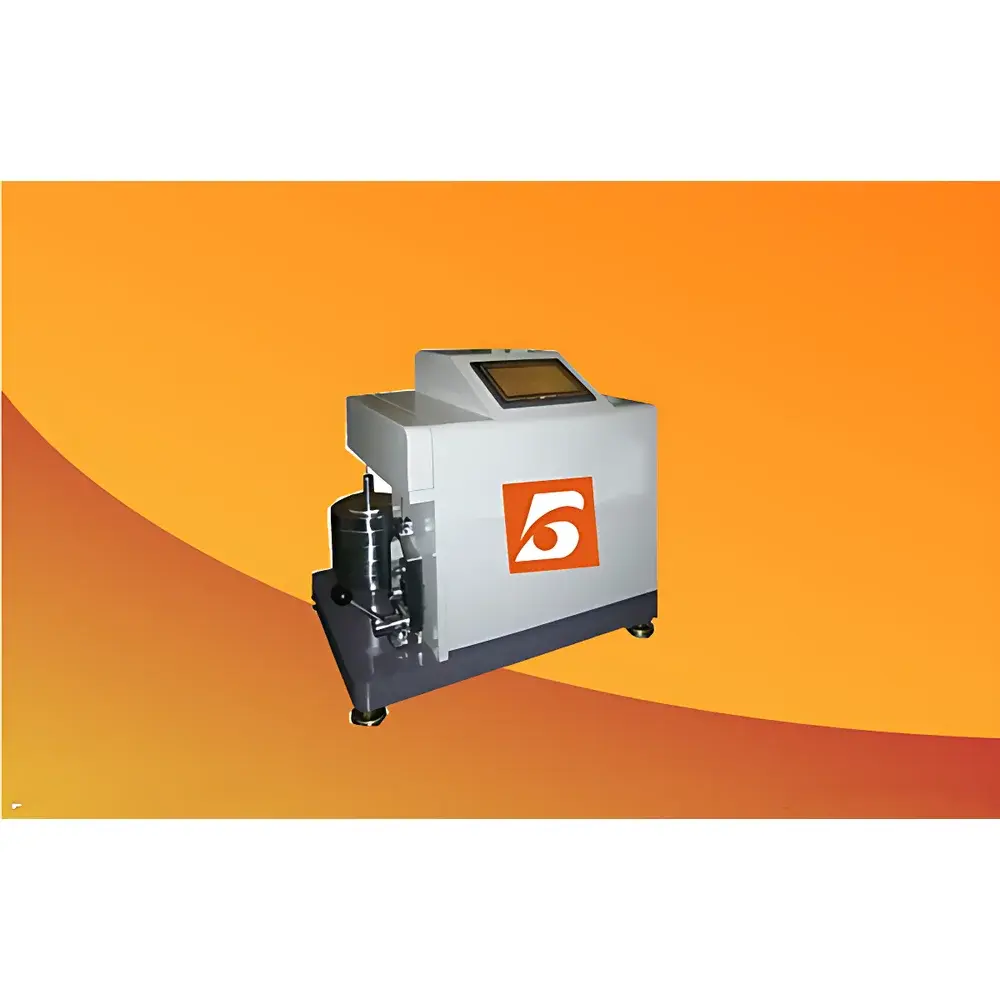
Beiguang Jingyi BMc-200 Plastic & Rubber Sliding Friction and Wear Tester
| Brand | Beiguang Jingyi / All Precision Instrument |
|---|---|
| Origin | Beijing, China |
| Manufacturer Type | Direct Manufacturer |
| Country of Origin | China |
| Model | BMc-200 |
| Price | USD 1,720 (FOB Beijing) |
Overview
The Beiguang Jingyi BMc-200 Plastic & Rubber Sliding Friction and Wear Tester is an ASTM- and ISO-aligned tribological testing instrument engineered for quantitative evaluation of sliding wear behavior, friction coefficient, and wear volume under controlled mechanical loading and kinematic conditions. It operates on the principle of pin-on-disk (or block-on-ring) tribometry in accordance with GB/T 3960–2016 (equivalent to ISO 8295 and ASTM D3702), where a stationary or reciprocating specimen (e.g., polymer, elastomer, or composite) is pressed against a rotating annular counterface under defined normal load, speed, and environmental conditions. The system captures real-time torque, rotational displacement, time, temperature, and applied load to compute dynamic frictional response and volumetric wear loss—critical parameters for material selection, formulation optimization, and quality assurance in rubber, thermoplastic, and thermoset applications.
Key Features
- Pin-on-disk tribometer architecture compliant with GB/T 3960–2016, ISO 8295, and ASTM D3702 test standards
- Adjustable rotational speed range: 0–400 rpm (stepless, digitally controlled), with dual-speed preset modes (180/360 rpm and 200/400 rpm)
- Programmable normal load: 196 N ±0.2% (standard), expandable up to 392 N via calibrated dead-weight loading system (4 kg × 1 + 1 kg × 4)
- High-fidelity torque measurement: 0–15 N·m range, ±3% full-scale accuracy, 100 kHz data acquisition rate
- Integrated 16-bit microcontroller-based control unit with color LCD interface and built-in safety interlocks (overload, over-torque, power failure recovery)
- Automated test sequencing: single-parameter setup enables fully unattended operation from start to stop, including automatic shutdown upon completion or fault detection
- Real-time curve generation: friction torque vs. time, coefficient of friction (COF) vs. time/revolutions/temperature, with localized zoom, data extraction, and export capabilities
Sample Compatibility & Compliance
The BMc-200 accommodates standard rectangular specimens per GB/T 3960 (30 mm × 7 mm × 6 mm ±0.1 mm) and supports alternative geometries—including pins, blocks, and thin films—via custom fixture kits. Compatible materials include thermoplastics (e.g., PA6, POM, PTFE), thermosets (e.g., phenolic, epoxy composites), elastomers (NR, SBR, EPDM), and filled or reinforced polymer systems. The counterface ring (Ø40 mm × 10 mm, hardened steel, surface concentricity <0.01 mm) meets dimensional tolerances specified in ISO 20806 and ASTM D3702 Annex A1. Test environments include dry, lubricated, and abrasive-slurry configurations. Data traceability complies with GLP principles; audit-ready digital logs support 21 CFR Part 11 readiness when paired with validated software modules.
Software & Data Management
The proprietary HX control and analysis software runs on Windows OS and provides synchronized acquisition of torque, rotational position, elapsed time, and optional external temperature inputs (via PT100 sensor). All raw data are timestamped and stored in binary + CSV formats with metadata tagging (operator ID, sample ID, test protocol, calibration date). Curve overlays, statistical summaries (mean COF, wear rate in mm³/N·m), and customizable report templates (PDF/Excel) are generated automatically. System firmware includes checksum validation, EEPROM backup on power loss, and hardware-level write protection to prevent accidental data corruption. Calibration certificates for torque sensor and load cell are provided with NIST-traceable documentation.
Applications
This instrument is routinely deployed in R&D laboratories and QC departments for: evaluating polymer-lubricant interactions in automotive bushings and seals; quantifying wear resistance of conveyor belt compounds under abrasive loading; benchmarking frictional stability of medical-grade silicone elastomers; assessing filler dispersion effects on tribological performance in TPEs; validating compliance of cable jacketing materials with IEC 60811-504 abrasion requirements; and supporting failure analysis of gear plastics subjected to cyclic sliding contact. It also serves as a reference platform for developing ASTM WK72495 (new standard for polymer wear under oscillatory motion).
FAQ
What standards does the BMc-200 comply with?
It conforms to GB/T 3960–2016, ISO 8295, ASTM D3702, and supports method development aligned with ISO 20806 and ASTM G99.
Can the tester operate under lubricated or slurry conditions?
Yes—optional liquid containment trays and slurry feed ports enable wet-friction and third-body abrasion testing per ASTM D2625 and ISO 15143-1.
Is the data acquisition system compliant with FDA 21 CFR Part 11?
Out-of-the-box, it records ALCOA+ compliant audit trails; full Part 11 compliance requires deployment with validated electronic signature and role-based access modules.
What is the maximum allowable test duration?
Time control spans 1 second to 9999 minutes; continuous operation beyond 166 hours is supported with thermal management and periodic auto-calibration.
Does the system support multi-specimen sequential testing?
Not natively—each test requires manual specimen replacement; however, custom robotic sample changers can be integrated upon request.




