
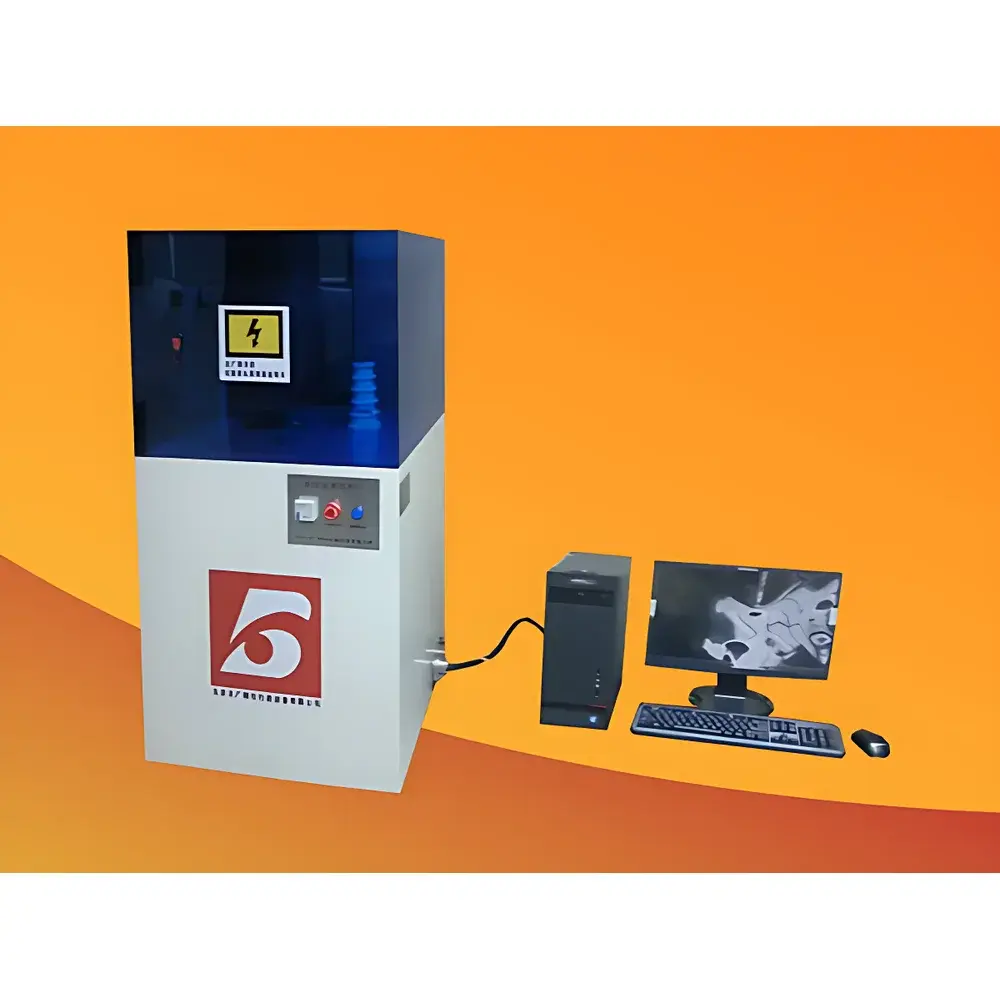
North Guang Precision Instruments JC-50KC Dielectric Strength & Voltage Breakdown Tester
| Brand | North Guang Precision Instruments |
|---|---|
| Origin | Beijing, China |
| Manufacturer Type | Direct Manufacturer |
| Model | JC-50KC |
| Output Voltage Range | AC/DC 0–50 kV |
| Voltage Accuracy | ≤1% |
| Rise Rate Options | 100–3000 V/s (adjustable in discrete steps) |
| Electrode Configurations | 2 × Ø25 mm disc electrodes, 1 × Ø75 mm disc electrode, 2 tubular electrodes |
| Test Modes | AC/DC ramp-up, step-stress, and withstand testing |
| Compliance Standards | GB/T 1408.1–2006, GB/T 1695–2005, GB/T 3333, HG/T 3330, GB 12656, ASTM D149 |
| Software Platform | Windows-based control interface with real-time curve plotting, data export to Excel, customizable reporting, user access management, and multi-standard selection |
| Safety Response Time | <0.05 s automatic voltage cutoff upon breakdown |
| Maximum Power Rating | 3 kVA |
| Test Capacity | Up to 5 specimens per test sequence |
| Withstand Duration Range | 0–6 hours (software-controlled) |
Overview
The North Guang Precision Instruments JC-50KC Dielectric Strength & Voltage Breakdown Tester is an engineered solution for quantifying the electrical insulation performance of solid dielectric materials under controlled AC or DC stress conditions. It operates on the fundamental principle of applying a continuously increasing or stepped high voltage across a standardized electrode configuration until electrical breakdown occurs—defined as the formation of a conductive path through the specimen resulting in a rapid, uncontrolled current surge. The instrument precisely measures the corresponding breakdown voltage (kV), from which dielectric strength (kV/mm) is calculated using specimen thickness per ISO 60243-1 and ASTM D149 methodologies. Designed for compliance-driven laboratories in polymer R&D, cable manufacturing, capacitor production, and insulating material certification, the JC-50KC delivers traceable, repeatable results aligned with international regulatory expectations for electrical safety validation.
Key Features
- Full-range AC/DC output capability (0–50 kV) with integrated high-precision voltage sampling—eliminating legacy voltage分级 schemes and enabling continuous, linear regulation without mechanical gear backlash.
- Motor-driven, servo-controlled voltage ramping system ensures exceptional temporal fidelity across six selectable rise rates (100, 200, 500, 1000, 2500, 3000 V/s), meeting both IEC 60243-1 slow-ramp requirements and accelerated qualification protocols.
- Dual-mode test architecture supports three operational paradigms per polarity: continuous ramp-to-failure, multi-step stress profiling, and programmable time-dependent withstand testing (0–6 h).
- Integrated digital protection circuitry triggers automatic voltage collapse (<0.05 s response) upon detection of leakage current exceeding user-defined thresholds—ensuring specimen integrity and operator safety.
- Multi-specimen test sequence capability (up to five samples per automated run) significantly improves throughput versus single-sample competitive platforms, reducing per-test labor and calibration overhead.
- Modular electrode set includes ASTM-compliant brass disc electrodes (Ø25 mm × 2, Ø75 mm × 1) and tubular fixtures for cylindrical specimens—constructed from 95% copper alloy to minimize oxidation-induced measurement drift.
Sample Compatibility & Compliance
The JC-50KC accommodates a broad spectrum of solid insulating materials including thermoplastics, elastomers, laminated composites, ceramic substrates, glass sheets, varnish-coated foils, mica tapes, and paper-based dielectrics. Testing may be performed either in ambient air or within temperature-stabilized insulating oil baths (optional accessory), per Clause 8 of GB/T 1408.1–2006 and Section 7.2 of ASTM D149. All hardware and firmware configurations conform to electromagnetic compatibility (EMC) Class B limits (GB/T 17626 series) and functional safety principles outlined in IEC 61010-1. The system supports audit-ready operation under GLP and GMP frameworks via timestamped, tamper-evident digital logs—including full traceability of operator identity, parameter versioning, and raw waveform capture.
Software & Data Management
Control and analysis are executed via a native Windows application featuring role-based authentication (user-level permissions, password-protected configuration changes), real-time oscillographic display of voltage vs. time and leakage current vs. time, and synchronized dual-axis plotting during active tests. All datasets—including peak breakdown voltage, time-to-failure, pre-breakdown leakage trends, and electrode gap metadata—are stored in encrypted binary archives with CSV/Excel export functionality. Report generation allows custom naming, header/footer templating, and direct printer output compliant with internal QA documentation standards. The software embeds selectable test templates mapped to GB/T 1408.1, ASTM D149, and proprietary industry specifications—enabling rapid reconfiguration for cross-standard validation studies.
Applications
This tester serves critical roles across multiple technical domains: evaluating batch-to-batch consistency of extruded polyethylene cable jackets; qualifying high-k dielectric films for flexible printed electronics; validating thermal aging resistance of epoxy-mica stator insulation; certifying aerospace-grade phenolic laminates per MIL-STD-202; assessing moisture-induced degradation in cellulose-based transformer pressboard; and supporting DOE-funded research into nanocomposite dielectrics for next-generation energy storage devices. Its precision ramp control and multi-electrode flexibility make it suitable for comparative studies involving surface vs. bulk breakdown mechanisms, electrode edge effects, and partial discharge inception threshold mapping.
FAQ
What standards does the JC-50KC natively support?
It includes built-in parameter presets and report formatting for GB/T 1408.1–2006, GB/T 1695–2005, ASTM D149, and five additional national and industrial standards—with expandable library support via XML-based template import.
Can the system perform simultaneous multi-sample testing?
Yes—up to five specimens can be tested sequentially in a single automated session, with independent pass/fail evaluation and individual result logging for each.
Is oil-immersion testing supported out of the box?
The base configuration includes air-gap testing capability; optional oil bath chambers with temperature control (±0.5 °C) and electrode immersion fixtures are available as configurable accessories.
How is measurement traceability ensured?
Voltage transducers are calibrated against NIM-traceable references annually; onboard self-diagnostic routines verify signal chain linearity and timing accuracy prior to each test sequence.
Does the software comply with FDA 21 CFR Part 11 requirements?
While not certified “out-of-the-box” for Part 11 environments, the audit trail architecture—including electronic signatures, immutable logs, and user activity history—provides foundational elements required for internal validation under regulated pharmaceutical or medical device quality systems.



