
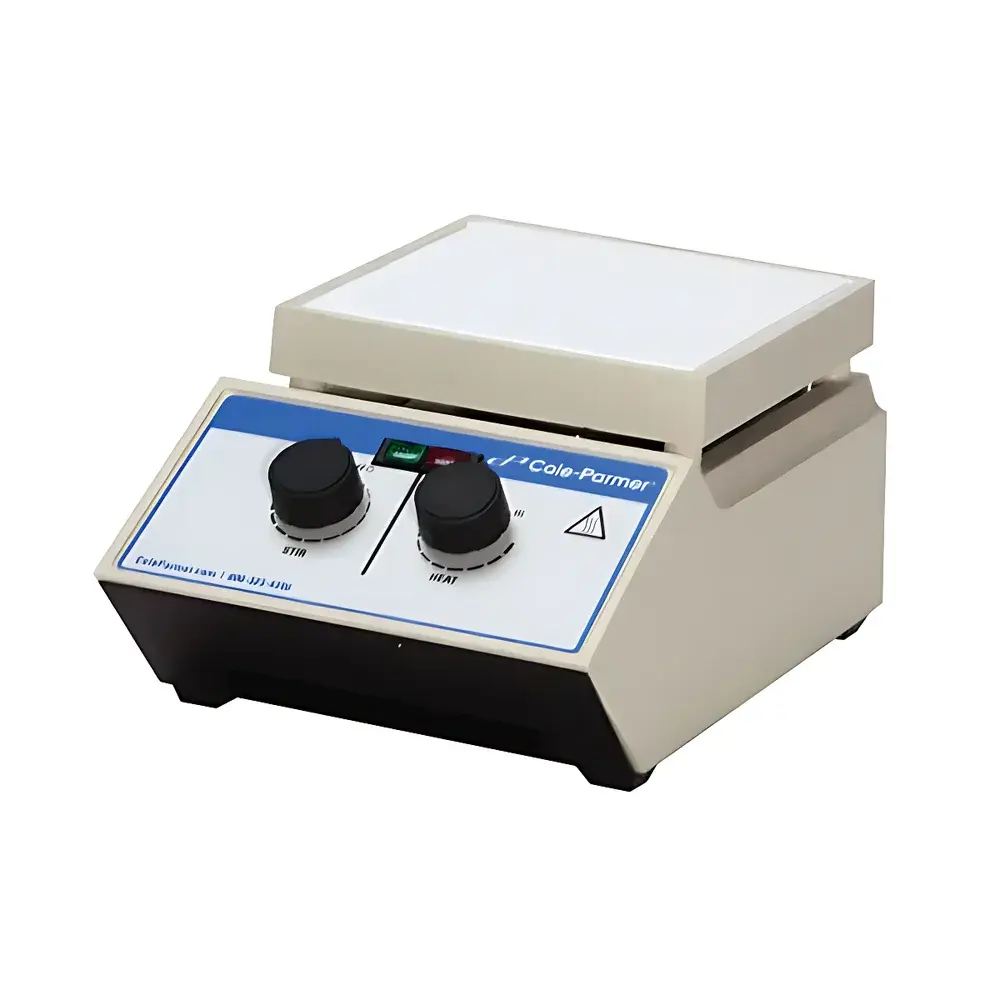
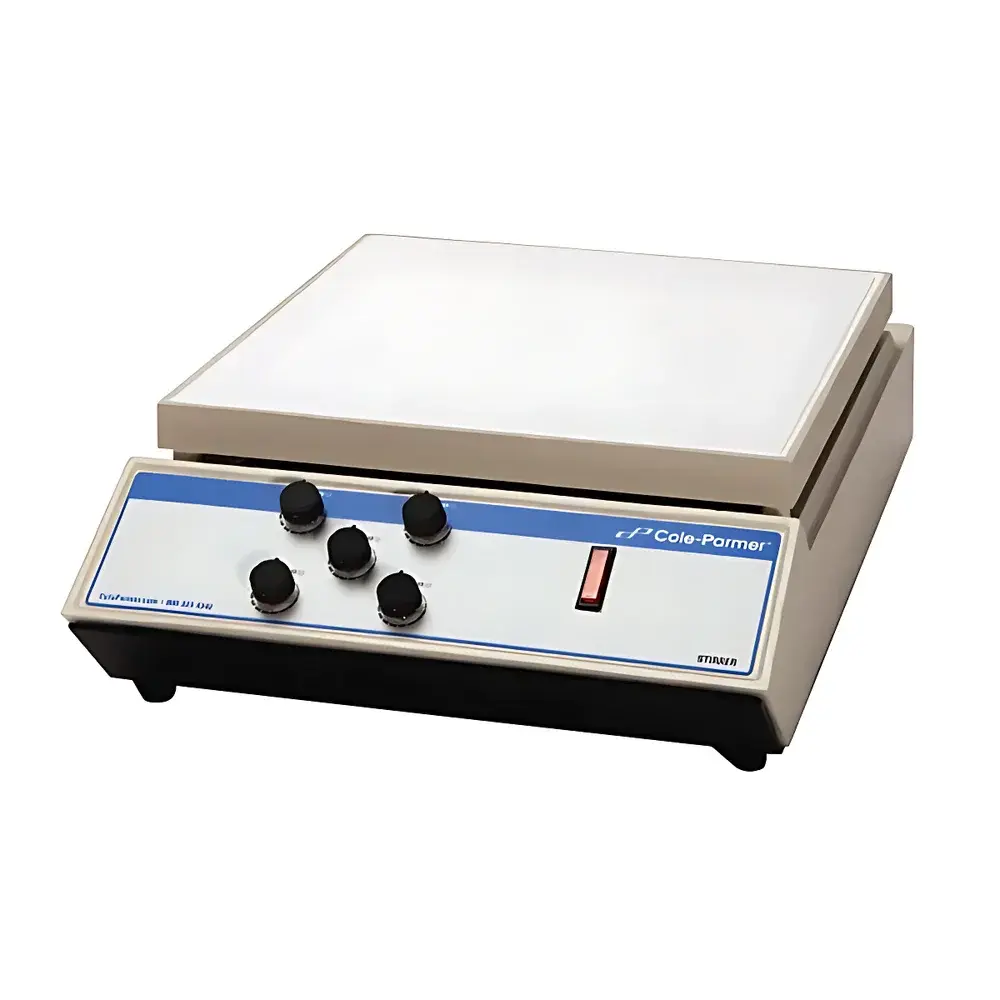
Cole-Parmer Multi-Position Magnetic Stirrer with Heating Plate
| Brand | Cole-Parmer |
|---|---|
| Origin | USA |
| Type | Magnetic Stirrer with Integrated Heating Plate |
| Max Stirring Volume | 10 L per Position |
| Speed Range | 100–1500 rpm |
| Temperature Control Range | 50–400 °C |
| Temperature Stability | ±5 °C of Setpoint |
| Heating Plate Options | Anodized Aluminum or Ceramic |
| Number of Stirring Positions | 5 or 9 (independently controlled) |
| Temperature Adjustment Steps | 210 discrete levels between High and Low settings |
| Safety Design | Front-panel controls to minimize contact with hot surface |
| Magnet Configuration | U-shaped permanent magnet array for robust stir bar retention |
| Compliance | Designed for general laboratory use under ISO/IEC 17025-aligned environments |
Overview
The Cole-Parmer Multi-Position Magnetic Stirrer with Heating Plate is an engineered solution for laboratories requiring simultaneous, independent control of multiple stirring and heating processes. Utilizing a rotating magnetic field generated by precisely arranged U-shaped permanent magnets, the system induces rotational motion in PTFE- or glass-coated magnetic stir bars placed within vessels. Each position operates autonomously—enabling concurrent experiments at distinct speeds and temperatures—without cross-interference. The integrated heating element delivers rapid thermal response and stable plateau maintenance across the full 50–400 °C range, making it suitable for applications ranging from buffer equilibration and reagent dissolution to polymerization initiation and accelerated stability testing. Its modular architecture supports both routine benchtop workflows and high-throughput sample preparation protocols common in QC labs, pharmaceutical development, and academic research settings.
Key Features
- Independent dual-parameter control per position: speed (100–1500 rpm, continuously adjustable) and temperature (50–400 °C, with 210-step resolution between High/Low presets)
- U-shaped magnet array ensures consistent torque transmission and secure stir bar engagement—even at elevated speeds or with viscous media up to 10 L per vessel
- Front-mounted digital interface minimizes operator exposure to heated surfaces; tactile feedback and LED indicators support glove-compatible operation
- Two plate material options: corrosion-resistant ceramic (recommended for aggressive solvents and sustained >300 °C operation) and anodized aluminum (optimized for rapid thermal cycling and cost-sensitive deployments)
- No-load temperature stability maintained within ±5 °C of setpoint under steady-state conditions, verified per internal calibration protocol
- Thermal cut-off protection and auto-shutdown on prolonged overload prevent uncontrolled heating events
Sample Compatibility & Compliance
The system accommodates standard laboratory glassware including beakers (50 mL–2 L), Erlenmeyer flasks, and custom reaction vessels, provided magnetic stir bars are appropriately sized (e.g., 30–60 mm length for 1–5 L volumes). It supports aqueous, organic, and mildly acidic/basic solutions but is not rated for halogenated solvents above 150 °C or molten salt applications. While not certified to IEC 61000-6-3 (EMC) or UL 61010-1 as a standalone unit, its design aligns with general laboratory safety expectations outlined in ANSI Z358.1 and adheres to electrical safety principles referenced in ISO/IEC 17025:2017 Clause 6.4. Data logging capabilities (via optional RS-232 or USB interface) enable traceable parameter recording compliant with basic GLP documentation requirements.
Software & Data Management
This model operates via embedded firmware without proprietary software dependency. All parameters are configured directly on-device using push-button navigation and rotary encoder input. Optional serial output (RS-232 or USB-to-serial adapter) permits integration with LabVIEW, Python-based acquisition scripts, or third-party SCADA systems for time-stamped parameter capture. Audit trails—including start/stop timestamps, speed/temperature setpoints, and duration per position—can be exported as CSV files for inclusion in analytical reports or regulatory submissions. No cloud connectivity or remote access functionality is included, preserving data sovereignty in regulated environments.
Applications
- Parallel synthesis screening in medicinal chemistry (e.g., Suzuki couplings under controlled thermal profiles)
- Buffer and media preparation across microbiology and cell culture labs
- Accelerated solvent extraction (ASE) pre-conditioning steps
- Viscosity benchmarking of polymer solutions prior to rheological analysis
- Calibration verification of pH meters and conductivity probes using temperature-stabilized standards
- Stability-indicating assays requiring defined thermal ramping and agitation sequences
FAQ
Can this unit be used in fume hoods with continuous operation?
Yes—provided ambient airflow does not exceed 0.5 m/s directly over the heating surface and ventilation does not compromise thermal uniformity across positions.
Is the ceramic plate resistant to hydrofluoric acid exposure?
No. While chemically inert toward most common solvents, the ceramic surface is not HF-resistant; use only with compatible reagents per manufacturer’s chemical compatibility guide.
Does each position retain its last-used settings after power cycling?
No. Settings reset to default (0 rpm, 50 °C) on power-up; configuration must be re-entered manually or via external controller.
What stir bar size is recommended for optimal performance at 1500 rpm in a 5 L beaker?
A 45 mm elliptical PTFE-coated stir bar with internal neodymium core provides maximum torque transfer and vortex stability under those conditions.
Is NIST-traceable calibration documentation available?
Calibration certificates are offered as a paid add-on service through Cole-Parmer’s authorized metrology partners, covering speed (optical tachometer verification) and temperature (PT100 probe validation at three points).



