
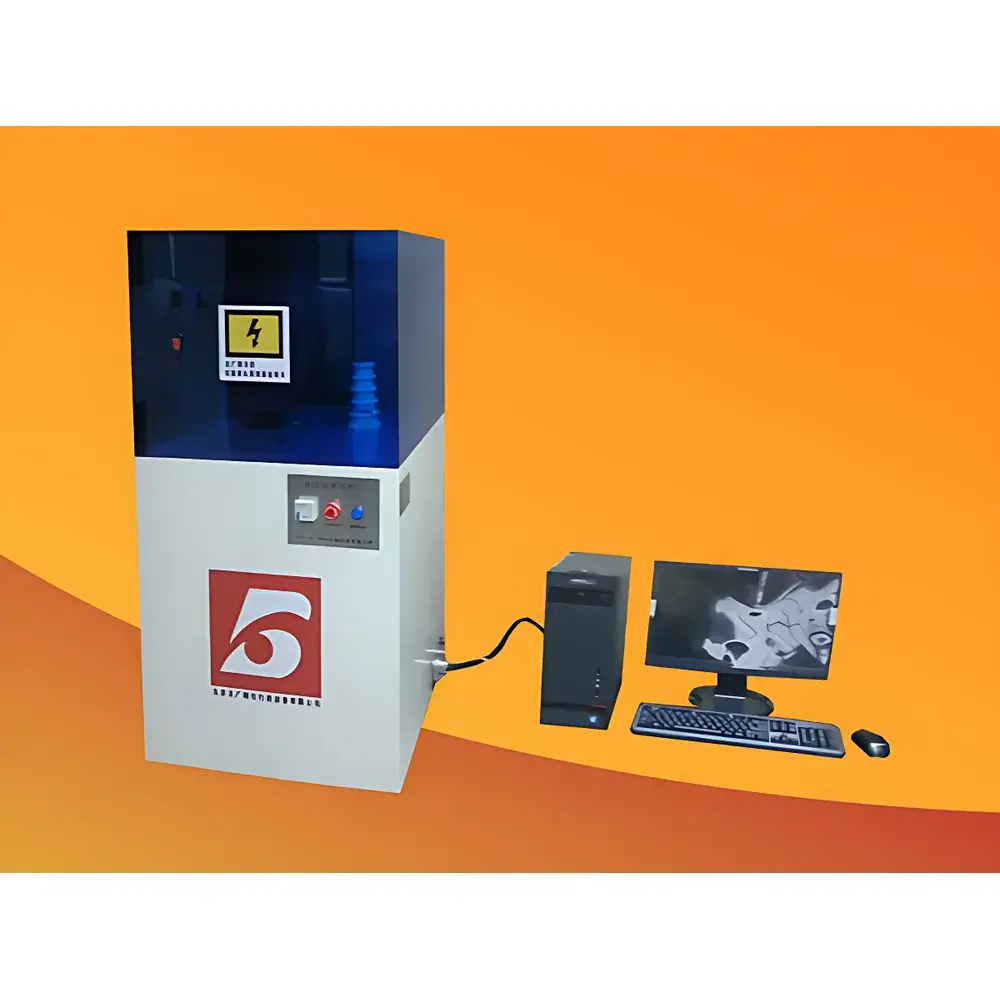
Beiguang Jingyi BJC-50K Dielectric Breakdown Strength Tester for Solid Insulating Materials
| Brand | Beiguang Jingyi / All Precision Instrument |
|---|---|
| Origin | Beijing, China |
| Manufacturer Type | OEM Manufacturer |
| Country of Origin | China |
| Model | BJC-50K |
| Output Voltage | AC/DC 0–50 kV |
| Power Rating | 5 kVA |
| Voltage Accuracy | ≤1% |
| Rise Rate | 0.1–5.0 kV/s (adjustable) |
| Response Time for Overcurrent Protection | ≤0.05 s |
| Current Resolution | mA-level real-time acquisition |
| Compliance | GB/T 1408.1–2006 |
| Electrode Set | Two Φ25 mm × 25 mm |
| Test Media | Air or insulating oil |
Overview
The Beiguang Jingyi BJC-50K Dielectric Breakdown Strength Tester is an industrial-grade high-voltage testing system engineered for the precise determination of dielectric strength in solid insulating materials—primarily polymers, elastomers, thermoplastics, and composite laminates used in wire & cable, automotive, aerospace, and electrical insulation manufacturing. It operates on the principle of controlled voltage ramping until electrical breakdown occurs across a standardized electrode gap, enabling quantitative assessment of material resistance to electric stress under defined environmental conditions (e.g., air or transformer oil immersion). Designed in strict accordance with GB/T 1408.1–2006 (equivalent to IEC 60243-1), the instrument delivers repeatable, traceable, and auditable test outcomes essential for QC/QA labs operating under GLP or pre-GMP frameworks. Its dual-mode capability—supporting both AC and DC voltage application—facilitates comparative evaluation of material behavior under alternating versus unidirectional fields, critical for applications involving DC transmission components or capacitor dielectrics.
Key Features
- Programmable voltage ramping: Adjustable rise rate from 0.1 to 5.0 kV/s, enabling compliance with multiple international test protocols including step-stress and withstand testing.
- Dual-polarity output: AC 0–50 kV and pulsed DC 0–50 kV generated via integrated silicon stack and shorting-bar switching mechanism—no external rectifier required.
- Real-time digital monitoring: Simultaneous acquisition of voltage (kV) and leakage current (mA) at ≥100 Hz sampling rate, with automatic termination upon breakdown detection.
- Redundant safety architecture: Dual-stage overcurrent protection (<0.05 s cutoff), hardware-based arc suppression, and dual-channel fault alarm (local HMI + PC software).
- Remote operation suite: Bluetooth-enabled control module supports wireless parameter setting, start/stop commands, and live data streaming—enabling operator separation from high-voltage zones per IEC 61010-1 requirements.
- Modular electrode configuration: Supplied with three standardized electrodes per GB/T 1408.1–2006: two 25 mm diameter × 25 mm height brass electrodes and one 75 mm diameter × 25 mm height electrode for volume resistivity correlation studies.
Sample Compatibility & Compliance
The BJC-50K accommodates flat, rigid, or semi-rigid sheet specimens up to 10 mm thick and ≥100 mm × 100 mm in planar dimension. Compatible sample matrices include but are not limited to polyethylene (PE), polypropylene (PP), polytetrafluoroethylene (PTFE), epoxy resins, silicone rubber, phenolic laminates, and fiber-reinforced composites. Testing may be conducted in ambient air or within the supplied dual oil bath chamber (ASTM D877/D149 reference geometry). The system conforms to national standard GB/T 1408.1–2006 and aligns with technical principles of IEC 60243-1, ASTM D149, and ISO 60243. Full documentation—including calibration certificate, factory verification report, and traceable metrology records—is provided to support internal audit readiness and regulatory submissions.
Software & Data Management
The embedded Windows-based control software provides role-based access (multi-user login with individual password protection), configurable test templates, and audit-trail-capable session logging compliant with FDA 21 CFR Part 11 principles (electronic signatures, immutable records, time-stamped events). Test parameters—including voltage mode, ramp rate, hold time, trip threshold, and electrode selection—are stored per user profile. Results are saved in .csv and .xlsx formats with embedded metadata (operator ID, timestamp, environmental conditions, specimen ID). Up to five test curves can be overlaid for comparative analysis; automated statistical summaries (mean, SD, CV%) are generated per batch. Data export supports LIMS integration via ODBC drivers. Software updates and remote diagnostics are supported via secure HTTPS channel.
Applications
This instrument serves as a core tool in R&D and production QA environments for: evaluating batch-to-batch consistency of insulating films in battery separators; validating dielectric integrity of extruded cable jackets prior to sheathing; screening candidate polymer blends for high-voltage connector housings; assessing aging effects (thermal/electrical stress) on transformer bushing materials; and supporting failure analysis of arcing-related field failures. It is routinely deployed in third-party certification labs performing CNAS-accredited testing for CCC, UL Recognition, and CE marking submissions. In academic settings, it supports graduate-level coursework in polymer physics and high-voltage engineering laboratories.
FAQ
Does the BJC-50K comply with international standards beyond GB/T 1408.1?
Yes—it implements test methodologies consistent with IEC 60243-1, ASTM D149, and ISO 60243, though formal certification to those standards requires site-specific validation by the end user.
Can the system perform step-voltage tests with programmable dwell times?
Yes—gradient testing mode allows discrete voltage steps with user-defined hold durations (1 s to 60 min per step) and automatic progression or abort-on-failure logic.
Is oil-filled testing mandatory, or can air-gap tests be performed?
Both configurations are supported. The standard setup includes dual oil tanks, but air-gap testing is enabled using the base electrode assembly without immersion.
What level of cybersecurity is implemented for remote Bluetooth operation?
Bluetooth 5.0 LE with AES-128 encryption ensures authenticated pairing and encrypted command/data transfer; no open network exposure is required.
How is calibration maintained over time?
Voltage and current channels are factory-calibrated against NIM-traceable references. Annual recalibration is recommended; the software includes built-in verification routines using internal shunt resistors and reference dividers.




