
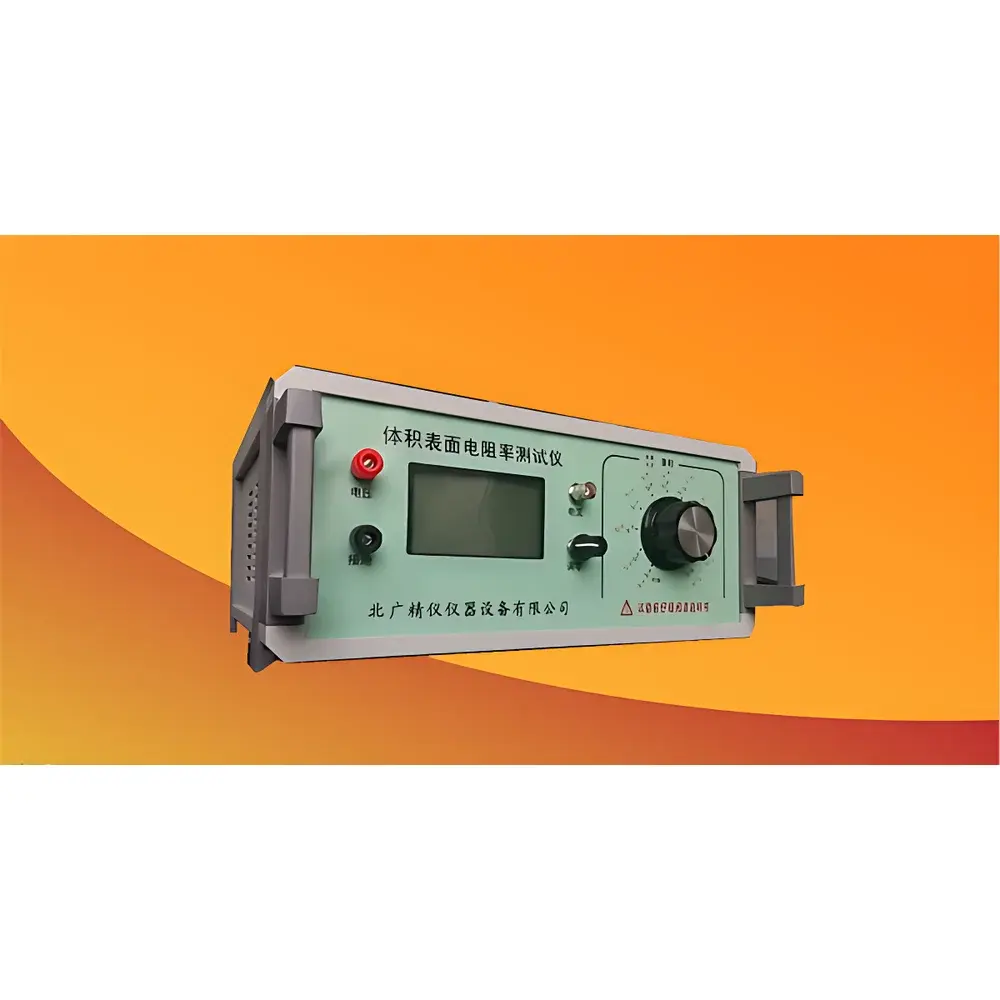
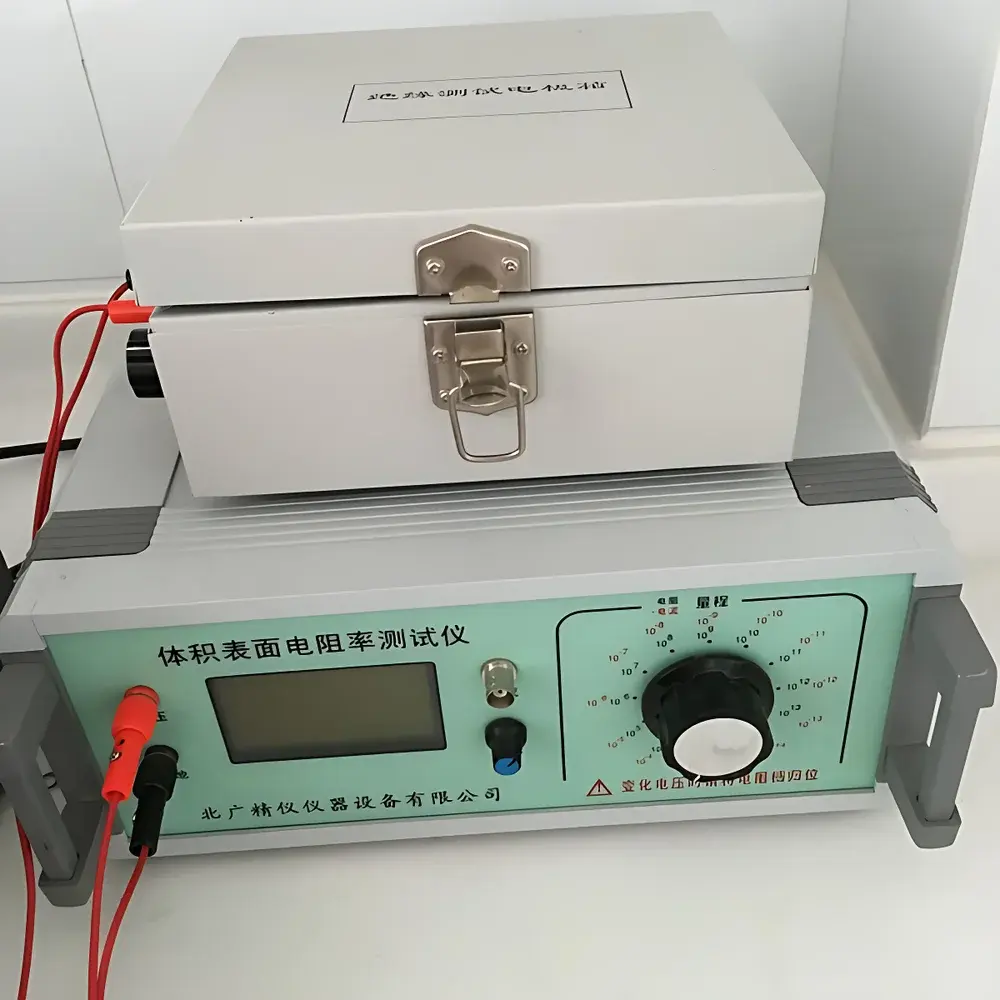
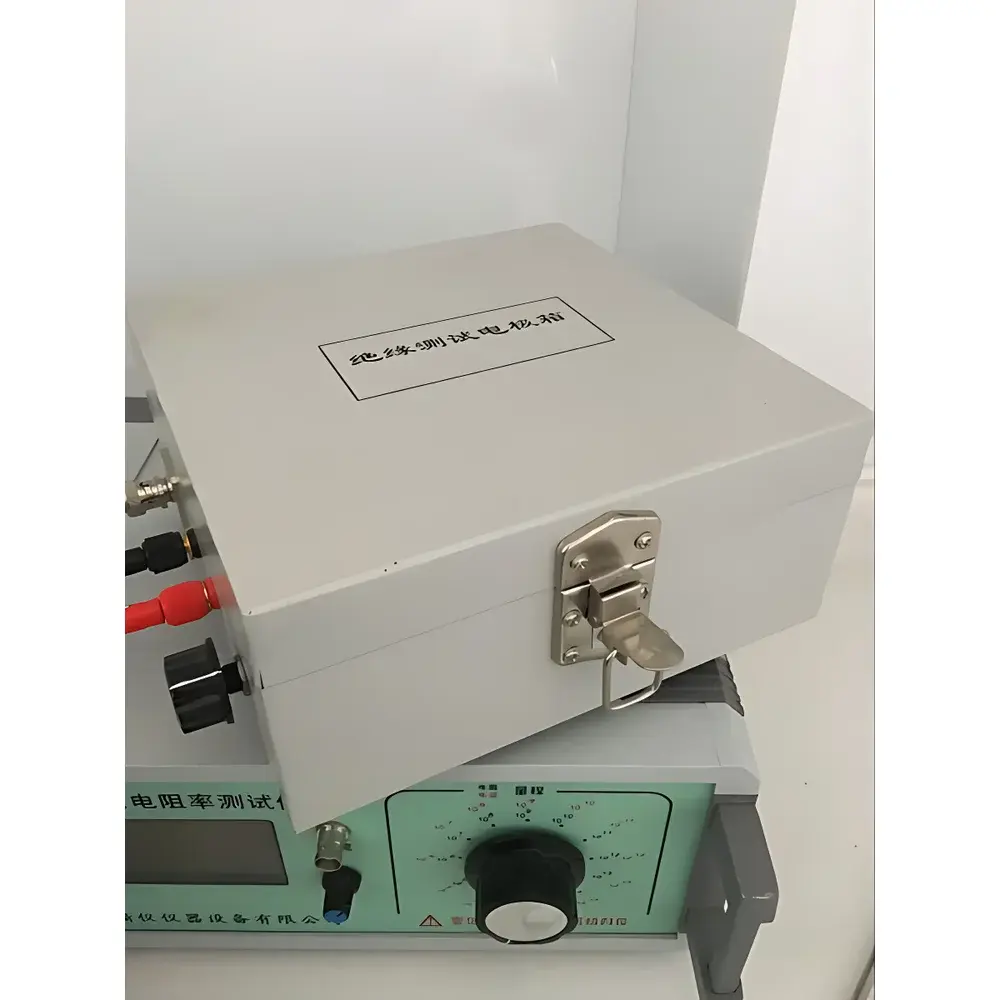
North Guang Jingyi BEST-121 High-Resistance Meter for Volume & Surface Resistivity Measurement of Plastics and Rubber
| Brand | North Guang Jingyi / All Precision Instrument |
|---|---|
| Origin | Beijing, China |
| Manufacturer Type | Direct Manufacturer |
| Product Origin | Domestic (China) |
| Model | BEST-121 High-Resistance Meter |
| Max. Resistance Range | 1×10⁴ Ω to 1×10¹⁸ Ω |
| Test Voltage Options | DC 10 V, 50 V, 100 V, 250 V, 500 V, 1000 V |
| Current Measurement Range | 2×10⁻⁴ A to 1×10⁻¹⁶ A |
| Input Impedance | >10¹⁵ Ω |
| Power Supply | AC 220 V ±10%, 50 Hz |
| Power Consumption | ~10 W |
| Operating Temperature | 0–40 °C |
| Relative Humidity | ≤70% RH |
| Dimensions (L×W×D) | 355 mm × 320 mm × 145 mm |
| Weight | ~6 kg (main unit) |
| Compliance | Q/TPGG 7–2008 (enterprise standard), GB/T 1410–2006, GB 1672–8, GB/T 22042–2008, GB/T 22043–2008, GB/T 18864–2002, GB/T 12703.6–2010, GJB 3007A–2009 |
Overview
The North Guang Jingyi BEST-121 High-Resistance Meter is an engineered solution for precise volumetric and surface resistivity characterization of insulating and antistatic materials—specifically formulated for polymers, elastomers, composites, and industrial rubber products. It operates on a four-terminal, constant-voltage source / precision current-sensing principle grounded in Ohm’s Law (R = V/I), eliminating nonlinearity inherent in analog galvanometer-based systems. Unlike conventional electrometers that fix voltage and infer resistance from deflection, the BEST-121 simultaneously digitizes both applied test voltage and resulting current using high-stability DC amplification (>10¹⁵ Ω input impedance) and real-time A/D computation. This architecture ensures traceable, linear digital readout across its full 14-decade range (10⁴–10¹⁸ Ω), independent of minor fluctuations in supply voltage or electrode contact resistance. Designed for laboratory-grade reproducibility under ASTM D257 and IEC 60093-aligned conditions, it supports standardized resistivity calculations per GB/T 1410–2006 (equivalent to ISO 3915 and ASTM D257), with optional integration into temperature-controlled environments (e.g., water baths per GB/T 1692–2008 for vulcanized rubber).
Key Features
- True dual-parameter digital display: simultaneous real-time readout of resistance (Ω) and current (A) without manual scaling or coefficient multiplication
- Six programmable DC test voltages (10 V, 50 V, 100 V, 250 V, 500 V, 1000 V) compliant with material-specific standards including GB/T 1410–2006 and GB/T 22043–2008
- Auto-ranging resistance measurement from 1×10⁴ Ω to 1×10¹⁸ Ω, with resolution down to 10¹² Ω at 1000 V
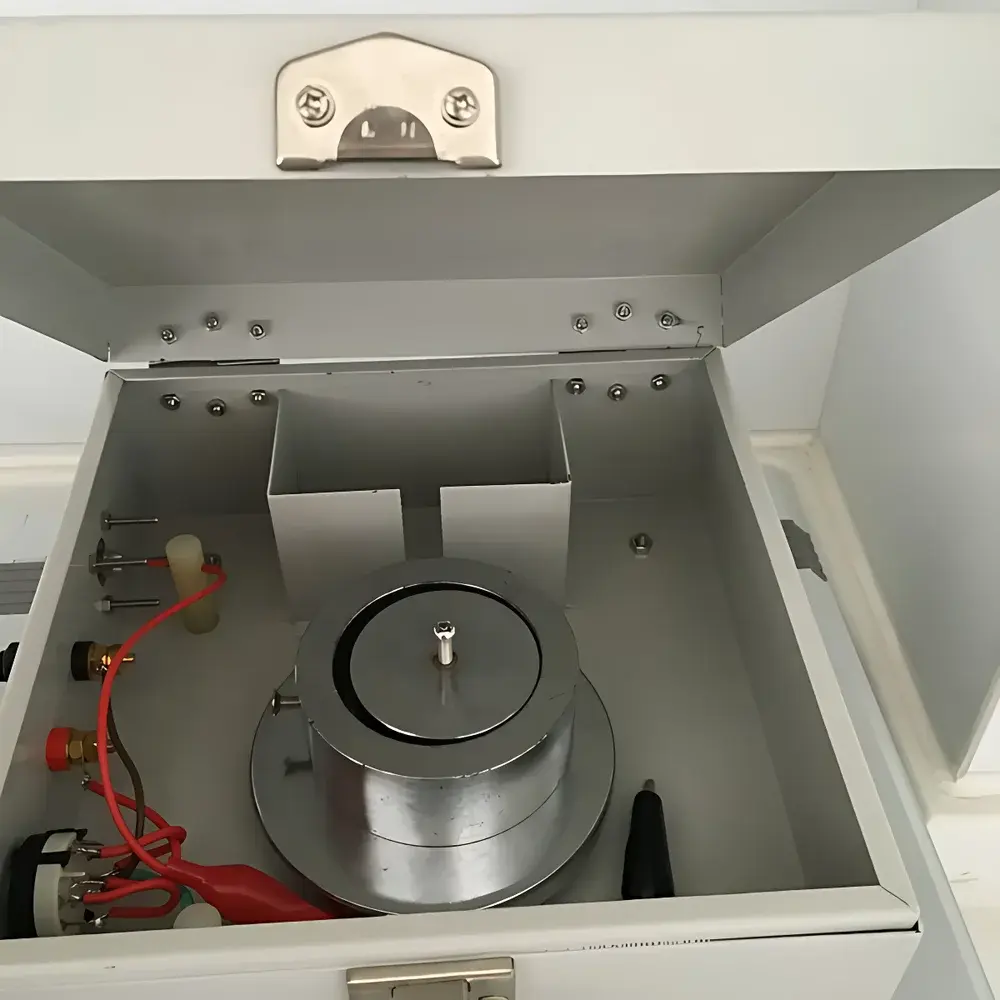
- Guarded three-electrode configuration support (guarded, guarded, unguarded) for accurate volume resistivity (ρᵥ) and surface resistivity (ρₛ) separation per IEC 60093 methodology
- Integrated high-input-impedance current amplifier (input Z > 10¹⁵ Ω) minimizing loading error during ultra-low-current (<10⁻¹⁵ A) detection
- Compact benchtop form factor (355 × 320 × 145 mm), low thermal drift design, and <10 W power consumption for continuous 8-hour operation
- Front-panel test mode selector (Rv/Rs) and rear-panel voltage/limit controls enable rapid method switching without reconfiguration
Sample Compatibility & Compliance
The BEST-121 is validated for use with solid dielectrics—including thermoplastics (e.g., PE, PP, PVC), thermosets (epoxy, phenolic), elastomers (SBR, NBR, silicone), conductive/antistatic composites, and textile-laminated substrates. Its measurement architecture satisfies the electrode geometry, guard ring, and dwell-time requirements specified in GB/T 1410–2006 (identical to ISO 3915:2013), GB/T 22042–2008 (footwear), GB/T 18864–2002 (industrial antistatic rubber), and GJB 3007A–2009 (ESD-safe workspaces). When paired with calibrated triaxial electrodes and environmental chambers, it meets data integrity requirements for GLP-compliant quality control labs. The instrument conforms to electromagnetic compatibility (EMC) Class B limits per GB/T 18268.1–2010 and carries CE-marking equivalence for export-ready deployment.
Software & Data Management
While the BEST-121 operates as a standalone analog-digital hybrid meter, its stable DC output signals (0–2 V proportional to log R) are compatible with third-party DAQ systems (e.g., National Instruments USB-6009, Keysight 34972A) for automated logging, statistical process control (SPC), and audit-trail generation. Users may configure time-stamped resistivity reports aligned with FDA 21 CFR Part 11 principles via external software—capturing operator ID, calibration status, environmental metadata (T/RH), electrode configuration, and voltage/current traces. Internal zeroing routines and open-circuit validation protocols ensure measurement integrity prior to each test cycle, supporting ISO/IEC 17025 documentation workflows.
Applications
- Volume resistivity (ρᵥ) determination of polymer films, molded parts, and cable insulation per GB/T 1410–2006 and ASTM D257
- Surface resistivity (ρₛ) evaluation of ESD-safe flooring, garments (GB 12014, GB/T 24249), and cleanroom textiles (GB/T 12703.6)
- Quality assurance of antistatic additives in rubber compounds (GB/T 18864–2002) and conductive masterbatches
- Development testing of carbon-black-filled TPEs, graphene-enhanced composites, and ionomer-based static-dissipative materials
- Compliance verification for military-grade ESD packaging (GJB 105–1998-Z) and petroleum-handling components (GB 13348–2009)
- Temperature-dependent resistivity profiling when coupled with thermostatic baths (e.g., GB/T 1692–2008 for vulcanized rubber)
FAQ
What standards does the BEST-121 support for volume resistivity testing?
It fully implements GB/T 1410–2006 (equivalent to ISO 3915 and ASTM D257), with hardware-level compliance for electrode spacing, guard ring geometry, and 60-second electrification timing.
Can the instrument measure both volume and surface resistivity on the same sample?
Yes—via front-panel Rv/Rs toggle and compatible three-electrode fixtures, enabling separation of bulk conduction from interfacial leakage paths.
Is the BEST-121 suitable for GLP or ISO/IEC 17025 accredited laboratories?
Its traceable calibration path, documented zeroing procedure, and stable long-term drift (<0.5% over 8 h) meet foundational metrological requirements; full accreditation requires user-established SOPs and external calibration certificates.
How is measurement accuracy maintained at ultra-high resistances (>10¹⁶ Ω)?
Through active guarding, triaxial cabling, >10¹⁵ Ω input impedance amplification, and shielded enclosure design—minimizing stray capacitance and surface leakage errors.
Does the device support automated data export?
It provides analog voltage outputs for external DAQ integration; full digital communication (RS-232/USB) requires optional interface modules configured per customer protocol specifications.



