
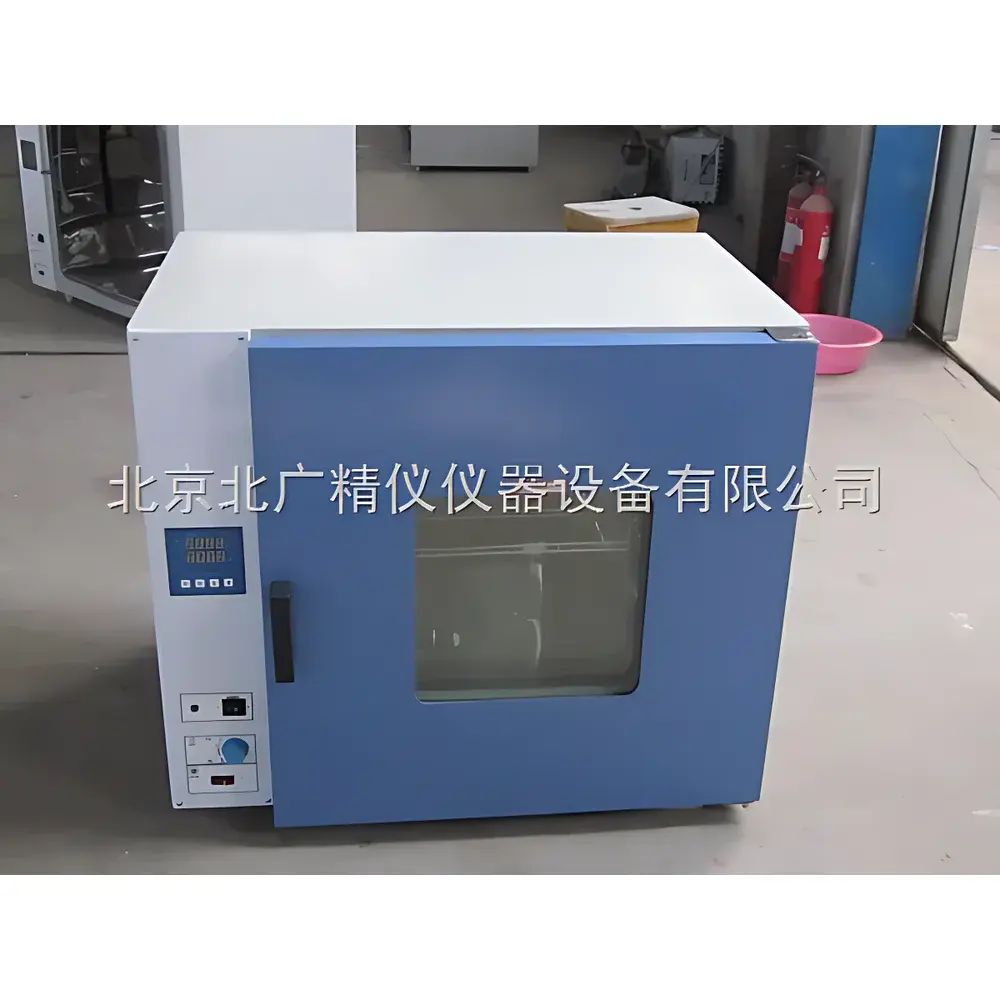
Beijing North Guang Precision Instruments HMYS-200 Foam Compression Set Tester
| Brand | Beijing North Guang Precision Instruments |
|---|---|
| Origin | Beijing, China |
| Manufacturer Type | Direct Manufacturer |
| Model | HMYS-200 |
| Temperature Range | Ambient to 200 °C |
| Temperature Uniformity | ±1% of full scale |
| Timer Range | 1–9999 min |
| Chamber Dimensions (W×D×H) | 350 × 300 × 300 mm |
| External Dimensions | 600 × 420 × 450 mm |
| Compression Ratios | 50%, 75%, 90% |
| Standard Test Temp | 70 °C |
| Standard Duration | 22 h |
| Specimen Size | 50 × 50 × 25 mm (n=5) |
| Glass Plate Requirement for Thin Samples | 1–1.5 mm thick, 50–55 mm square |
| Power Supply | 220 V AC |
Overview
The Beijing North Guang Precision Instruments HMYS-200 Foam Compression Set Tester is a dedicated thermal-mechanical testing system engineered for the precise determination of permanent compression deformation in flexible polymeric foams—primarily polyurethane, latex, and ethylene-propylene-diene monomer (EPDM) formulations. It operates on the principle of controlled compressive loading under elevated temperature conditions, followed by recovery assessment after thermal stress relaxation. Per ISO 1856 Method A, ASTM D3574 (Sections D–J), JIS K6400-7, and GB/T 6669–2001, the instrument subjects conditioned specimens to defined compression ratios (50%, 75%, or 90%) within a thermally stabilized chamber, maintains that strain state for a specified duration (typically 22 hours at 70 °C), then measures residual thickness after standardized recovery (30 minutes at ambient conditions). The resulting compression set (%) is calculated as: C = [(t₀ − t₁)/t₀] × 100, where t₀ is original thickness and t₁ is recovered thickness. This metric quantifies the material’s ability to retain elastic integrity after prolonged viscoelastic strain—critical for evaluating long-term performance in cushioning, gasketing, sealing, and automotive interior applications.
Key Features
- Microprocessor-controlled temperature chamber with PID algorithm ensures stable thermal regulation across the full operating range (ambient to 200 °C), with documented uniformity of ±1% of full scale.
- Dual-function digital timer supports programmable dwell periods from 1 minute to 9999 minutes—enabling compliance with extended test protocols beyond standard 22-hour cycles.
- Robust hot-air circulation system employs high-temperature-rated axial fans and optimized duct geometry to minimize spatial temperature gradients (<±0.5 °C deviation across chamber volume).
- Modular compression fixture assembly accommodates interchangeable platens and spacers, supporting standardized specimen dimensions (50 × 50 × 25 mm) and optional glass plate overlays (1–1.5 mm thick) for thin or low-modulus samples.
- Stainless steel internal chamber construction resists oxidation and chemical exposure during repeated thermal cycling; external housing features powder-coated mild steel for mechanical durability and corrosion resistance.
Sample Compatibility & Compliance
The HMYS-200 is validated for use with open-cell and closed-cell flexible foams exhibiting initial densities between 15–120 kg/m³ and nominal hardness values (per ISO 2439) ranging from 50–300 N. It supports multi-specimen batch testing (up to five 50 mm × 50 mm × 25 mm cubes per cycle) while maintaining inter-sample thermal and mechanical equivalence. All operational parameters align with internationally recognized standards: ISO 1856 (Method A), ASTM D3574 (Test Methods D, E, F, G, H, I, J), JIS K6400-7, and GB/T 6669–2001. Data generated meets GLP documentation requirements when paired with traceable calibration records and operator logs. While not FDA 21 CFR Part 11–compliant out-of-the-box, the system architecture permits integration with validated LIMS or ELN platforms for audit-trail-enabled reporting in regulated environments.
Software & Data Management
The HMYS-200 operates via an embedded microcontroller interface with LED-based digital display and tactile membrane keypad—designed for reliability in industrial laboratory settings where network connectivity is non-critical. Temperature setpoint, dwell time, and cycle status are configured manually and retained in non-volatile memory. For traceability, users record test parameters, specimen IDs, and post-recovery measurements in standardized lab notebooks or electronic spreadsheets. Optional RS-232 or USB-to-serial adapters enable connection to external PCs for automated data logging using third-party SCADA or LabVIEW-compatible acquisition software. Calibration certificates for chamber temperature sensors (Class A Pt100) and mechanical compression fixtures are provided with each unit and should be renewed annually per ISO/IEC 17025 recommendations.
Applications
This tester serves quality control laboratories in foam manufacturing, automotive component suppliers, furniture OEMs, and R&D centers developing next-generation elastomeric materials. Typical use cases include: qualification of new foam formulations against OEM specification limits (e.g., Ford WSS-M99P1211-A, GMW15634); comparative evaluation of aging effects following thermal preconditioning; validation of crosslink density improvements in vulcanized rubber foams; and stability screening of bio-based polyols in sustainable PU systems. Its reproducibility supports statistical process control (SPC) charting of compression set variability across production lots, directly informing release decisions per ISO 9001 Clause 8.6.
FAQ
What standards does the HMYS-200 fully support?
It is mechanically and thermally configured to execute ISO 1856 Method A, ASTM D3574 (all subsections D–J), JIS K6400-7, and GB/T 6669–2001 without modification.
Can the instrument perform tests at temperatures above 70 °C?
Yes—the chamber is rated for continuous operation up to 200 °C, enabling accelerated aging studies per ASTM D3045 or custom thermal stress protocols.
Is calibration documentation included with shipment?
Each unit ships with factory calibration reports for the temperature sensor and dimensional verification of compression fixtures, traceable to national metrology institutes.
What maintenance is required to ensure long-term accuracy?
Annual recalibration of the temperature controller and visual inspection of gasket integrity and fan motor bearings are recommended; no routine lubrication is required.
Does the system support automatic data export?
No native software is bundled, but the hardware interface supports serial communication for integration with user-supplied data acquisition systems compliant with Modbus RTU or ASCII protocols.



