
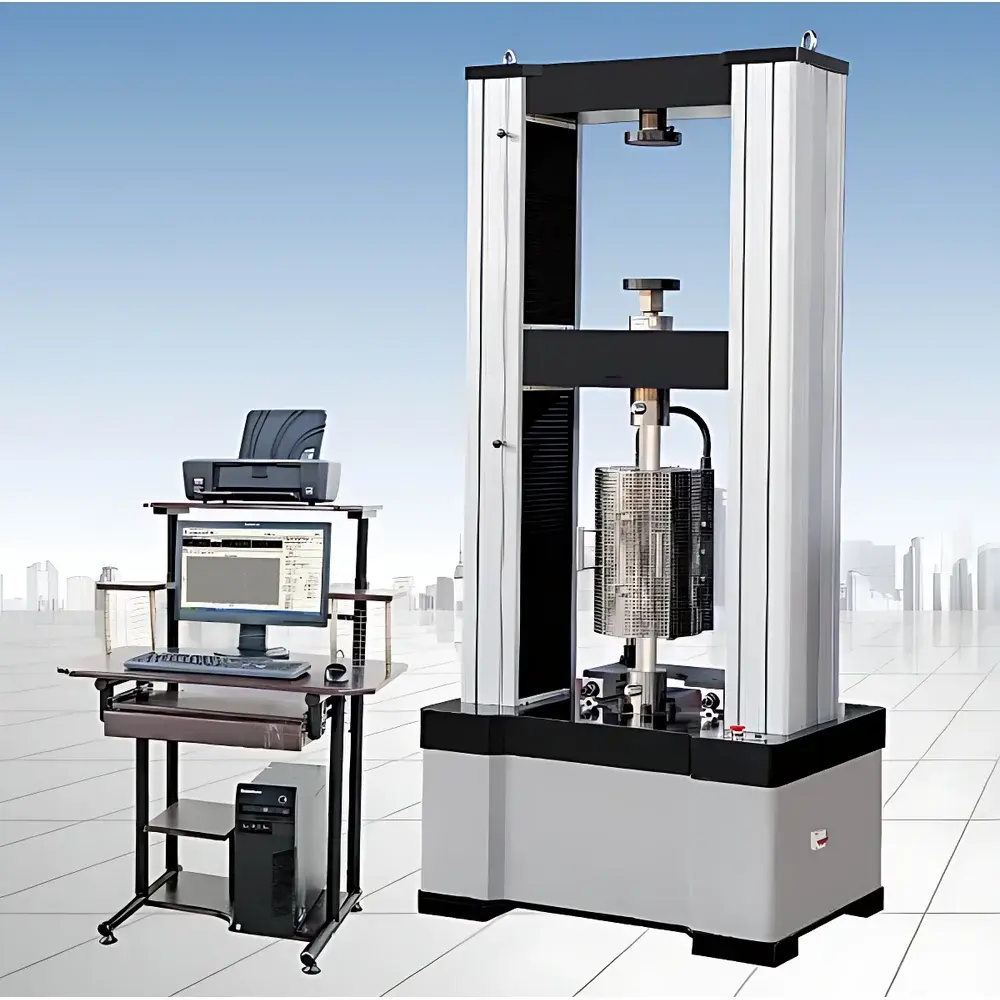
Beijing North Guang Precision Instruments BWN-5KN Universal Electronic Tensile Testing Machine
| Brand | Beijing North Guang Precision Instruments |
|---|---|
| Origin | Beijing, China |
| Manufacturer Type | Direct Manufacturer |
| Instrument Type | Electronic Universal Testing Machine |
| Model | BWN-5KN |
| Load Cell Capacity | 5000 N |
| Force Accuracy | ±0.5% |
| Force Resolution | 1/10000 |
| Displacement Resolution | 0.001 mm |
| Displacement Accuracy | ≤0.5% |
| Speed Range | 0.01–500 mm/min |
| Test Width | 350 mm |
| Crosshead Travel | 950 mm (excluding fixtures) |
| Data Interface | RS232 |
| Control Mode | Pulse Command |
| Sampling Rate | 200 Hz |
| A/D Converter | 24-bit |
| Encoder Type | LINE DRIVE, 2500 P/R |
| Safety Features | Overload emergency stop, travel limit switches, leakage protection, automatic breakpoint halt |
| Software | UTM107 + Windows XP-based testing suite with multi-standard compliance (ASTM, ISO, GB, DIN, JIS, BS), Excel export, multi-language UI (EN/CN), audit-ready data logging |
Overview
The Beijing North Guang Precision Instruments BWN-5KN Universal Electronic Tensile Testing Machine is a statically calibrated, servo-controlled electromechanical system engineered for precision mechanical property characterization of metallic and non-metallic materials under uniaxial loading conditions. It operates on the principle of controlled displacement actuation via a high-torque DC motor coupled to a precision ball-screw transmission system, enabling reproducible application of tensile, compressive, flexural, peel, shear, and puncture loads per ISO 6892-1, ASTM E8/E9, ASTM D638/D790/D3039, and GB/T 228.1–2021 standards. The machine integrates a traceable 5000 N load cell compliant with ISO 376 Class 0.5 accuracy requirements, delivering force measurement stability within ±0.5% of full scale across seven auto-ranging amplification segments. Its modular architecture supports routine QC verification in polymer manufacturing, R&D validation in composite development, and regulatory-compliant mechanical testing in medical device and automotive component supply chains.
Key Features
- High-fidelity force measurement using a certified 5000 N USA-made load cell with ±0.5% accuracy and 24-bit A/D conversion at 200 Hz sampling rate
- Seven-range automatic force amplification (×1 to ×100) ensures optimal signal-to-noise ratio across low-force elastomer testing and high-strength metal evaluation
- Pulse Command digital control system enables precise velocity regulation from 0.01 to 500 mm/min, with programmable ramp-hold-step profiles for creep, stress-relaxation, and cyclic loading protocols
- LINE DRIVE optical encoder (2500 pulses/revolution) delivers 0.001 mm displacement resolution and immunity to electromagnetic interference in industrial laboratory environments
- Dual-mode calibration: full-scale linear correction plus segment-specific fine-tuning for enhanced traceability across the entire force range
- Integrated safety architecture including dual mechanical end-limit switches, electronic overload cutoff, ground-fault interrupter (GFI), and auto-stop-on-fracture functionality
- Motorized crosshead with coarse/fine adjustment capability facilitates rapid specimen alignment and repeatable gauge length setup
Sample Compatibility & Compliance
The BWN-5KN accommodates specimens ranging from ultra-thin polymer films (≥10 µm thickness) to structural metal coupons (up to 25 mm thick), fiber bundles, textile weaves, adhesive lap joints, and biomedical sutures. Standard test width (350 mm) and crosshead travel (950 mm) support ASTM D882 film strips, ISO 527-2 Type 1B bars, and EN 13115 packaging tape configurations. Optional extensometers—including clip-on axial devices (±0.5% accuracy) and non-contact video-based systems—enable strain measurement per ISO 9513 Class 1 requirements. The system meets essential CE machinery directive (2006/42/EC) safety provisions and supports GLP/GMP-aligned operation through configurable audit trails, user access levels, and electronic signature-capable reporting.
Software & Data Management
The UTM107 software platform runs natively on Windows XP (or later via compatibility mode) and provides full ISO/IEC 17025-aligned data integrity: all test parameters, raw acquisition timestamps, operator IDs, environmental metadata, and calibration certificates are embedded in encrypted binary archives. Modular test standard libraries include preconfigured methods for ASTM D638 (tensile plastics), ASTM D3039 (composites), ISO 11843 (detection limits), and GB/T 1040 (general plastics). Real-time plotting supports synchronized load-displacement, stress-strain, and multi-curve overlay views with AutoScale scaling and dynamic axis switching. All results export to native Excel (.xlsx) format with formula-protected worksheets; custom report templates allow integration into enterprise LIMS or ERP workflows. Data backup is configurable to network drives or NAS endpoints, and historical test replay functionality permits retrospective parameter reanalysis without retesting.
Applications
This system serves as a primary mechanical characterization tool in accredited materials labs performing: tensile modulus and yield strength determination per ISO 527; peel adhesion quantification per ASTM D903 and FINAT FTM 1; tear resistance assessment (Elmendorf, trouser, and tongue methods); compression testing of foams per ISO 3386; flexural stiffness evaluation of thermoplastics per ASTM D790; and wire/cable elongation verification per IEC 60811. It is routinely deployed for supplier qualification audits in Tier-1 automotive supply chains, biocompatibility matrix validation for ISO 10993-12 compliant polymers, and accelerated aging studies where mechanical property drift must be tracked over time under controlled humidity/temperature chambers.
FAQ
Does the BWN-5KN comply with FDA 21 CFR Part 11 requirements for electronic records?
Yes—the UTM107 software supports role-based user authentication, electronic signatures, and immutable audit logs with timestamped operator actions, meeting core Part 11 criteria for regulated pharmaceutical and medical device testing environments.
Can third-party extensometers be integrated?
The system features analog and digital input ports compatible with industry-standard LVDT, strain-gauge, and video extensometers from ZwickRoell, MTS, and Imetrum, provided they output ±10 V or TTL signals.
Is calibration traceability to NIST or CNAS available?
Factory calibration includes a certificate traceable to China National Institute of Metrology (CNIM); optional UKAS or NIST-traceable recalibration services are available through authorized regional partners.
What is the maximum specimen thickness supported with standard grips?
Standard wedge-action pneumatic grips accommodate specimens up to 12 mm thick; hydraulic or custom jaw inserts extend capacity to 25 mm for cast alloys and reinforced composites.
How is thermal drift compensated during long-duration tests?
The load cell incorporates temperature-compensated semiconductor strain gauges, and software applies real-time thermal zero-shift correction algorithms validated per ISO 376 Annex C.



