
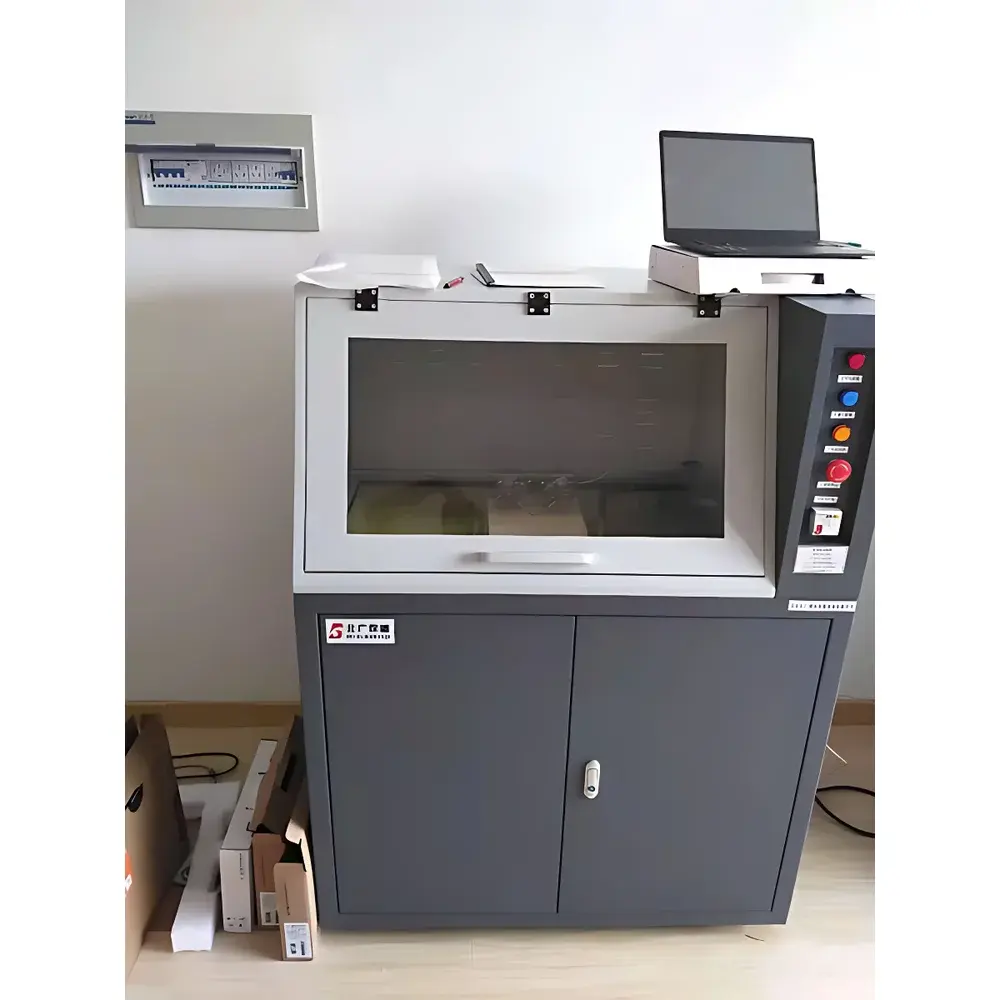
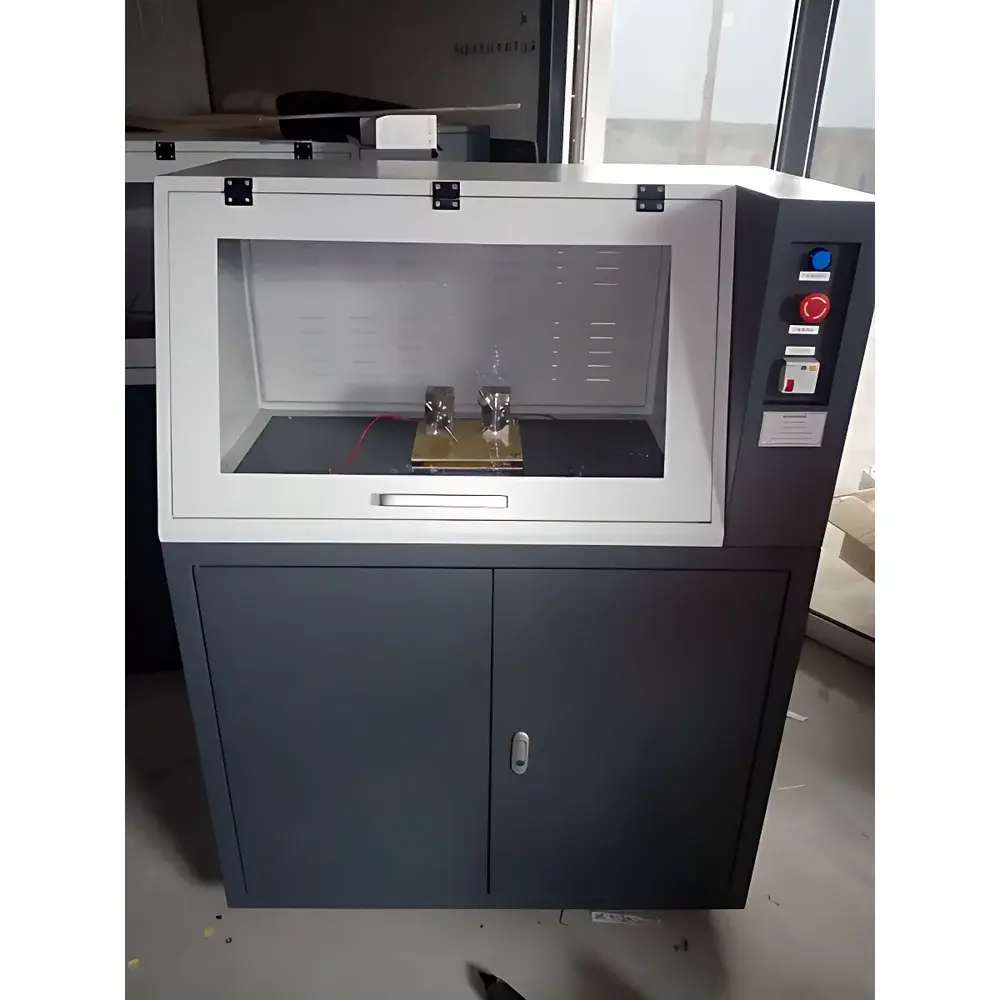
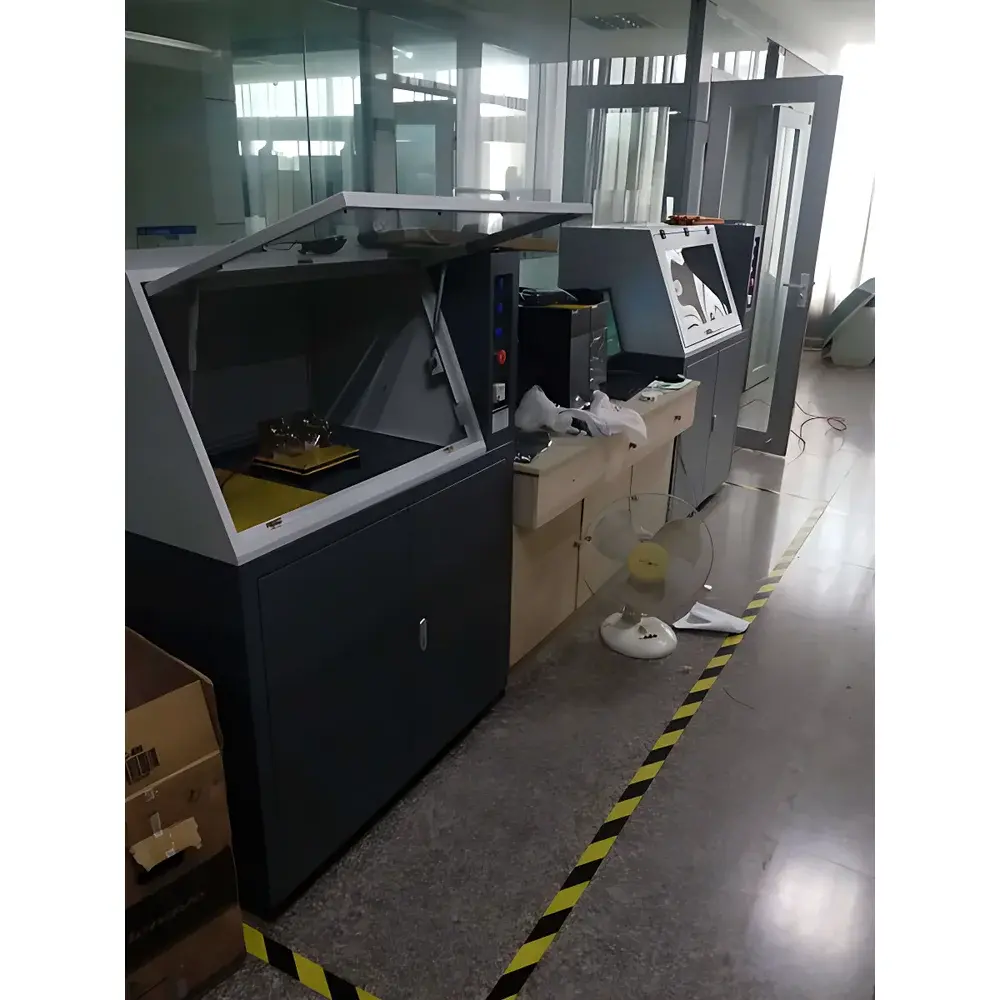
North Guangjingyi BDH-20KV Arc Resistance Tester
| Brand | North Guangjingyi / All Precision Instrument |
|---|---|
| Origin | Beijing, China |
| Manufacturer Type | Manufacturer |
| Model | BDH-20KV |
| Input Voltage | AC 220 V |
| Output Voltage Range | 0–12.5 kV AC |
| Rated Power Capacity | 3 kVA |
| Test Modes | Intermittent arc & continuous arc |
| Selectable Test Currents | 10, 20, 30, 40 mA |
| Voltage Regulation Accuracy | ≤ ±1% |
| Arc On/Off Timing Accuracy | < 5 ms |
| Adjustable Electrode Gap & Angle | Yes |
| Electrode Configuration | Tungsten rods (Φ2.5 mm × 70 mm), 110° included angle, tip force 0.5 ± 0.05 N |
| Electrode Material | Tungsten carbide |
| Sample Mounting | Rigid flat-stage fixture for solid insulating materials |
| Safety Protections | Overvoltage, overcurrent, short-circuit, interlocked safety door, software operation lockout |
| Dimensions (W×D×H) | 800 × 800 × 1450 mm |
| Compliance Standards | GB 1411–1978, IEC 61621:1997, ASTM D495, JEC 149, UL 746A |
Overview
The North Guangjingyi BDH-20KV Arc Resistance Tester is an engineered test system designed to evaluate the resistance of solid insulating materials to surface degradation under high-voltage, low-current electric arcing conditions. Based on the principle of controlled arc initiation and propagation across a standardized electrode gap, the instrument subjects specimens to repeated or sustained arcs at voltages up to 12.5 kV AC and currents ranging from 10 to 40 mA. The test method simulates real-world electrical stress scenarios—such as tracking, carbonization, and surface erosion—that occur in high-voltage components including motor windings, transformer bushings, circuit breaker housings, and appliance insulation systems. Unlike dielectric strength testers, which measure bulk breakdown voltage, this apparatus quantifies time-to-failure under progressive surface arcing, delivering a comparative metric for material ranking and formulation screening.
Key Features
- Precision-engineered tungsten carbide electrodes (Φ2.5 mm × 70 mm) with fully adjustable alignment, gap distance, and 110° included angle—ensuring strict conformance to IEC 61621:1997 mechanical requirements.
- Electrode tip loading mechanism calibrated to apply 0.5 ± 0.05 N normal force on specimen surfaces, eliminating variability caused by inconsistent contact pressure.
- High-stability AC high-voltage generator (0–12.5 kV, ≤ ±1% regulation) coupled with isolated current sensing and fast-response solid-state switching for arc timing control (< 5 ms accuracy).
- Dual-mode operation: programmable intermittent arc cycles (e.g., 0.5 s on / 0.5 s off) and continuous arc exposure, both configurable via embedded microcontroller interface.
- Integrated safety architecture including hardware interlocks (safety door cut-off), overvoltage/overcurrent trip circuits, short-circuit protection, and software-level operational safeguards against misconfiguration.
- Modular design supports firmware updates to align with evolving national and international standards—including backward compatibility with GB 1411–1978 and forward readiness for revised editions of IEC 61621 and ASTM D495.
Sample Compatibility & Compliance
The BDH-20KV accommodates rigid, flat specimens of thermoplastics (e.g., nylon, PBT, PC), thermosets (epoxy, phenolic), laminates (GPO-3, FR-4), ceramics, glass, mica, paperboard, and cured insulating varnishes and coatings. Specimens must be ≥ 3 mm thick and ≥ 50 mm × 50 mm in planar dimension to ensure thermal stability and edge-effect minimization during testing. The system meets essential requirements for GLP-compliant laboratories: full traceability of test parameters, non-volatile storage of raw timing data, and user-accessible calibration logs. It is validated per ISO/IEC 17025 guidelines for electrical safety testing equipment and conforms to the electrical safety provisions of IEC 61010-1. Its test protocol satisfies regulatory expectations for material qualification under UL 746A (polymeric materials for electrical equipment) and JEC 149 (Japanese Electrical Standards for insulating materials).
Software & Data Management
The included Windows-based arc resistance measurement software provides real-time visualization of voltage, current, and arc state transitions. Each test session automatically records timestamped event logs—including arc initiation, extinction, carbon track formation, and final failure—exportable as CSV or PDF reports. Audit trails capture operator ID, calibration date, parameter settings, and firmware version, supporting FDA 21 CFR Part 11 compliance when deployed with electronic signature modules. The software supports multi-user role management (administrator, technician, reviewer), password-protected configuration changes, and automated report generation with embedded pass/fail criteria based on user-defined time thresholds (e.g., >180 s = Class A; < 60 s = Class C). Raw waveform data can be exported for post-test spectral analysis or integration into LIMS environments via OPC UA or Modbus TCP interfaces.
Applications
This tester serves quality control laboratories in OEM manufacturing of rotating machinery, power distribution equipment, consumer electronics enclosures, and EV battery module housings. It enables comparative evaluation of halogen-free flame-retardant additives in polyamide 66 formulations, validates UV-stabilized polyester resins for outdoor insulators, and supports R&D efforts in developing arc-resistant nanocomposite coatings for switchgear contacts. In academic research, it facilitates correlation studies between surface resistivity, filler dispersion homogeneity, and arc tracking resistance—providing empirical input for predictive models of insulation lifetime under partial discharge conditions. Routine use ensures compliance with procurement specifications requiring minimum arc resistance durations prior to production release.
FAQ
What standards does the BDH-20KV comply with?
It supports GB 1411–1978, IEC 61621:1997, ASTM D495, UL 746A, and JEC 149 through hardware design and firmware-programmable test sequences.
Can the electrode force be verified or recalibrated in-house?
Yes—the integrated load cell and digital readout allow periodic verification using NIST-traceable deadweight standards; calibration certificates are provided with each unit.
Is remote operation supported?
The system includes Ethernet connectivity and supports remote monitoring and parameter adjustment via secure HTTPS interface, though safety-critical functions (e.g., HV enable) require local physical confirmation.
How is specimen conditioning handled before testing?
Per IEC 61621, specimens must be conditioned at 23 °C ± 2 °C and 50 % ± 5 % RH for ≥ 48 h prior to mounting; the instrument does not include environmental chambers but interfaces with external climate-controlled rooms via digital I/O.
What maintenance is required for long-term reliability?
Electrode tips should be inspected and re-polished after every 50 test cycles; high-voltage bushings require annual dielectric oil analysis; firmware updates are delivered quarterly via encrypted USB key or authenticated download portal.
Related Products






