
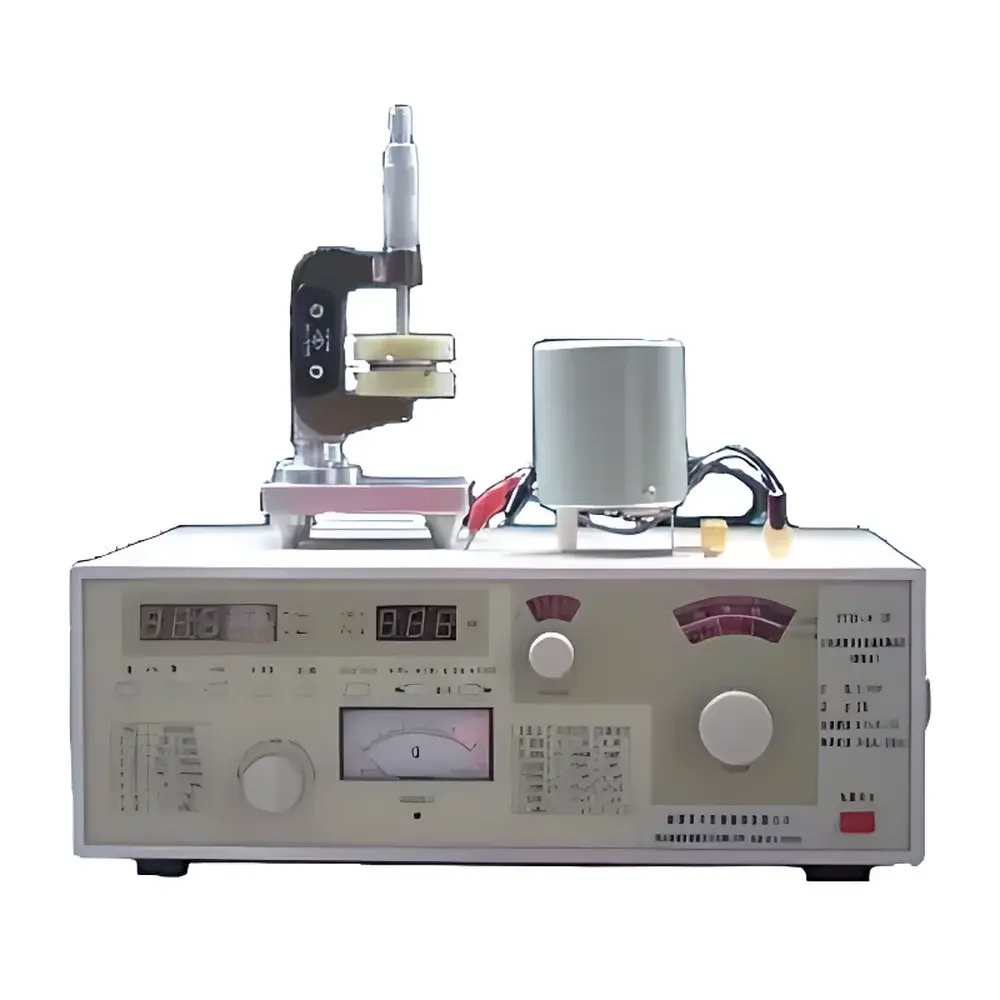
North Guangjingyi GDAT-C Dielectric Constant and Q-Factor Meter
| Brand | North Guangjingyi / All Precision Instrument |
|---|---|
| Origin | Beijing, China |
| Manufacturer Type | Manufacturer |
| Product Origin | Domestic (China) |
| Model | GDAT-C |
| Pricing | Available Upon Request |
Overview
The North Guangjingyi GDAT-C Dielectric Constant and Q-Factor Meter is a precision LCR-based resonant impedance analyzer engineered for accurate measurement of dielectric properties—including relative permittivity (εr) and loss tangent (tan δ)—as well as quality factor (Q), inductance (L), capacitance (C), and resonant frequency of solid, liquid, and thin-film dielectric samples. It operates on the principle of series/parallel resonance in a high-stability air-core oscillator circuit, where the sample—integrated as part of a calibrated resonant cavity or electrode fixture—alters the system’s natural resonant frequency and damping characteristics. By precisely tracking shifts in resonance peak and bandwidth under controlled sinusoidal excitation (1 kHz to 70 MHz), the instrument calculates εr via standard cavity perturbation or parallel-plate electrode models compliant with ASTM D150 and IEC 60250 methodologies. Its digital phase-locked loop (DPLL) signal synthesis ensures spectral purity and frequency stability better than ±10 ppm over temperature, critical for repeatable permittivity determination across material batches and environmental conditions.
Key Features
- Digital Synthesis Signal Source: DPLL-controlled RF oscillator with continuous, stepless frequency coverage from 1 kHz to 70 MHz; five-digit frequency display resolution (±0.01% basic accuracy).
- High-Resolution Q Measurement: Automatic and manual range selection across three Q scales (1–100, 1–316, 1–999); 0.1-Q resolution with inherent error ≤ ±5% ±3% of full scale.
- Low-Residual-Inductance Architecture: Optimized RF path design limits residual inductance to ≤30 nH, minimizing systematic Q error at frequencies above 10 MHz.
- Multi-Parameter LCD Interface: Backlit graphical LCD displays real-time Q, test frequency, tuning status, GO/NO-GO pass/fail flag, and preset threshold value—all simultaneously in menu-driven format.
- Digitally Programmable Q Thresholding: User-defined Q pre-set (range: 1–1000) triggers audible beep and “GO” indicator upon achievement; “NO GO” displayed for out-of-spec results—enabling rapid pass/fail screening in QC environments.
- Calibrated Tuning Capacitor System: Main capacitor: 40–500 pF, ±1% or ±0.5 pF accuracy; fine-tuning section: –3 to +3 pF, 0.2 pF resolution—supporting precise resonance nulling for high-Q measurements.
Sample Compatibility & Compliance
The GDAT-C supports standardized electrode configurations including parallel-plate, coaxial, and guarded-electrode fixtures (accessories sold separately), enabling εr evaluation of ceramics, polymers, composites, transformer oils, and aqueous electrolytes per ASTM D150-21 (Standard Test Methods for Dielectric and Resistivity Properties of Solid Electrical Insulating Materials) and IEC 60250 (Determination of the Dielectric Constant and Dissipation Factor of Electrical Insulating Materials at Power, Audio and Radio Frequencies). Its hardware architecture and firmware logic are designed to support GLP-compliant data integrity requirements—including user-accessible calibration logs, timestamped measurement records, and non-erasable system event history—facilitating internal audit readiness. While not FDA 21 CFR Part 11 certified out-of-the-box, the instrument’s deterministic analog front-end and deterministic digital control architecture allow integration into validated laboratory systems when paired with compliant data acquisition software and procedural controls.
Software & Data Management
The GDAT-C operates as a standalone benchtop instrument with no embedded operating system or network interface. All measurements are displayed and stored locally on the unit’s non-volatile memory (retains ≥1,000 test records with frequency, Q, L, C, and pass/fail status). Data export is supported via RS-232 serial interface (standard) or optional USB-to-serial adapter, enabling direct logging into third-party applications such as LabVIEW, MATLAB, or custom Python scripts using ASCII-based SCPI-like command syntax (e.g., “FREQ?”, “Q?”, “PASS?”). Firmware updates are performed offline via UART bootloader protocol using manufacturer-provided utilities. Audit trails—including operator ID (manually entered per session), calibration date, and firmware revision—are embedded in each saved record header, supporting traceability under ISO/IEC 17025 Clause 7.7.
Applications
- Quality control of polymer films and laminates in packaging and flexible electronics manufacturing.
- Dielectric characterization of ceramic powders and sintered substrates for RF/microwave component development.
- In-process monitoring of insulating oil degradation in power transformers (via tan δ trend analysis at 1 kHz and 10 kHz).
- Academic research on ferroelectric hysteresis, relaxor behavior, and interfacial polarization in nanocomposites.
- Validation of coating thickness and uniformity on conductive substrates using capacitance shift modeling.
- Routine verification of reference standards (e.g., NIST-traceable SiO2, polyethylene, distilled water) in metrology labs.
FAQ
What standards does the GDAT-C comply with for dielectric constant measurement?
It supports test methodologies aligned with ASTM D150 and IEC 60250; however, final compliance depends on fixture selection, calibration procedure, and environmental control per standard clauses.
Can the GDAT-C measure complex permittivity (ε’ and ε”) directly?
No—it derives εr indirectly from resonant frequency shift and Q-factor change using predefined electrode geometry models; ε’ and ε” require post-processing with known sample thickness and electrode area.
Is external calibration required before first use?
Yes. A two-point open/short calibration using supplied standards is mandatory prior to measurement; annual recalibration against traceable references is recommended.
Does the instrument support automated sweep modes or frequency sweeps?
No—it is a single-frequency, point-measurement instrument; swept-frequency analysis requires external signal generator and vector voltmeter integration.
What is the typical measurement uncertainty for εr on a 1 mm thick epoxy sample at 1 MHz?
Under controlled lab conditions (23 °C ±0.5 °C, RH <50%, calibrated fixture), combined expanded uncertainty (k=2) is approximately ±3.5% for εr values between 3 and 6.



