
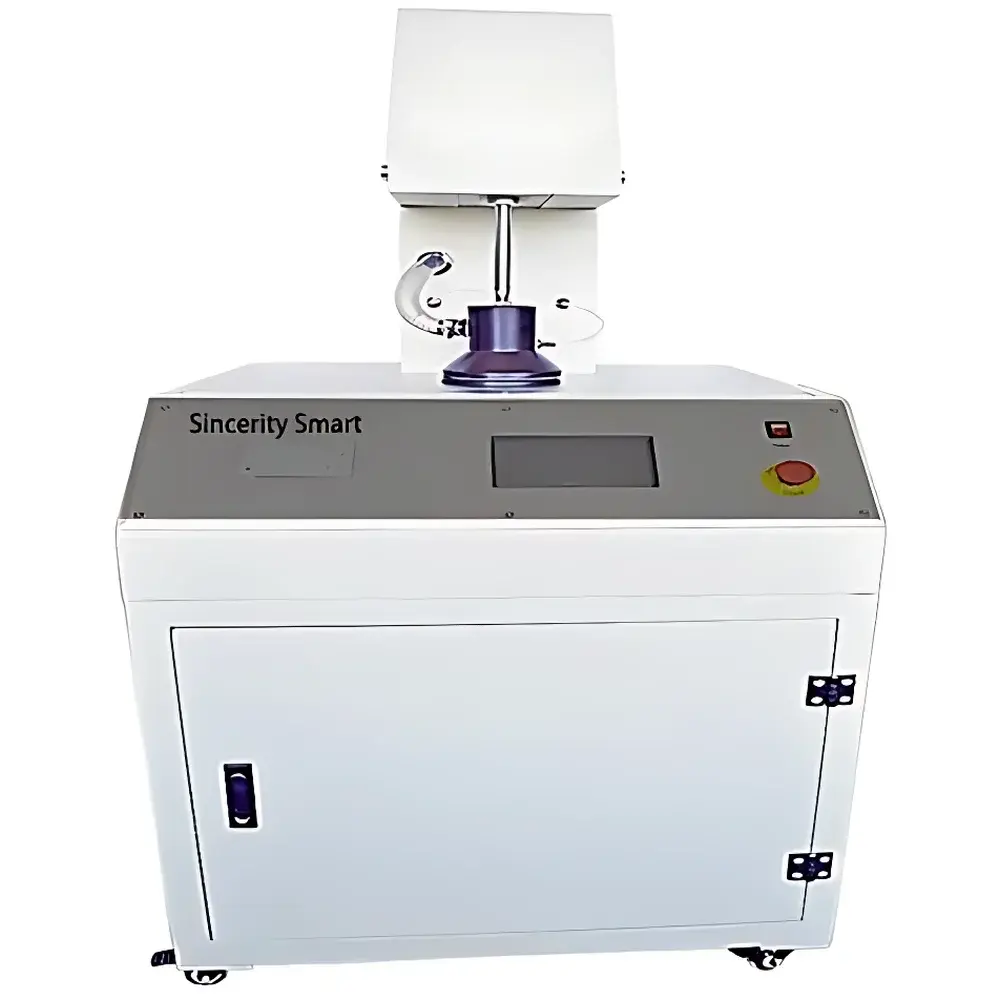
Beiguang Jingyi BSZ-400 Meltblown Fabric Particle Filtration Efficiency Tester
| Brand | Beiguang Jingyi / All Precision Instrument |
|---|---|
| Origin | Beijing, China |
| Manufacturer Type | Direct Manufacturer |
| Product Category | Domestic |
| Model | BSZ-400 |
| Instrument Form Factor | Benchtop |
| Wavelength Configuration | Dual-Wavelength UV/Blue Light |
| UV Filter Size | 1 unit |
| UV Lamp | 1 unit |
| Power Rating | 1500 W |
Overview
The Beiguang Jingyi BSZ-400 Meltblown Fabric Particle Filtration Efficiency Tester is a purpose-built, ISO/IEC 17025-aligned laboratory instrument engineered for quantitative assessment of aerosol filtration performance in nonwoven meltblown materials—primarily used in respiratory protective devices including surgical masks, N95 respirators, and PPE filter media. It operates on the principle of controlled microbial and inert particle challenge under standardized negative-pressure conditions, complying with internationally recognized test protocols including ASTM F2101 (bacterial filtration efficiency), ASTM F2299 (particulate filtration efficiency), EN 14683:2019, YY 0469–2011, GB 2626–2019, and NIOSH 42 CFR Part 84. The system integrates a Class II biological safety cabinet architecture with dual-path Andersen six-stage cascade impactors, enabling simultaneous upstream/downstream sampling to determine fractional collection efficiency across defined aerodynamic particle size ranges (0.6–7.0 µm). Its design prioritizes operator safety, metrological traceability, and reproducibility—critical for GLP-compliant quality control labs, regulatory submission testing, and R&D validation of filtration media.
Key Features
- Integrated Class II biosafety cabinet with ≥120 Pa negative pressure differential, equipped with dual HEPA filters (≥99.995% @ 0.3 µm; ≥99.9995% @ 0.12 µm) for personnel and environmental protection
- Dual-channel six-stage Andersen impactor system for size-resolved particle capture across six discrete aerodynamic diameter bands: >7.0 µm, 4.7–7.0 µm, 3.3–4.7 µm, 2.1–3.3 µm, 1.1–2.1 µm, and 0.6–1.1 µm
- Calibrated microbial aerosol generator producing monodisperse bioaerosols with mass median aerodynamic diameter (MMAD) of 3.0 ± 0.3 µm and geometric standard deviation (GSD) ≤1.5
- Precision-controlled nebulization system with adjustable spray flow (8–10 L/min, ±5% accuracy) and programmable peristaltic pump (0.006–3 mL/min, ±2% accuracy)
- Industrial-grade 10.1-inch resistive touchscreen HMI with real-time display of critical parameters: sampling flow (28.3 L/min, ±2%), aerosol chamber pressure (−90 to −120 Pa, ±1%), and pre-filter pressure differentials
- Onboard data logging capacity exceeding 500,000 test records, expandable via SD card or USB storage
- UV germicidal lamp (254 nm) and LED task lighting integrated within the safety cabinet for post-test decontamination and visual inspection
- RS232 and Modbus RTU interfaces for integration into automated lab networks; optional custom protocol support for SCADA or LIMS synchronization
Sample Compatibility & Compliance
The BSZ-400 accepts circular or rectangular flat-sheet samples up to 100 mm in diameter or equivalent surface area, compatible with ASTM F2100 Level 1–3 mask materials, EN 149 FFP1–FFP3 filter media, and ISO 16890-rated HVAC filter substrates. It supports both biological challenge (e.g., Staphylococcus aureus ATCC 6538 at 2200 ± 500 CFU per test) and polystyrene latex (PSL) or NaCl aerosol challenges per ISO 16890 Annex D and EN 1822-3:2009. All operational parameters—including flow calibration, pressure monitoring, and aerosol generation—are traceable to NIST-certified standards. The system meets requirements for audit readiness under FDA 21 CFR Part 11 (electronic records/signatures), EU Annex 11 (computerized systems), and ISO/IEC 17025:2017 clause 7.7 (uncertainty estimation and validation documentation).
Software & Data Management
The instrument ships with SJBF-AS Control & Analysis Software—a Windows-based application supporting remote instrument control, real-time parameter visualization, automated calculation of filtration efficiency (%FE = [1 − (Cdown/Cup)] × 100), and statistical reporting per test standard. Raw data exports are available in CSV and XML formats, preserving metadata such as timestamp, operator ID, sample ID, ambient temperature/humidity, and calibration certificate numbers. Audit trails record all user actions, parameter modifications, and firmware updates. Data integrity safeguards include password-protected access levels, electronic signature workflows, and encrypted local database storage compliant with ALCOA+ principles (Attributable, Legible, Contemporaneous, Original, Accurate, Complete, Consistent, Enduring, Available).
Applications
- Quality assurance of meltblown polypropylene filter layers during production line release testing
- Regulatory submission testing for FDA 510(k), CE Marking (MDR Annex II), and NMPA registration dossiers
- Comparative evaluation of electrostatic charging efficacy, fiber morphology effects, and hydrophobic treatment durability
- Validation of cleaning/reuse protocols for reusable respirator cartridges under ISO 15797
- Research on filtration mechanisms—including diffusion, interception, inertial impaction, and electrostatic attraction—at submicron particle sizes
- Supporting ISO 13485-certified QMS documentation through calibrated, documented, and repeatable test procedures
FAQ
Does the BSZ-400 comply with NIOSH 42 CFR Part 84 sodium chloride and dioctyl phthalate (DOP) test requirements?
Yes—the system supports both NaCl aerosol generation (via ultrasonic nebulizer) and microbial challenge modes, with airflow control and particle sizing aligned to NIOSH’s specified test conditions for particulate filter classification (N95, N99, R95, etc.).
Can the instrument be used for testing liquid filtration membranes or only air filter media?
No—it is specifically designed for airborne particulate challenge of porous solid filter media; it does not support liquid-phase filtration testing.
Is third-party calibration certification included with delivery?
A factory calibration report traceable to national metrology institutes is provided; full ISO/IEC 17025-accredited calibration services are available upon request.
What is the maximum allowable ambient temperature and humidity range for stable operation?
The system is rated for continuous operation at 15–30 °C and 30–70% RH (non-condensing); extended-range environmental chambers may be integrated for accelerated aging studies.
How frequently must the HEPA filters and impactor stages be cleaned or replaced?
HEPA filters require replacement every 12 months or after 2000 operating hours; Andersen impactor stages should be cleaned with isopropyl alcohol after each test series and inspected for nozzle wear per ASTM F2101 Annex A3.




