
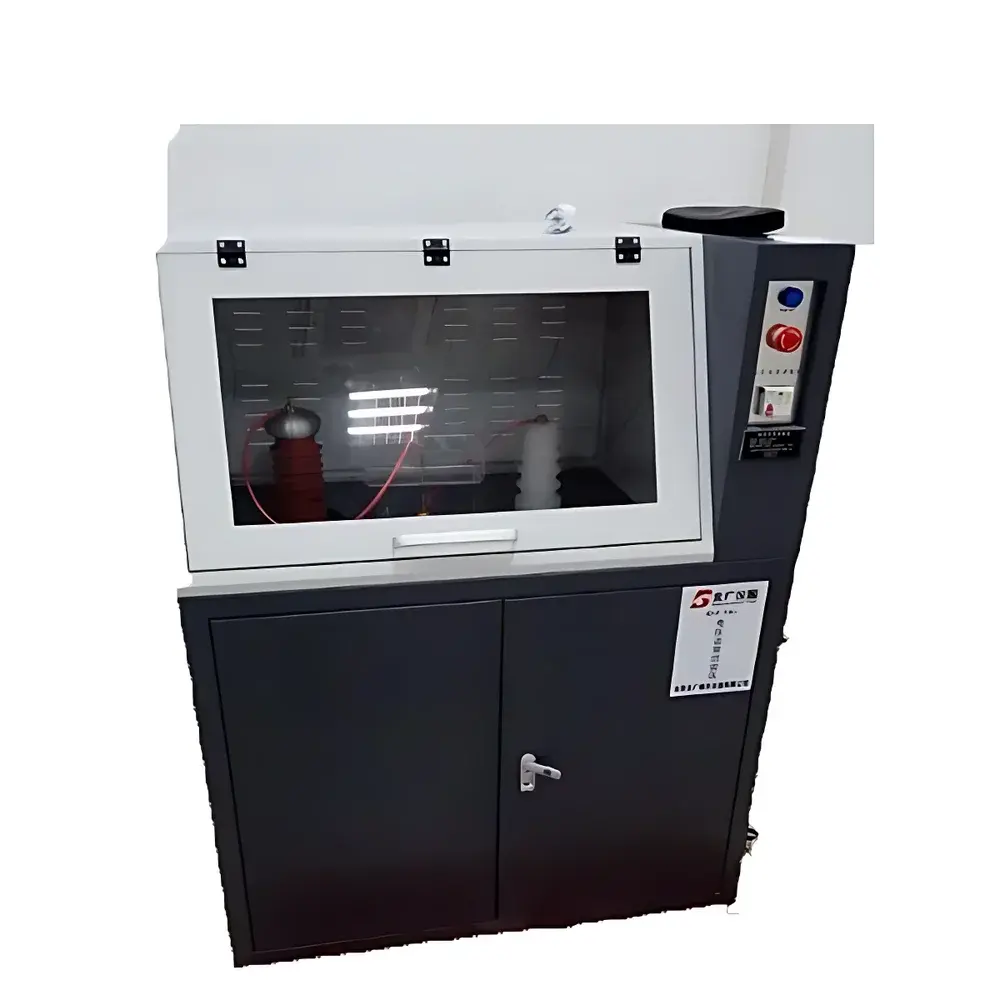
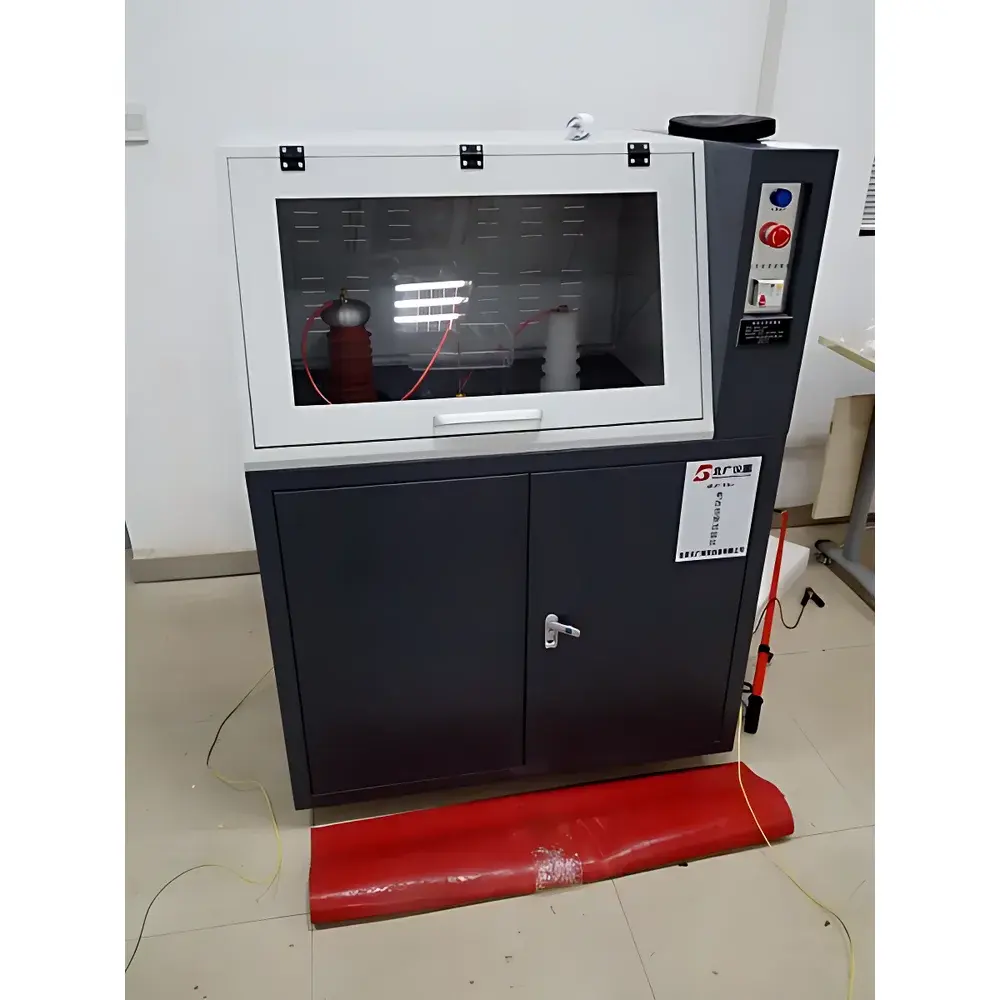
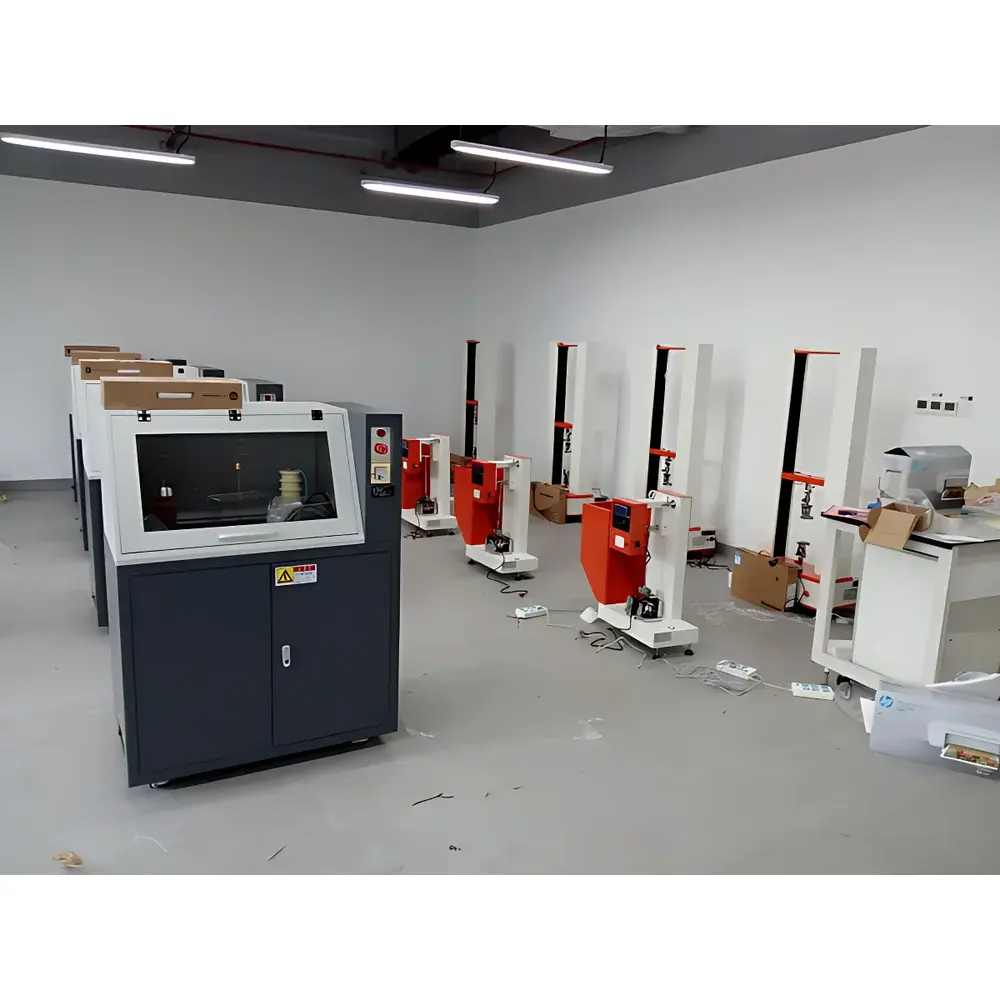
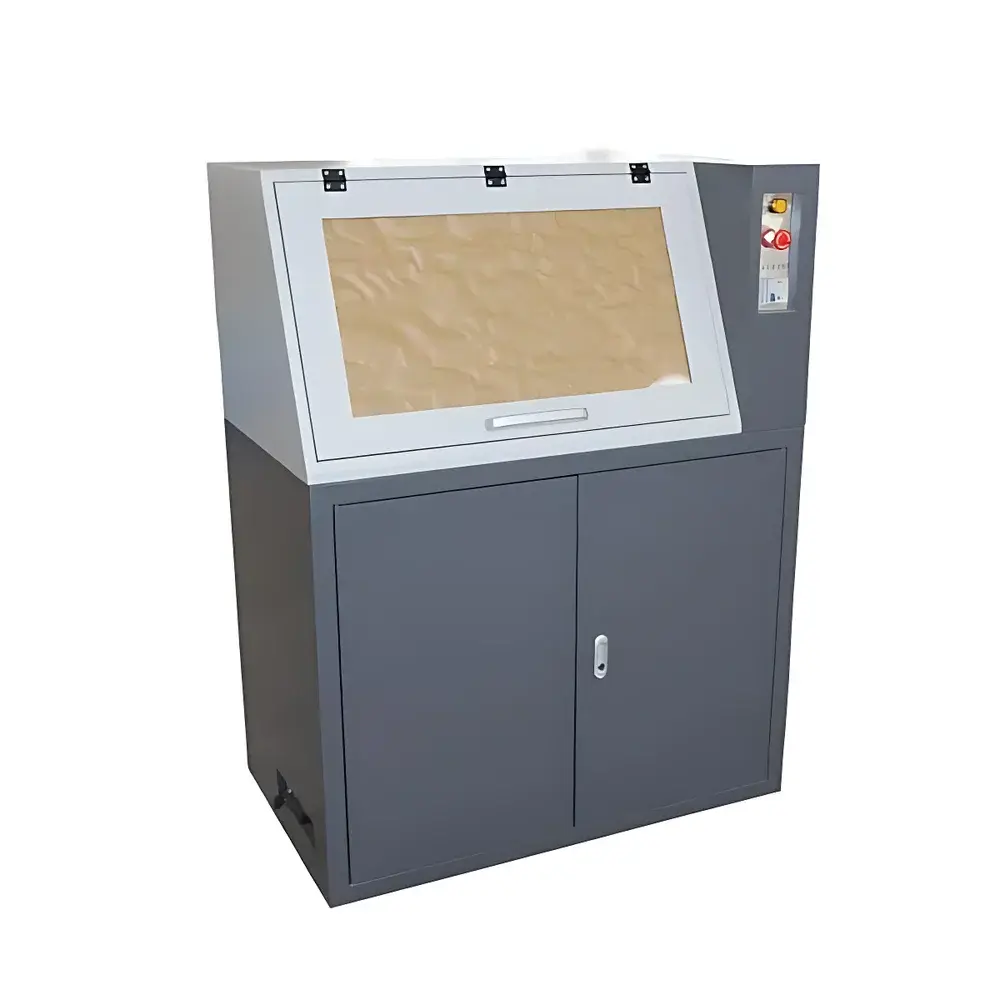
Beiguang Jingyi BDJC-Series Voltage Breakdown Tester for Dielectric Strength Testing
| Brand | Beiguang Jingyi / All Precision Instrument |
|---|---|
| Origin | Beijing, China |
| Manufacturer Type | Direct Manufacturer |
| Country of Origin | China |
| Model | BDJC-Series |
| Price | USD 4,500 (approx.) |
| Maximum Output Voltage | 50 kV AC/DC |
| Input Voltage | AC 220 V ±10%, 50 Hz ±1% |
| Output Power | 2 kVA |
| Voltage Measurement Range | 0–50 kV AC/DC |
| Measurement Accuracy | ≤±2% |
| Ramp Rate | 1–5 kV/s (adjustable) |
| Hold Time | 0–6 h |
| Leakage Current Setting Range | 1–30 mA |
| Dimensions (L×W×H) | 800 × 800 × 1450 mm |
| Weight | 100 kg |
| Operating Temperature | 15–30 °C |
| Relative Humidity | 0–85% RH |
| Grounding Requirement | Dedicated earth electrode ≥1.5 m depth |
Overview
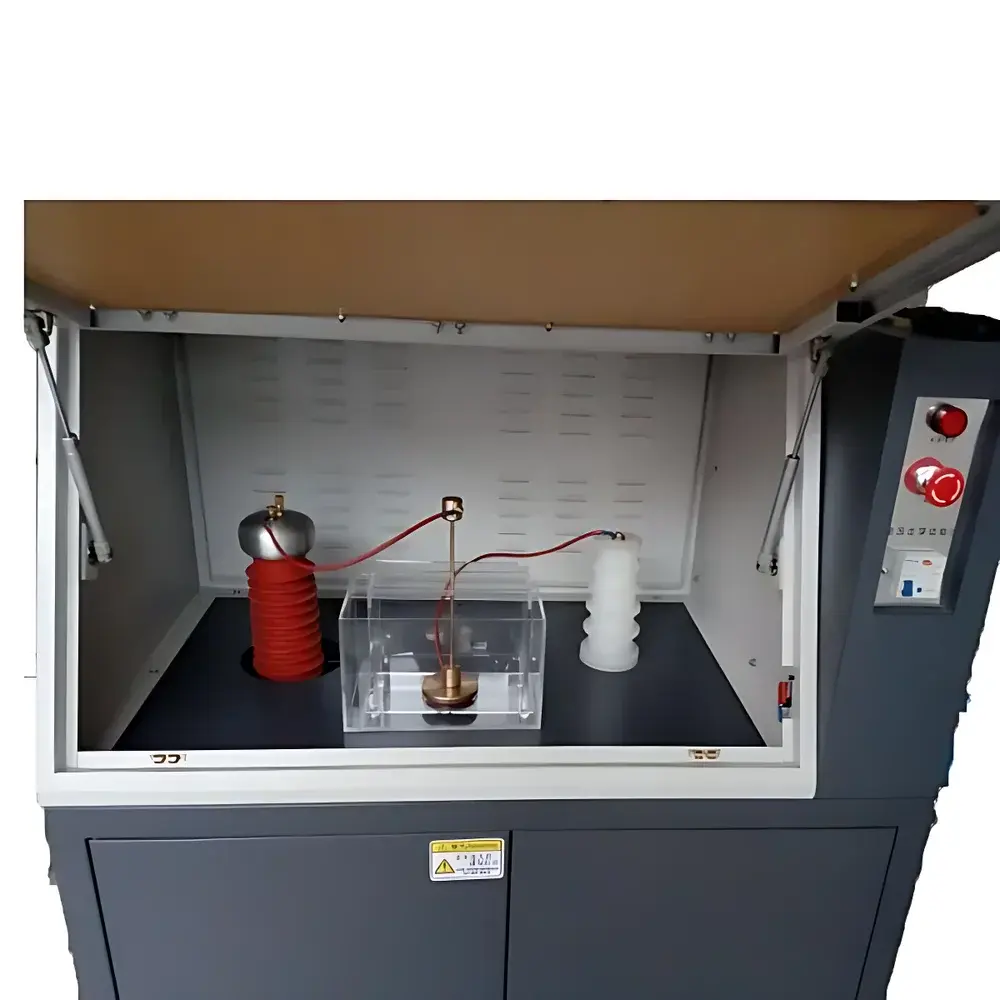
The Beiguang Jingyi BDJC-Series Voltage Breakdown Tester is a precision-engineered high-voltage testing system designed for quantitative evaluation of dielectric strength and voltage endurance in solid insulating materials under standardized AC or DC stress conditions. Based on the fundamental principle of electrical breakdown—where a rapid, irreversible conduction path forms across an insulator when the applied electric field exceeds its intrinsic dielectric limit—the instrument delivers controlled, traceable, and repeatable voltage ramping to determine either the short-term breakdown voltage (kV) or the time-dependent withstand voltage (kV @ t seconds/hours). Compliant with core international test methodologies—including ASTM D149 (Standard Test Method for Dielectric Breakdown Voltage of Solid Electrical Insulating Materials at Commercial Power Frequencies), IEC 60243-1, and GB/T 1408.1—this tester supports both continuous uniform ramp and stepwise voltage application modes. Its architecture integrates a high-stability oil-immersed high-voltage transformer, optically isolated data acquisition, microprocessor-based closed-loop control, and real-time arc detection logic to ensure measurement integrity in demanding laboratory or QC environments.
Key Features
- True dual-mode operation: configurable AC (48–62 Hz) or DC (pulsating, silicon-stack rectified) output up to 50 kV, with front-panel mode selection and software-synchronized measurement calibration.
- Optically isolated A/D conversion system ensures immunity from electromagnetic interference during high-voltage transients, critical for accurate leakage current capture (1–30 mA range, user-definable threshold).
- Programmable ramp rate (1–5 kV/s) with sub-second response time; automatic voltage collapse (<100 ms) upon breakdown detection to minimize thermal damage and preserve sample integrity.
- Integrated safety subsystems: overcurrent cutoff (<0.1 s), automatic post-test discharge circuitry, grounding verification interlock, and physical HV shielding compliant with IEC 61010-1 CAT III requirements.
- Modular electrode configuration: standard 25 mm and 75 mm diameter brass electrodes (ASTM D149-compliant geometry); optional custom electrode sets available for specialized geometries or liquid immersion cells.
- Self-contained oil bath chamber (PMMA construction) with temperature-stable transformer oil handling for liquid-medium testing per IEC 60156 guidelines.
Sample Compatibility & Compliance
The BDJC-Series accommodates a broad spectrum of solid dielectrics—including polymer films (e.g., PET, PI), molded thermosets (epoxy, phenolic), elastomers (silicone rubber, EPDM), ceramics, glass, paper-based laminates, varnish-coated wires, and fiber-reinforced composites. Testing may be performed in ambient air (with optional silicone anti-flashover collars) or immersion media (transformer oil for ≤90 °C; high-temperature cylinder oil for 90–300 °C applications). All procedures adhere strictly to preconditioning requirements specified in ASTM D618 and IEC 60216: samples are conditioned at 23 ±2 °C / 50 ±5 % RH for ≥24 h prior to testing unless otherwise defined by material-specific standards. The system meets GLP documentation requirements for audit-ready test records, including timestamped raw voltage/current traces, operator ID logging, and electronic signature support per FDA 21 CFR Part 11 when configured with validated software modules.
Software & Data Management
The proprietary Windows-based control software provides full I/O integration via RS-232/USB interface. It enables real-time plotting of voltage vs. time and leakage current vs. time curves using color-coded overlays for comparative analysis across multiple specimens. Each test session automatically archives raw binary data (.bin), processed CSV exports, and printable PDF reports with embedded metadata (test date, operator, environmental conditions, electrode type, ramp profile). Advanced features include manual validity flagging per test run, parameter revision history with version timestamps, Excel/Word export compatibility, and customizable report templates aligned with ISO/IEC 17025 accreditation needs. Audit trail functionality logs all user actions—including parameter changes, test aborts, and data deletions—with immutable timestamps. Software validation documentation (IQ/OQ protocols) and calibration certificates traceable to NIM (National Institute of Metrology, China) are supplied with each unit.
Applications
This instrument serves critical quality assurance and R&D functions across multiple regulated sectors: incoming raw material screening for cable jacketing compounds (UL 1581, ICEA T-28-520); qualification of encapsulation resins in power electronics modules; lifetime modeling of insulation systems in EV traction inverters; development of high-k dielectrics for flexible printed circuits; and compliance verification for aerospace-grade polyimide films (MIL-STD-202G Method 302). In academic research, it supports fundamental studies on treeing initiation thresholds, space charge accumulation dynamics, and humidity-accelerated degradation kinetics. Its modular design permits adaptation to non-standard configurations—such as multi-electrode arrays for partial discharge inception mapping or elevated-temperature chambers for thermal aging correlation studies—under engineering consultation.
FAQ
What standards does this tester comply with?
It conforms to ASTM D149, IEC 60243-1, GB/T 1408.1, and supports test execution per UL 746, IEC 60674-2, and MIL-STD-202G when operated within specified environmental and procedural constraints.
Can the system perform both AC and DC breakdown tests without hardware modification?
Yes—DC output is enabled by manually removing a shorting rod inside the HV transformer tower; AC mode reverts upon reinsertion. Software must be set to the corresponding voltage type to ensure correct scaling and alarm logic.
Is remote operation or network integration supported?
The base configuration uses local PC control via serial/USB. Optional Ethernet-enabled controllers and OPC UA server modules are available for integration into factory MES or LIMS platforms.
How is calibration maintained over time?
Annual recalibration is recommended using NIST-traceable HV dividers and reference meters. The system includes built-in self-diagnostic routines for sensor linearity verification and ground resistance monitoring.
What safety certifications apply to the mechanical enclosure?
The chassis meets IP2X finger-protection rating per IEC 60529 and incorporates dual redundant emergency stop circuits, interlocked access doors, and HV status LED indicators per IEC 61010-1 Clause 6.5.
Related Products



