
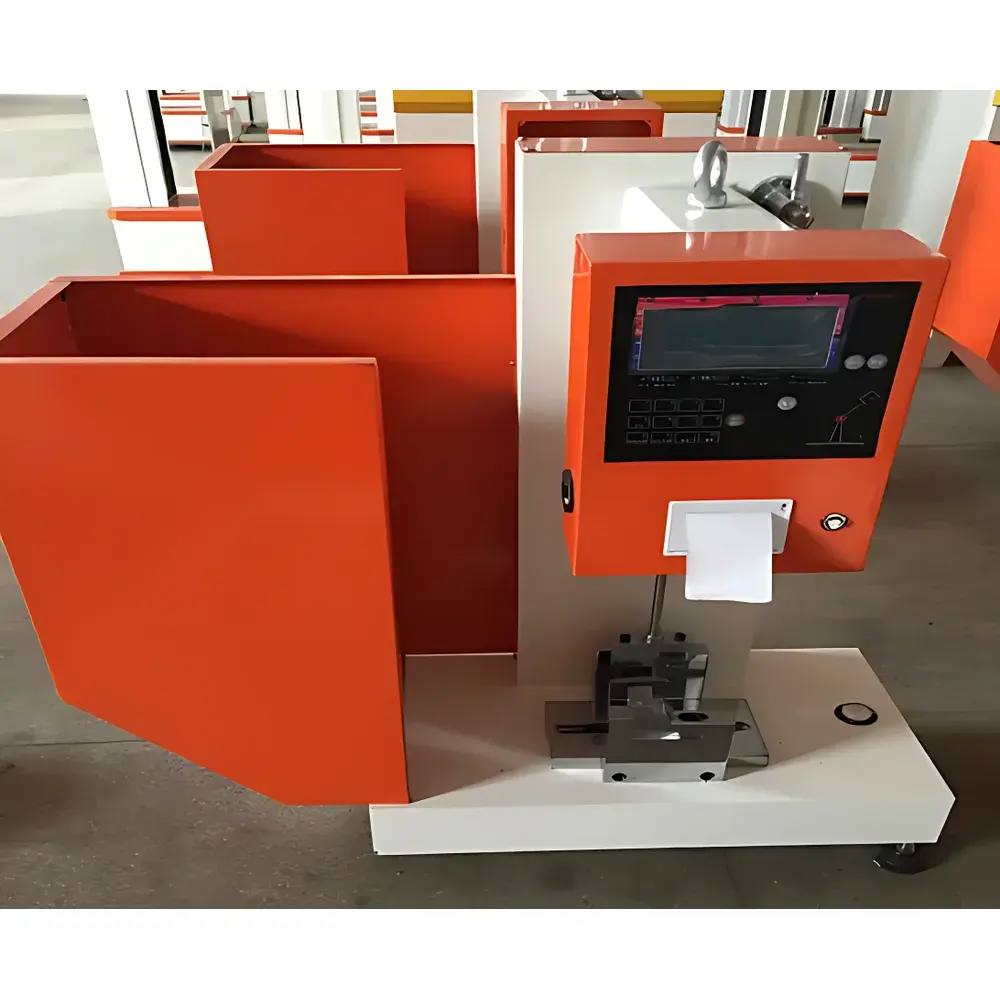
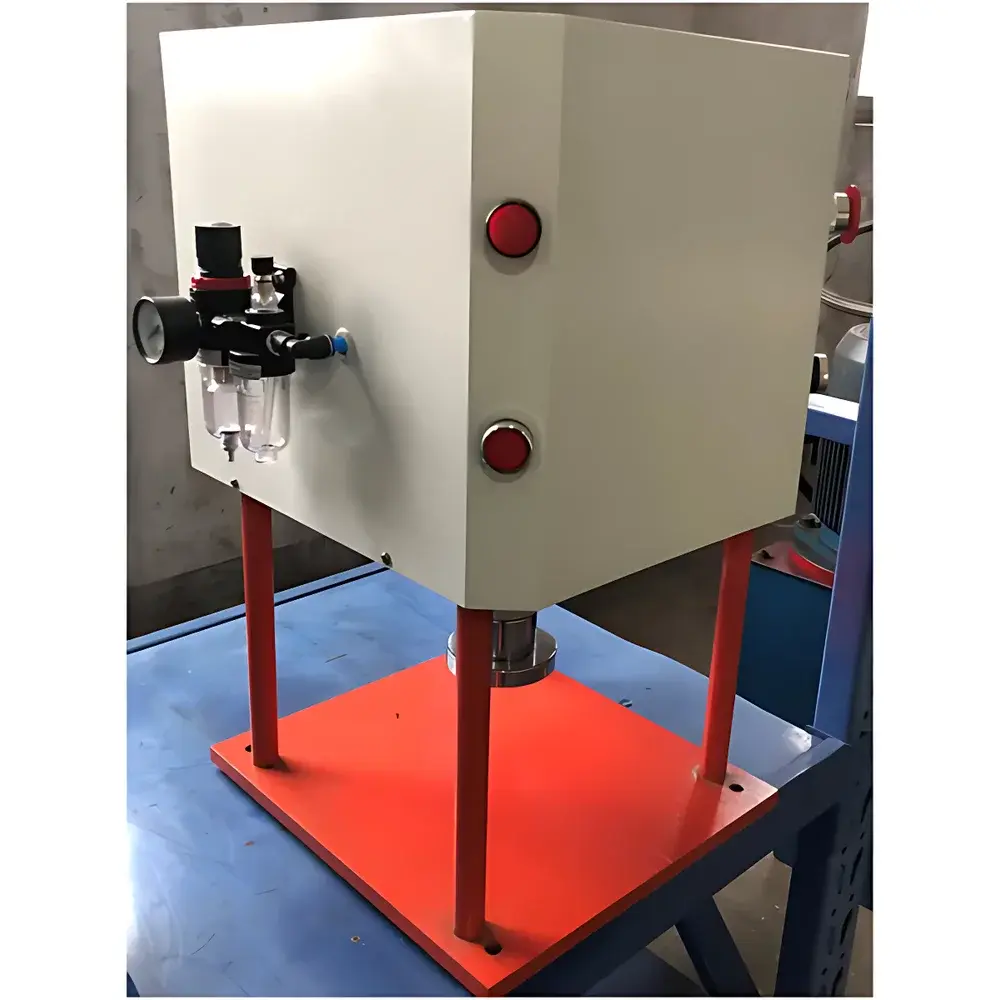
Beiguang Jingyi CBX-B Charpy/IZOD Impact Testing Machine for Thin Films and Rigid Plastics
| Brand | Beiguang Jingyi / All Precision Instrument |
|---|---|
| Origin | Beijing, China |
| Manufacturer Type | Direct Manufacturer |
| Instrument Type | Pendulum Impact Tester |
| Impact Energy Options | 7.5 J, 15 J, 25 J, 50 J (custom higher energy available) |
| Impact Velocity | 3.8 m/s |
| Pendulum Center Distance (Support Span) | 395 mm |
| Pendulum Pre-lift Angle | 150° |
| Blade Radius | 0.8 ± 0.2 mm |
| Blade Angle | 75° |
| Blade Front Angle | 5° |
| Blade Back Angle | 10° |
| Test Specimen Support Span Options | 60 mm, 70 mm, 62 mm, 95 mm (configurable per standard) |
| Display | LCD Digital Readout with Photoelectric Encoder (2500-line resolution, ±0.018° angular accuracy) |
| Energy Calculation Method | Potential Energy Loss (E = Pd·(cosβ − cosα)) with Air Friction & Bearing Loss Correction |
| Power Supply | 220 V AC ±10%, 50 Hz, 0.2 A |
| Operating Temperature | 15–35 °C |
| Dimensions (W×D×H) | 930 × 520 × 950 mm |
| Net Weight | 80 kg |
| Compliance | GB/T 1043-1993, ISO 179-1:2010, GB/T 2611-2007, JB/T 8762-1998 |
Overview
The Beiguang Jingyi CBX-B Charpy/IZOD Impact Testing Machine is a precision-engineered pendulum impact tester designed specifically for quantitative evaluation of impact resistance in thin-film specimens and rigid non-metallic materials—including thermoplastics, engineering polymers (e.g., nylon, polycarbonate), fiber-reinforced composites, electrical insulating materials, and elastomeric sheets. It operates on the classical principle of gravitational potential energy conversion: a calibrated pendulum is raised to a fixed pre-lift angle (150°), released, and strikes a notched or unnotched specimen supported in a simply supported beam (three-point bending) configuration. The residual swing angle is measured via a high-resolution 2500-line optical encoder (±0.018° angular accuracy), enabling precise calculation of absorbed energy using the standardized formula E = Pd·(cosβ − cosα), where Pd is the pendulum constant (3.95 N·m at 395 mm center distance), α is the initial release angle, and β is the post-impact rebound angle. For low-energy tests (<5 J), automatic correction for bearing friction and air resistance—based on empty-swing calibration (α′)—is applied per ISO 179-1 Annex B, ensuring traceable, reproducible results compliant with GLP documentation requirements.
Key Features
- Semi-automatic operation with mechanical pendulum locking, one-touch release, and integrated LCD display for real-time angular position, energy absorption, and test counter.
- Modular pendulum system supporting four standard impact energy levels (7.5 J, 15 J, 25 J, 50 J); custom configurations up to 100 J available upon request with recalibrated Pd and reinforced frame.
- Interchangeable anvil sets with standardized support spans (60 mm, 62 mm, 70 mm, 95 mm) and precision-ground 75° impact blades (R = 0.8 ± 0.2 mm) conforming to ISO 179 and GB/T 1043 dimensional tolerances.
- Digital measurement architecture featuring a 2500-pulse-per-revolution optical encoder, delivering angular resolution of 0.036° and certified energy accuracy of ±0.05% full scale across all ranges.
- Onboard data logging with optional thermal printer interface (57 mm thermal paper); supports direct output of test ID, specimen dimensions (L × W × D), energy value (J), and pass/fail status per user-defined thresholds.
- Robust cast-iron base with adjustable leveling feet and built-in spirit level ensures long-term alignment stability and minimizes vibration-induced measurement drift.
Sample Compatibility & Compliance
The CBX-B accommodates standardized rectangular specimens per ISO 179-1 and GB/T 1043, including Type 1 (80 × 10 × 4 mm), Type 2 (50 × 6 × 4 mm), Type 3 (120 × 15 × 10 mm), and Type 4 (125 × 13 × 13 mm). It is validated for use with ASTM D6110 (Charpy), ISO 180 (Izod), and GB/T 1843 (notched Izod) geometries when equipped with appropriate anvils and blade assemblies. All mechanical dimensions—including blade radius, support span tolerance (±0.2 mm), and anvil parallelism—meet the metrological requirements of ISO/IEC 17025-accredited laboratories. The instrument satisfies mandatory clauses of GB/T 2611-2007 (General Requirements for Testing Machines) and JB/T 8762-1998 (Technical Specifications for Plastic Impact Testers), and its energy calibration protocol aligns with ISO 13802:2015 (Verification of Pendulum Impact Machines).
Software & Data Management
While the CBX-B operates as a standalone benchtop instrument with embedded firmware, its digital encoder output (RS-232 or TTL-level quadrature signals) is compatible with third-party LIMS or laboratory data acquisition systems. Internal memory stores up to 999 test records with timestamp, specimen ID, energy value, and operator code. Calibration parameters—including pendulum constant Pd, pre-lift angle α, and empty-swing correction coefficient α′—are stored in non-volatile EEPROM with write-protection. Audit trails for calibration events and parameter changes are retained per FDA 21 CFR Part 11 principles when connected to compliant host software. Optional PC-based analysis modules provide statistical reporting (mean, SD, CV%), Weibull distribution fitting for brittle fracture analysis, and export to CSV/PDF formats.
Applications
This instrument serves critical quality control and R&D functions across polymer manufacturing, automotive component validation, electrical insulation certification, and academic materials science. Typical use cases include: evaluating notch sensitivity of polypropylene films for packaging integrity; quantifying embrittlement onset in PVC cables after UV/thermal aging; benchmarking impact performance of bio-based PLA composites versus petroleum-derived alternatives; verifying batch-to-batch consistency of glass-fiber-reinforced nylon used in structural housings; and supporting regulatory submissions requiring ISO 179-compliant toughness data for medical device polymer components. Its robust design and metrological traceability make it suitable for ISO 9001-certified production labs and CNAS-accredited testing facilities.
FAQ
What standards does the CBX-B comply with?
It meets GB/T 1043-1993, ISO 179-1:2010, GB/T 2611-2007, JB/T 8762-1998, and supports test execution per ASTM D6110 and ISO 180 with appropriate fixtures.
Can the machine test specimens thinner than 4 mm?
Yes—Type 5 specimens (80 × 10 × 2.5 mm) are supported using the 62 mm span anvil set; minimum thickness is governed by ISO 179-1’s requirement that d ≥ b/4 to avoid shear-dominated failure modes.
Is energy correction for friction losses automated?
Yes—the system performs automatic empty-swing calibration during startup or manual initiation, storing α′ and applying correction per ISO 179-1 Annex B for all subsequent tests below 5 J.
What maintenance is required to maintain calibration?
Annual verification of pendulum geometry (blade radius, support span), encoder linearity, and energy loss profile against NIST-traceable reference specimens is recommended; Beiguang Jingyi provides certified calibration kits and service documentation.
Does the instrument support GLP-compliant audit trails?
When interfaced with validated external software, full electronic records—including operator ID, calibration history, raw encoder data, and result calculations—are generated in accordance with ALCOA+ principles and 21 CFR Part 11 requirements.



