
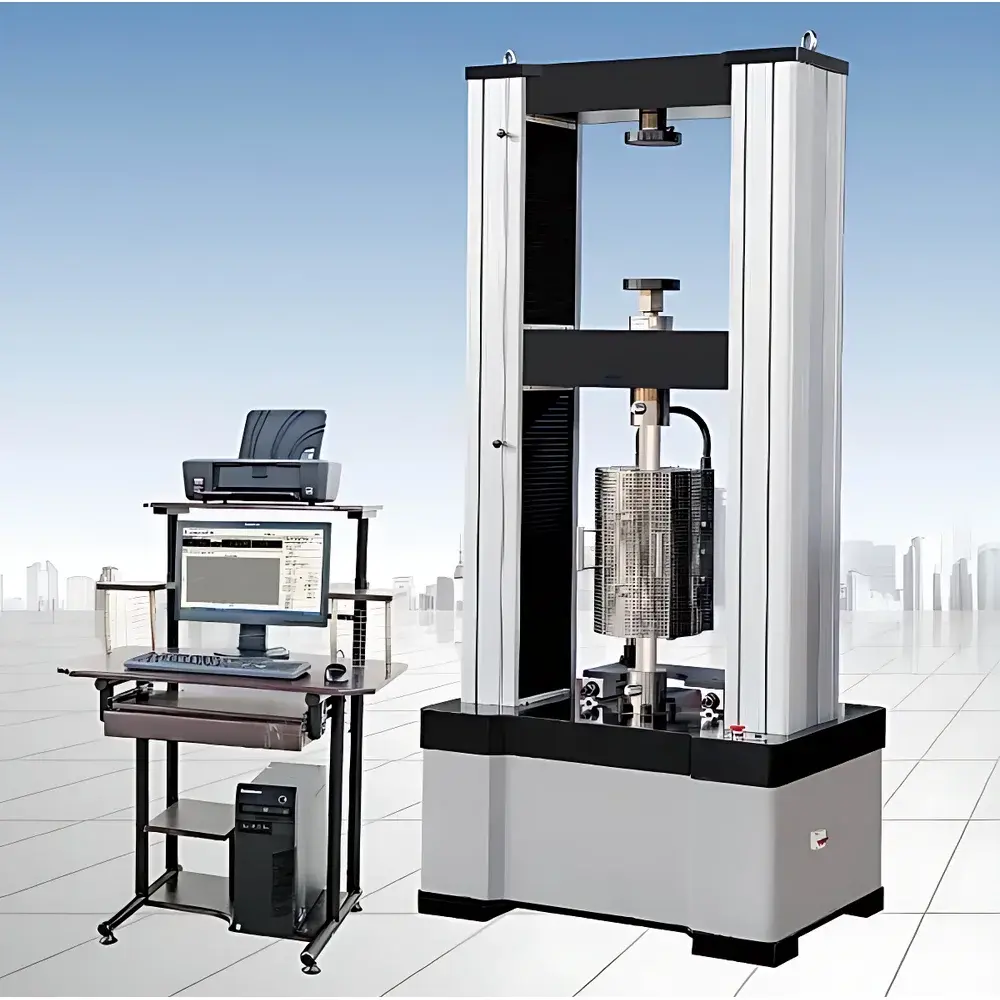
Beijing North Guang Precision Instruments BG-5KN Electronic Universal Testing Machine for Geotextile Tensile Testing
| Brand | Beijing North Guang Precision Instruments |
|---|---|
| Origin | Jiangsu, China |
| Manufacturer Type | OEM Manufacturer |
| Instrument Type | Electronic Universal Testing Machine |
| Model | BG-5KN |
| Max Load Capacity | 5 kN |
| Compliance | GB, ASTM, ISO, DIN, JIS, BS |
| Control System | Full-digital servo motor + precision ball screw drive |
| Speed Range | 0.01–500 mm/min |
| Force Accuracy | ±0.5% FS |
| Displacement Resolution | 0.001 mm |
| Test Width | 350 mm |
| Crosshead Travel | 950 mm (excluding fixtures) |
| Power Supply | 220 V, 50/60 Hz |
| Dimensions (L×W×H) | 665 × 455 × 1700 mm |
| Weight | Approx. 180 kg |
Overview
The Beijing North Guang Precision Instruments BG-5KN Electronic Universal Testing Machine is a high-precision, microprocessor-controlled mechanical testing system engineered for standardized tensile, compression, bending, peel, shear, and tear evaluation of geotextiles and other civil engineering materials. Designed in accordance with the fundamental principles of uniaxial quasi-static mechanical testing—governed by Hooke’s law, stress–strain continuum mechanics, and ISO 13934-1 (tensile properties of textiles), ASTM D4595 (geotextile tensile testing), and GB/T 14800 (geosynthetic tensile strength)—this machine delivers traceable, repeatable, and audit-ready results across laboratory and quality control environments. Its rigid dual-column frame, coupled with a high-resolution load cell (0–1 ton full-scale, ±0.5% accuracy) and optical encoder-based displacement feedback (0.001 mm resolution), ensures structural integrity under dynamic loading and long-term calibration stability. The system operates within ambient conditions of 10–35°C and 20–80% RH, meeting baseline requirements for GLP-compliant material certification workflows.
Key Features
- Full-digital closed-loop servo control architecture with pulse command positioning for precise velocity regulation (0.01–500 mm/min) and automatic return-to-origin functionality.
- Seven-range auto-switching force measurement system (×1 to ×100) with 24-bit A/D conversion and 200 Hz sampling rate—achieving effective resolution of 1 part in 100,000 full scale.
- Precision ground ball screw actuation driven by arc-synchronous reduction gearbox—minimizing backlash and ensuring smooth crosshead motion during high-cycle fatigue-relevant protocols.
- Dual-mode control interface: programmable test modes include constant-rate-of-traverse (CRT), constant-rate-of-load (CRL), constant-strain-rate, constant-stress-rate, and multi-step ramp-hold sequences per ASTM E8/E8M and ISO 6892-1.
- Integrated safety subsystems: overload emergency stop, upper/lower travel limit switches, leakage current protection, automatic breakpoint halt, and optional wireless remote control or manual pendant box.
- Modular fixture compatibility—standard wedge-action tensile grips included; custom fixtures available for geogrids, geomembranes, needle-punched nonwovens, woven/filament geotextiles, and coated composites.
Sample Compatibility & Compliance
The BG-5KN accommodates a broad spectrum of geotechnical and civil construction materials—including needle-punched polyester/nonwoven geotextiles, polypropylene woven fabrics, HDPE geomembranes, geogrids (uniaxial/biaxial), geocells, and composite drainage cores—as well as general-purpose specimens such as plastics, rubber, metals, composites, paper, packaging films, and biomedical polymers. It supports over 400 preconfigured test standards, including but not limited to: ASTM D4595 (wide-width tensile), ASTM D6637 (grab tensile), ISO 10319 (wide-width tensile), ISO 9863-1 (puncture resistance), GB/T 15788 (geotextile tensile), and EN ISO 13432 (tear propagation). All test routines comply with data integrity requirements under FDA 21 CFR Part 11 when operated with audit-trail-enabled software configuration and user access controls.
Software & Data Management
The UTM107 WinXP-based testing software provides modular, standards-driven operation with real-time graphical visualization (load–displacement, stress–strain, load–time, displacement–time, and multi-curve overlay). Key capabilities include: configurable test templates aligned to GB, ASTM, ISO, DIN, JIS, and BS specifications; user-defined specimen databases with formula editing for custom modulus or elongation calculations; dual-report generation (PDF + native Excel export); dynamic unit switching (N/kN/kgf/lbf for force; mm/cm/inch for displacement); auto-scaling graphs with live interpolation; and comprehensive post-test analytics—yield strength (upper/lower), tensile strength, elongation at break, Young’s modulus, secant modulus, tear energy, peel adhesion peak/average, and hysteresis loss quantification. Data archival supports timestamped storage on any local or network drive, with version-controlled backups and historical test replay functionality. Language support includes Simplified Chinese, Traditional Chinese, and English.
Applications
This instrument serves critical roles in geosynthetic quality assurance, highway and railway subgrade verification, landfill liner qualification, erosion control validation, and hydraulic structure reinforcement testing. Typical use cases include: wide-width tensile strength verification per ASTM D4595 for roadbed stabilization fabrics; grab tensile assessment of filtration geotextiles used in drainage layers; puncture resistance screening of geomembrane–geotextile composites; creep compliance evaluation under sustained loading; and seam strength testing of heat-welded or sewn geosynthetic joints. Beyond civil infrastructure, it fulfills routine mechanical characterization needs in polymer R&D labs, medical device component validation (e.g., suture anchors, mesh implants), automotive NVH material screening, and aerospace composite laminate qualification—where traceable, repeatable mechanical property data is mandated by ISO/IEC 17025-accredited laboratories.
FAQ
What geotextile-specific test standards does this machine support?
It natively implements ASTM D4595, ASTM D6637, ISO 10319, ISO 9863-1, GB/T 15788, and EN ISO 13432—with additional standards deployable via software module configuration.
Can the system perform creep or stress-relaxation tests?
Yes—through programmable multi-step hold routines and time-dependent data logging at user-defined intervals (minimum 100 ms sampling), enabling ISO 899-1 creep and ISO 3387 stress-relaxation protocols.
Is the force sensor calibrated to national metrological standards?
All load cells are factory-calibrated against NIM (National Institute of Metrology, China)-traceable reference standards, with optional third-party calibration certificate (CNAS-accredited) available upon request.
Does the software meet regulatory requirements for electronic records?
When configured with password-protected user roles, audit trail logging, and digital signature enforcement, the system satisfies FDA 21 CFR Part 11 and EU Annex 11 expectations for electronic data integrity.
What maintenance is required to ensure long-term accuracy?
Annual verification of force and displacement calibration is recommended; periodic inspection of grip serrations, ball screw lubrication, and encoder coupling alignment ensures sustained repeatability per ISO 7500-1 Class 1 performance criteria.



