
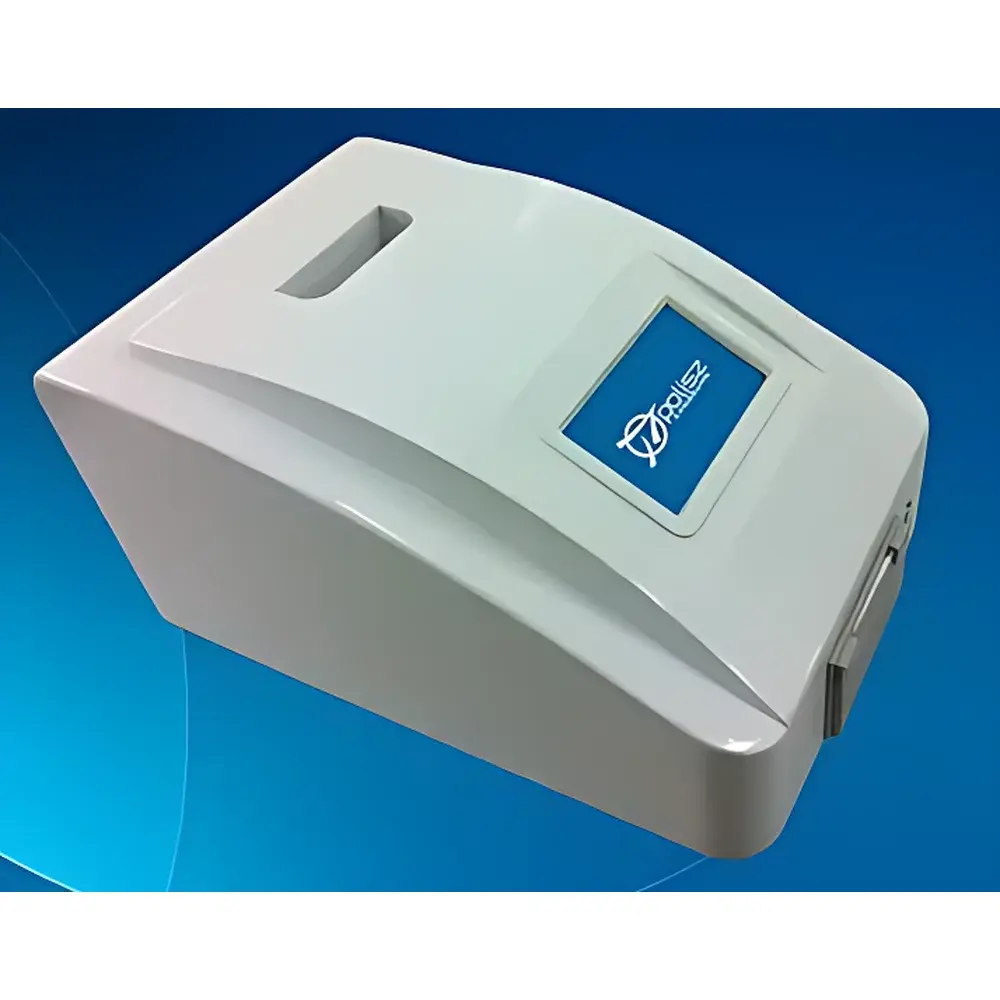
All Precision Instrument BQS-19 Portable Automated Filter Integrity Tester for Pall-Style Membranes
| Brand | All Precision Instrument |
|---|---|
| Origin | Beijing, China |
| Manufacturer Type | OEM Manufacturer |
| Country of Origin | China |
| Model | BQS-19 |
| Power Supply | 170–240 V AC, 50/60 Hz, 100 W |
| Max Test Pressure | 6900 mbar (sensor customizable) |
| Pressure Sensitivity | ±1.0 mbar |
| Bubble Point Accuracy | ±60 mbar |
| Operating Temperature | 0–50 °C |
| Relative Humidity | 10–80% RH |
| Dimensions (W×D×H) | 240 × 320 × 260 mm |
| Display | 5.7–7-inch color touchscreen, 256-color, GUI in English/Chinese |
| Data Storage | 32 GB internal, ≥1 million test records |
| Print Output | Thermal printer, bilingual (English/Chinese), includes test parameters, results, and pressure decay curves |
| Test Duration | Bubble Point: 2 ± 2 min |
| Diffusion Flow | 7 ± 2 min |
| Water Intrusion | 7 ± 2 min |
| System Leak Check | 3 ± 1 min |
Overview
The All Precision Instrument BQS-19 Portable Automated Filter Integrity Tester is an engineered solution for non-destructive, quantitative assessment of membrane filter integrity in pharmaceutical, biotechnology, and sterile manufacturing environments. It operates on established physical principles—primarily the pressure decay (diffusion flow), bubble point, and water intrusion methods—as defined in ASTM F838-22, ISO 13408-2, and USP . Designed specifically for compatibility with Pall-style disc membranes, cartridge filters, capsule filters, and vent filters, the BQS-19 delivers traceable, auditable, and GMP-compliant test outcomes. Its compact, battery-ready chassis enables deployment at point-of-use—within cleanrooms, isolators, or mobile QC labs—without compromising measurement fidelity or regulatory alignment.
Key Features
- Fully automated test sequencing with zero manual intervention: pre-test leak verification, pressure ramping, stabilization, data acquisition, and pass/fail evaluation are executed under embedded logic control.
- ARM9-based real-time controller running Windows CE 6.0 OS ensures deterministic timing, low-latency sensor response, and stable firmware execution across thermal and electromagnetic variations typical in production suites.
- Dual-language (English/Chinese) graphical user interface with capacitive touchscreen—optimized for gloved operation and compliant with IEC 62366-1 usability engineering requirements.
- Modular pneumatic architecture supports single-core to 9-core cartridge configurations, disc membranes from Φ25 mm to Φ300 mm, and air-vent filters up to 40 inches in length.
- Integrated thermal printer outputs fully traceable reports—including timestamp, operator ID, test method, pressure curve plot, raw sensor values, and compliance status—formatted per FDA 21 CFR Part 11 Annex 11 expectations for electronic records.
- Onboard 32 GB flash storage maintains full audit trails: each record includes metadata (test ID, filter lot, operator, equipment ID), raw time-series pressure data, and digital signatures for change control.
Sample Compatibility & Compliance
The BQS-19 validates integrity across three primary filter formats: (1) flat-sheet disc membranes used in laboratory-scale sterilization and clarification; (2) standard cylindrical cartridges employed in bulk fluid processing; and (3) compact capsule filters deployed in final-fill or buffer preparation lines. It meets functional equivalency requirements for testing hydrophilic (e.g., PVDF, PES) and hydrophobic (e.g., PTFE, PP) membranes. Regulatory alignment includes support for GMP documentation workflows, GLP audit readiness, and integration into quality management systems (QMS) via CSV-compatible export protocols. The instrument’s pressure transducer calibration traceability conforms to ISO/IEC 17025-accredited reference standards, and its software architecture incorporates electronic signature enforcement, role-based access control, and immutable audit logs—key prerequisites for FDA, EMA, and PMDA inspections.
Software & Data Management
The embedded CE 6.0 platform hosts a deterministic test engine with configurable pass/fail thresholds, customizable reporting templates, and built-in system diagnostics. All test data are stored in encrypted binary format with SHA-256 hashing to prevent tampering. Export options include CSV and PDF—both retaining full metadata and digital signatures. The system supports periodic backup to external USB drives and facilitates remote validation protocol execution via secure serial command interface (RS-232). Audit trail entries log every user action—including parameter edits, report generation, and calibration events—with timestamps accurate to ±100 ms and linked to authenticated operator credentials. No cloud connectivity is enabled by default, preserving data sovereignty in regulated environments.
Applications
This tester is routinely deployed for pre-use post-sterilization (PUPSIT) verification of sterilizing-grade filters in aseptic processing lines; integrity confirmation of vent filters in bioreactor exhaust trains; qualification of filtration steps during viral clearance studies; and routine release testing of final container-closure systems. It supports both aqueous (bubble point/diffusion) and non-aqueous (water intrusion) test modalities, enabling robustness assessment across diverse process fluids—from cell culture harvests to purified monoclonal antibodies. Its portability allows for cross-shift verification without relocating filters, reducing risk of handling damage and environmental contamination.
FAQ
Does the BQS-19 comply with FDA 21 CFR Part 11 requirements for electronic records and signatures?
Yes—the system implements role-based authentication, electronic signatures with biometric or PIN verification, and immutable audit trails meeting Part 11 Subpart B technical controls.
Can test methods be validated per ASTM F838-22 and ISO 13408-2 using this instrument?
Affirmative. The pressure control resolution (±1.0 mbar), temperature-compensated transducers, and programmable ramp profiles satisfy method-specific precision and repeatability criteria.
Is calibration traceable to national metrology institutes?
All pressure sensors ship with NIST-traceable calibration certificates; field recalibration tools and procedures are supplied with documented uncertainty budgets.
What maintenance intervals are recommended for GMP operations?
Annual performance qualification (PQ) is advised; daily system leak checks and quarterly sensor verification are included in the SOP package.
How is data integrity preserved during power interruption?
The device employs non-volatile memory with atomic write operations—no partial record corruption occurs, and interrupted tests resume from last valid checkpoint upon reboot.




