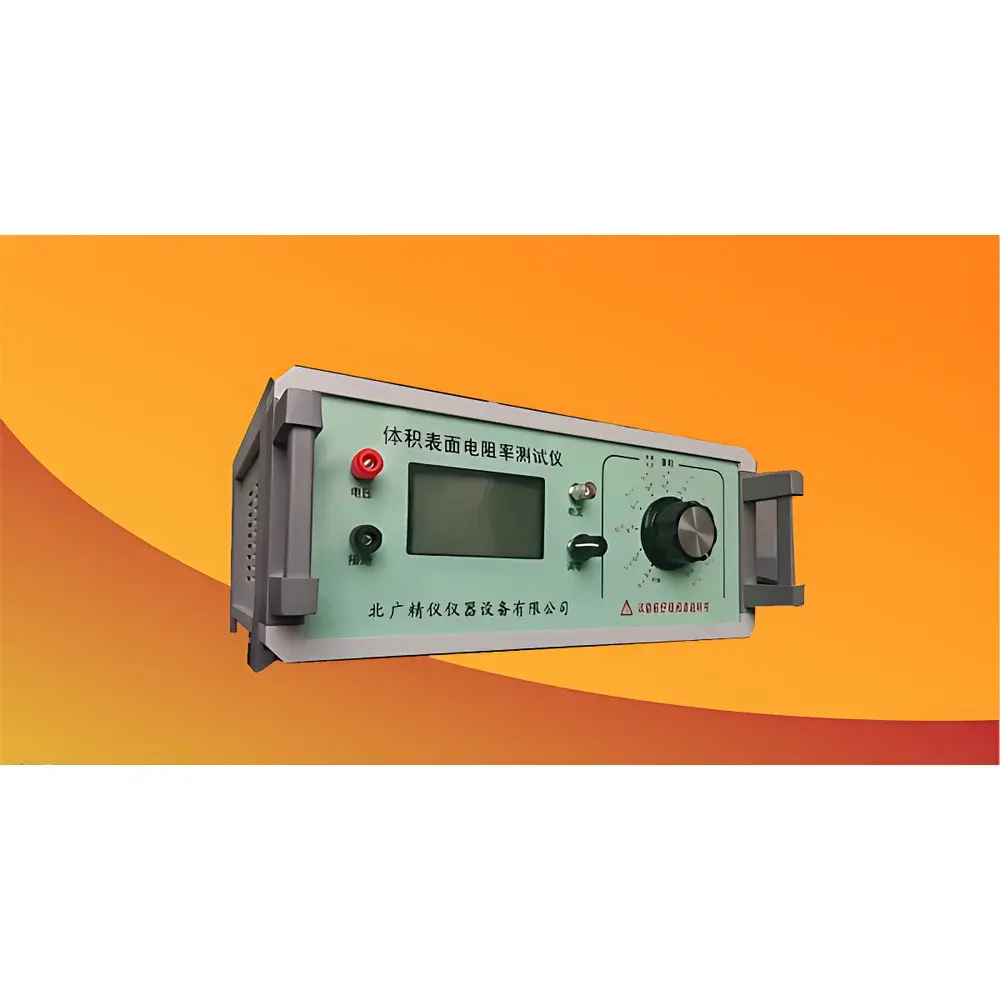
Beijing Guangjing BEST-121 Volume and Surface Resistivity Tester
| Brand | Beijing Guangjing / All Precision Instrument |
|---|---|
| Origin | Beijing, China |
| Manufacturer Type | OEM Manufacturer |
| Country of Origin | China |
| Model | BEST-121 |
| Price | USD 1,700 (FOB) |
| Test Voltage Range | DC 10 V, 50 V, 100 V, 250 V, 500 V, 1000 V |
| Resistance Measurement Range | 1×10⁴ Ω to 1×10¹⁸ Ω |
| Current Measurement Range | 2×10⁻⁴ A to 1×10⁻¹⁶ A |
| Accuracy | ±1% (typical), ±10–20% depending on range and voltage |
| Input Impedance | >10¹⁵ Ω |
| Power Supply | AC 220 V ±10%, 50 Hz |
| Power Consumption | ~5 W |
| Dimensions (L×W×D) | 355 mm × 320 mm × 145 mm |
| Weight | 6 kg (main unit) |
| Compliance | GB/T 1410-2006, ASTM D257, ISO 3915, IEC 62631-3-1 |
Overview
The Beijing Guangjing BEST-121 Volume and Surface Resistivity Tester is a precision digital high-resistance meter engineered for accurate, repeatable measurement of volume resistivity (ρv) and surface resistivity (ρs) in solid insulating materials, electrostatic dissipative (ESD) components, and functional polymers. It operates on the principle of direct current (DC) voltage application combined with simultaneous high-impedance current sensing—enabling true Ohmic calculation (R = V/I) via integrated analog-to-digital conversion and proprietary signal conditioning. Unlike analog megohmmeters relying on nonlinear scale interpretation, the BEST-121 employs dual 3½-digit LED displays to concurrently output resistance (Ω) and leakage current (A), eliminating coefficient-based manual correction and minimizing operator-induced error. Its architecture incorporates an ultra-high-input-impedance (>10¹⁵ Ω) DC amplifier stage and selectable test voltages (10–1000 V DC), making it suitable for compliance testing across low-conductivity dielectrics, antistatic textiles, conductive flooring, and semiconductor packaging substrates.
Key Features
- Simultaneous dual-parameter readout: real-time display of resistance (1×10⁴ Ω to 1×10¹⁸ Ω) and current (2×10⁻⁴ A to 1×10⁻¹⁶ A)
- Six programmable DC test voltages: 10 V, 50 V, 100 V, 250 V, 500 V, and 1000 V — fully switchable without recalibration
- Three-electrode measurement configuration per ASTM D257 and GB/T 1410-2006, supporting both guarded and unguarded electrode setups
- Integrated shielding terminal (“G” terminal) for guarding against surface leakage currents during high-resistivity measurements
- Auto-ranging architecture with eight multiplier scales (×10² to ×10⁹), each calibrated per voltage step with documented uncertainty (±10% to ±20% depending on range)
- Low power consumption (~5 W) and compact benchtop footprint (355 × 320 × 145 mm), optimized for QC labs and R&D environments
- Compliance-ready design: meets requirements for GLP documentation workflows, including stable zero-drift performance over 8-hour continuous operation
Sample Compatibility & Compliance
The BEST-121 is validated for use with rigid and flexible solids—including thermoplastics, elastomers, laminates, ceramics, coated fabrics, and ESD-safe composites—as defined in GB/T 1410-2006, ASTM D257, and IEC 62631-3-1. It supports standard electrode geometries (e.g., circular electrodes per ASTM D257 Annex A1, concentric ring electrodes per GB/T 1410 Clause 6.2) and accommodates specimens up to 100 mm in diameter. When paired with optional temperature-controlled sample holders or immersion fixtures, it enables resistivity profiling under controlled thermal conditions (0–40 °C ambient). The instrument conforms to national and international ESD control standards including GB 12014 (antistatic workwear), GB/T 22042 (garment surface resistivity), GB 50611 (electronic facility grounding), and GJB 3007A-2009 (ESD protected area requirements). Its metrological traceability aligns with JJG 691–2019 (Chinese national verification regulation for high-resistance meters).
Software & Data Management
While the BEST-121 operates as a standalone hardware instrument with no embedded software stack, its analog output signals and digital display interface support integration into automated test systems via optional RS-232 or USB-to-serial adapters (sold separately). Raw resistance and current values can be logged externally using LabVIEW, MATLAB, or custom SCADA platforms. For regulated environments, users may implement 21 CFR Part 11-compliant audit trails by coupling the device with validated third-party data acquisition software that records timestamped operator ID, test voltage selection, electrode configuration, and environmental metadata (temperature/humidity). Calibration certificates include NIST-traceable reference resistor verification at five voltage points (100 V, 250 V, 500 V, 1000 V) and three resistance decades (10⁸ Ω, 10¹² Ω, 10¹⁶ Ω).
Applications
- Quality control of insulating materials: plastics, rubber compounds, epoxy resins, and ceramic substrates per GB/T 1692–2008 and GB/T 12703.4–2010
- ESD product validation: antistatic footwear (GB 4385–1995), conductive floor tiles (GB 26539–2011), cleanroom garments (GB/T 24249–2009), and static-dissipative carpets (GB/T 18044–2008)
- Electrical safety testing of wire & cable insulation (non-shielded types) when used with constant-temperature water baths
- Material development for aerospace composites, battery separators, and printed electronics requiring sub-picoampere current resolution
- Failure analysis of field-deployed components where surface contamination or moisture ingress alters ρs/ρv ratios
FAQ
What is the difference between volume and surface resistivity measurements?
Volume resistivity quantifies bulk material resistance perpendicular to current flow (Ω·m), while surface resistivity measures resistance along a material’s top layer (Ω/square). The BEST-121 performs both using standardized three-electrode configurations specified in GB/T 1410 and ASTM D257.
Can this instrument measure liquids or powders?
No—it is designed exclusively for solid, planar, or sheet-like specimens. Liquid resistivity requires specialized conductivity cells; powder resistivity demands compaction fixtures and pressure-controlled electrodes not supported by this platform.
Is calibration traceable to international standards?
Yes. Factory calibration uses certified reference resistors traceable to CNAS-accredited laboratories (equivalent to ISO/IEC 17025), with full documentation provided per JJG 691–2019.
How does the guard terminal (“G”) improve measurement accuracy?
The guard terminal diverts surface leakage current away from the measurement path, effectively eliminating parasitic conduction paths—critical when measuring materials with hygroscopic surfaces or contaminated interfaces.
Does the instrument meet FDA or EU regulatory requirements for medical device testing?
It complies with general electrical safety testing requirements referenced in IEC 60601-1 Annex DD and supports resistivity verification of ESD-safe enclosures per ISO 13485 quality management systems—but does not perform biocompatibility or sterilization validation.